
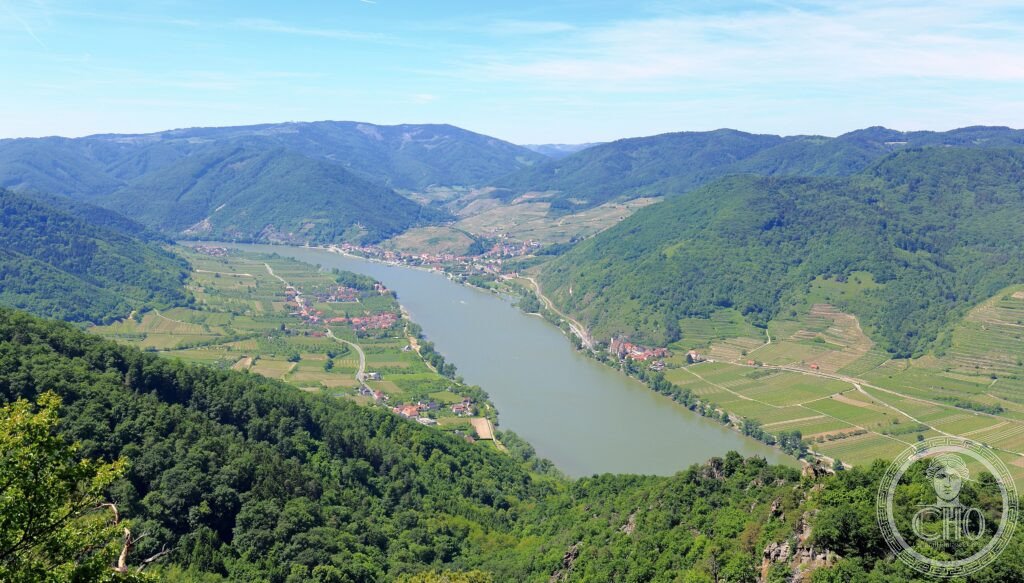
Austria’s most celebrated river valley and one of the great wine landscapes of the world. The Wachau, a 36 km stretch of the Danube between Melk and Krems in Lower Austria, combines the most visually dramatic terraced wine landscape in Austria, the ruined castle where Richard the Lionheart was imprisoned in 1192, and the most spectacular Baroque monastery complex in Austria (Melk Abbey) in a 36 km river valley that has been continuously inhabited and cultivated since the Paleolithic.
At a glance
The Wachau valley (population across 28 municipalities approximately 25,000) runs 36 km along the Danube between the abbey town of Melk (at the western end) and the twin wine towns of Krems and Stein (at the eastern end), approximately 80 km west of Vienna. The valley is flanked by steep schist and gneiss hillsides covered in terraced vineyards (up to 250 metres above the river) that have been cultivated since at least the 11th century. The most picturesque concentration of monuments and scenery is in the middle Wachau, centred on the village of Dürnstein. The essential visit combines Melk Abbey (in the morning), a drive or boat trip through the valley, and the village of Dürnstein (in the afternoon).
Key facts
- Dürnstein Castle (Kuenringerburg, 12th century) and the captivity of Richard the Lionheart (1192–1193): the most significant episode in medieval Austrian history and a defining event in the history of England and the Crusades. Richard I of England (Richard the Lionheart, r. 1189–1199) was captured near Vienna in December 1192 during his return journey from the Third Crusade. He had antagonised Duke Leopold V of Austria at the Crusader siege of Acre (1191) by having the Duke’s banner thrown down from the walls (an insult to Leopold’s dignity). Leopold captured Richard in a village near Vienna and transferred him to Duke Hadmar II of Kuenring, who held him at Dürnstein Castle. Richard was then transferred to the Holy Roman Emperor Henry VI. The ransom negotiated was 150,000 marks of silver (approximately 35 tonnes; twice the annual revenue of England). Every English subject was taxed one-quarter of their annual income to raise the ransom. England was nearly bankrupt. Richard was released in February 1193 after the first instalment of the ransom was paid. The medieval troubadour legend of Blondel de Nesle (who searched for Richard throughout the Holy Roman Empire, singing their shared love song until he heard Richard reply from the tower) has no basis in contemporary historical documents but became one of the most popular romantic stories of the Middle Ages. The castle ruins on the hill above Dürnstein are the most visited site in the Wachau.
- Stift Melk (Melk Abbey, founded 1089; current Baroque building 1702–1736): the most spectacular Baroque monastery in Austria and one of the most important Baroque building complexes in Europe. The Benedictine Abbey of Melk was founded in 1089 by Margrave Leopold II of Austria on a rocky promontory above the Danube at the western end of the Wachau. The present Baroque building was designed and built by Jakob Prandtauer (1660–1726) between 1702 and 1736 for Abbot Berthold Dietmayr. The building is sited on a narrow rocky ridge with vertical drops on three sides. The twin towers of the church (completed 1738, after Prandtauer’s death, by his nephew Josef Munggenast) and the terraced approach from the entrance courtyard give the monastery a theatrical quality that is unmatched among Austrian Baroque buildings. The interior: the church (ceiling frescoes by Johann Michael Rottmayr; side altars; the tomb of St Coloman of Stockerau, patron saint of Austria, which has been in Melk since 1014), the library (94 metres long; ceiling frescoes by Paul Troger, 1732; approximately 100,000 volumes, including manuscripts from the 9th century; open to visitors), and the marble gallery (overlooking the Danube) are among the finest Baroque interiors in Austria. The monastery is still active (approximately 30 Benedictine monks; the abbey runs a secondary school).
- The Wachau wine classification (Vinea Wachau): the most distinctive regional wine classification system in Austria and one of the most rigorous in Europe. The Vinea Wachau Nobilis Districtus is a voluntary association of Wachau wine growers (founded 1983) that created a unique classification of Wachau wines into three categories: Steinfeder (named after the Feathergrass, Stipa pennata, a grass found in the Wachau vineyards; the lightest, most delicate wines; maximum 11.5% alcohol; drunk young). Federspiel (named after the falconers’ lure used when hunting with peregrines, a traditional Wachau practice; medium-bodied wines; 11.5–12.5% alcohol). And Smaragd (named after the Emerald lizard, Lacerta viridis, which sunbathes in the Wachau vineyards; the fullest, most concentrated wines; minimum 12.5% alcohol; the most age-worthy). The grape varieties are primarily Grüner Veltliner and Riesling. The finest Wachau Riesling Smaragd wines from the Terrassen (terraced) sites above Dürnstein and Weissenkirchen are among the longest-lived dry Riesling wines in the world.
- The Venus of Willendorf (25,000 BC): the most famous prehistoric artefact found in Austria and one of the most recognisable figures in world prehistory, found in the Wachau. The Venus of Willendorf (Willendorf Venus; Fachausdruck: Venusfigurine), a 11.1 cm limestone figure of a female, was discovered in 1908 at an archaeological site on the Wachau riverbank near the village of Willendorf. It dates from the Gravettian culture of approximately 25,000 BP (before present). It is one of the earliest and most sophisticated human sculptural objects known and is the most famous Paleolithic artefact in Austria. It is now displayed in the Naturhistorisches Museum Wien (Natural History Museum, Vienna).
- Heritage: UNESCO World Heritage Site, Wachau Cultural Landscape, inscribed 2000.
- GPS: 48.3686° N, 15.4271° E (Dürnstein, centre of the valley).
History
The Wachau has been continuously inhabited since the Paleolithic (evidence of camps at Willendorf from approximately 25,000 BC). Bronze Age and Iron Age settlements are known. Roman road and river traffic passed through the valley. The Babenberg Margraves of Austria controlled the Wachau from the 11th century. Richard I of England was imprisoned at Dürnstein 1192–1193. The Benedictines of Melk managed the valley’s viticulture from the 11th century. The present Baroque Melk Abbey was built 1702–1736. The Vinea Wachau classification was established 1983. UNESCO inscription 2000.
What you see
The most rewarding approach is by boat (DDSG Blue Danube river service from Vienna or from Krems to Melk; approximately 1h from Krems to Dürnstein, 3h from Krems to Melk; the boat passes the vineyards at water level and gives the most intimate sense of the Wachau landscape). By car, drive the B3 road on the north bank from Krems west (Krems → Stein → Weissenkirchen → Spitz → Dürnstein → Melk; the most scenic road). The essential stops: Melk Abbey (the entrance is from the abbey’s reception building in the town of Melk below; the tour leads through the Marble Gallery, the library, and the church; allow 1.5 hours). The village of Dürnstein (the Baroque church tower is the most photographed in Austria; walk to the castle ruins above the village; the walk takes 30 minutes each way and the view from the ruins over the valley is exceptional). Weissenkirchen and Spitz (the most atmospheric wine villages for a Buschenschank lunch or wine tasting).
Practical information
- Admission: Melk Abbey approximately €14 adult (essential; very busy in summer; arrive early). Dürnstein is free to walk around (the church interior is open during the day for a small donation). The castle ruins above Dürnstein are freely accessible via a well-marked footpath. The Wachau museum in Weissenkirchen covers local history and wine heritage. The best wine-tasting experience is at a Buschenschank (open-farm wine tavern; look for a pine branch hung above the door indicating the season is open). The apricot season (mid-July to late August) is the best time for the Wachau Marillenfest (apricot festival; the Marillenknödel — apricot dumplings in beurre noisette — and Marillen jam are the essential food souvenirs).
- Getting there: from Vienna by Railjet train: 1h to Krems (the eastern gateway to the Wachau; a frequent service from Vienna Franz-Josefs-Bahnhof). 1h to Melk (from Vienna Hauptbahnhof; change at St Pölten). By car from Vienna: 80 km to Krems (1h) via A22/B3. By boat: DDSG Blue Danube from Vienna to Krems (approximately 3.5 hours one way by fast boat). The boat tickets are sold at Schwedenplatz in Vienna. A combination train + boat is the classic Wachau excursion (train from Vienna to Krems, boat from Krems to Melk, train from Melk back to Vienna).
- Stift Klosterneuburg: the Augustinian monastery at Klosterneuburg (12 km north of Vienna) was intended by the Habsburg Emperor Karl VI (r. 1711–1740) to be the Austrian Escorial. A combined royal palace and monastery inspired by Philip II’s El Escorial at San Lorenzo de El Escorial (see separate CHO place card). The project was never completed beyond one wing, but the surviving Baroque wing and the original Romanesque-Gothic abbey church (11th century; with the most complete surviving medieval enamel altarpiece in the world, the Verdun Altar of 1181 by Nicolas of Verdun) make it the most important monastery in the Vienna region outside the Wachau.
Getting there
From Vienna: train to Krems (1h) or Melk (1h). By car (80 km, 1h). By DDSG boat from Vienna to Krems (3.5h). GPS: 48.3686, 15.4271 (Dürnstein).
Nearby
- Stift Göttweig. 10 km south-east of Krems (15 min by car). The most visually commanding Benedictine monastery in Lower Austria. Göttweig Abbey (founded 1083; current Baroque building begun 1719, architect Johann Lukas von Hildebrandt) stands on a commanding hill above the Danube plain (468 metres). The imperial staircase (Kaiserstiege, 1739, von Hildebrandt) is the finest monumental staircase in Austria after the Vienna Belvedere. The library and the Göttweig Stiftskirche are important Baroque interiors. The abbey is still active and produces wine (the vineyards visible from the monastery terrace are among the highest-altitude Wachau-adjacent sites in Lower Austria).
- Krems and Stein. At the eastern end of the Wachau. The twin cities Krems and Stein (effectively one continuous urban fabric) are the most important wine trading cities on the Austrian Danube. Krems has a well-preserved medieval old town (the Untere Landstraße and the Gozzoburg, a 13th-century palace now serving as the Stadtmuseum) and the Kunsthalle Krems (a contemporary art exhibition space in a converted tobacco factory), making it the most culturally complete city at the Wachau gateway. Stein, the western neighbourhood of Krems, has an even more intact late-medieval and Baroque streetscape (the Steiner Tor, a 15th-century city gate; the Minoritenkirche, one of the finest Austrian Baroque church interiors in the region).
- Gottsdorf / Venus of Willendorf archaeological site. 7 km from Dürnstein (10 min by car). The site on the Danube riverbank near Willendorf where the Venus of Willendorf (25,000 BP, the most famous Paleolithic figure in Austria) was found in 1908. The archaeological site itself is not visually impressive (a riverbank hillside with no permanent excavation exposed) but the neighbouring village of Willendorf has a small outdoor monument marking the find spot and an interpretive panel. The Venus herself is in the Naturhistorisches Museum Wien. The Wachau Prehistory Museum in Asparn an der Zaya (60 km to the north-east) covers the Paleolithic–Bronze Age archaeology of Lower Austria in depth.
Sources
- Wikipedia, Wachau. Melk Abbey. Dürnstein. Richard I of England. Venus of Willendorf, accessed June 2026.
- UNESCO, Wachau Cultural Landscape, WHS reference 970, inscribed 2000.
- Alfred Weidinger and Lisa Noggler-Gürtler, Das Stift Melk, Benediktinerstift Melk, 2012.
- John Gillingham, Richard I, Yale University Press, 1999 (captivity in the Wachau).
Find it on the map
See this place and what’s around it →
📷 Become a Cultural Heritage Online photographer
Share your photos of places: they stay published under your name as the author. The more they're seen, the more you get noticed — and soon a contest will reward the most appreciated photos.
Log in or sign up free to add a photo