
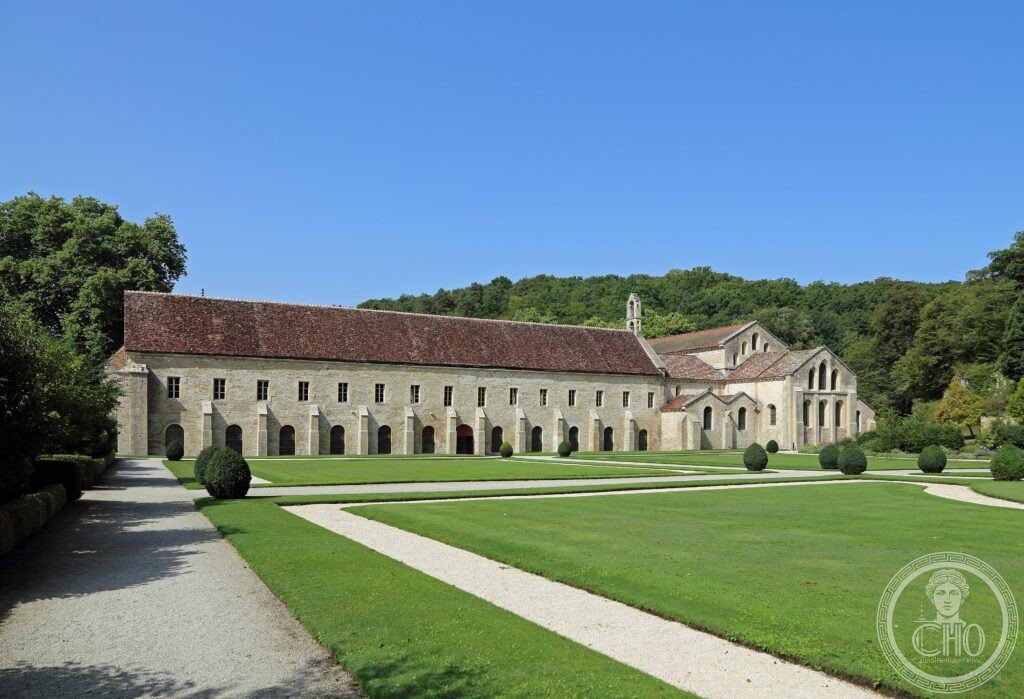
The most perfectly preserved Cistercian monastery in the world and the greatest single monument to the Cistercian ideal of austere beauty. The Abbaye de Fontenay, in a forested valley near Montbard in the Côte-d’Or, was founded by St Bernard of Clairvaux in 1118 AD as a model of the Cistercian vision of monastic poverty, self-sufficiency, and architectural plainness. Consecrated by Pope Eugenius III in 1147, the monastery’s complete building ensemble. Church, cloister, chapter house, dormitory, refectory, forge, and guest wing. Was built in a single 30-year campaign and survives almost entirely intact, making it the most unified medieval monastery in Europe.
At a glance
Fontenay is 5 km north-east of Montbard (the main town of the northern Côte-d’Or), 80 km north-west of Dijon and 60 km north-east of Vézelay. The monastery is in a small wooded valley (the Val de Fontenay), sheltered from sight by the surrounding forest. The Cistercian rule required monasteries to be built in remote valleys, away from towns and roads, to emphasize the monks’ withdrawal from the world. The monastery is privately owned (by the descendants of the industrialist Edouard Aynard who restored it in 1906–1911) and operated as a public museum. Guided and self-guided visits are available. The church, cloister, chapter house, monks’ dormitory, forge, and abbot’s lodging are all open. The visit takes 1.5–2 hours.
Key facts
- St Bernard of Clairvaux and the Cistercian reform: Fontenay was founded by St Bernard of Clairvaux (1090–1153 AD), the most influential churchman in 12th-century Europe. Bernard joined the fledgling Cistercian Order (founded 1098 at Cîteaux, 15 km south of Dijon) in 1112 at the age of 22, bringing with him 30 friends and relatives. In 1115 he was sent to found a new Cistercian monastery at Clairvaux (in the Aube valley 100 km north-east of Dijon). He founded Fontenay in 1118 as one of Clairvaux’s first daughter houses. Bernard’s vision of monastic life was the opposite of the Cluniac tradition (which Vézelay, 80 km west, represents): where Cluny built elaborate, ornate churches as an expression of devotion to God’s glory, Bernard argued that elaborate ornamentation distracted the monk’s attention from prayer. The Cistercian aesthetic program is expressed in Bernard’s famous polemic against Cluniac church ornament (“Apologia ad Guillelmum”, c. 1125): “What profit is there in those ridiculous monsters, in that marvellous and deformed comeliness, that comely deformity? … To what purpose are those unclean apes, those fierce lions, those monstrous centaurs, those half-men…?”. At Fontenay, the answer is expressed in stone: no figurative carving, no elaborate capitals (just simple scallop or leaf designs), no stained glass (only clear glass, to admit light without colour), no towers, no elaborate liturgical furniture.
- The church (consecrated 1147 AD): the most architecturally significant surviving Cistercian church in the world. The Fontenay church is 66 metres long and 16 metres wide, with a nave of 8 bays and north and south transepts of 2 bays each. The structural system is Burgundian Romanesque (pointed barrel vault over the nave, groin vaults over the aisles, pointed transverse arches — the pointed arch at Fontenay is one of the earliest uses of the pointed arch in Burgundy, appearing approximately 1125–1135 AD, slightly predating its full exploitation in Gothic architecture). The decorative programme is rigorously minimal: the capitals are of the simplest scallop type, the windows are clear glass in round-headed arches, the only ornamentation is the mathematical regularity of the stonework itself. The west façade has three plain portals and a single oculus window. The luminosity of the interior (the white limestone and the clear glass give an ethereal grey-white light very different from the dark Romanesque interior of Vézelay or the coloured Gothic light of Saint-Denis) is the primary aesthetic experience.
- The iron forge of 1150 AD: one of the most important industrial monuments in France and possibly the oldest surviving industrial building in Western Europe. The Fontenay forge (built approximately 1150 AD, 30 years after the monastery’s founding) is a large rectangular building (approximately 53 x 14 metres) powered by a water wheel on the adjacent Fontenay stream. The wheel drove bellows for the forge fire and hammers for working the iron. The forge produced iron implements for the monastery’s agricultural operation and also sold iron goods to the surrounding region (Cistercian monasteries were required to be financially self-sufficient and were pioneers of agricultural innovation and industrial production). The forge building is the earliest known surviving iron-working building in France and one of the earliest in Europe. The water-wheel mechanism has been partially reconstructed.
- The dormitory (1150 AD): the monks’ dormitory is on the first floor of the east range (the standard Cistercian layout places the dormitory above the chapter house, so monks can descend directly to the church for the night offices without going outside). At Fontenay, the dormitory (50 metres long, 10 metres wide) has a wooden wagon-vault ceiling and retains its original Romanesque windows in both side walls. The floor is the original 12th-century stone pavement. The dormitory is used today for exhibitions and cultural events.
- Heritage: UNESCO World Heritage Site, Cistercian Abbey of Fontenay, inscribed 1981.
- GPS: 47.6274° N, 4.3961° E.
History
Fontenay was founded by St Bernard in 1118 with a small group of monks from Clairvaux. The monastery grew rapidly under the patronage of the Bishop of Norwich (Everard of Puiset, an Anglo-Norman bishop who withdrew to Fontenay at the end of his life and was buried there), whose gifts allowed the construction of the permanent monastery buildings from approximately 1118 to 1147. The church was consecrated by Pope Eugenius III in 1147 (Eugenius was a former monk of Clairvaux under St Bernard and was the first Cistercian pope). At its height in the 13th century, Fontenay had approximately 300 monks and lay brothers and was a significant economic and cultural centre. The Hundred Years’ War (1337–1453) disrupted the monastery repeatedly (English forces plundered the valley several times). The monastery declined gradually in the 15th–17th centuries. It was sold during the French Revolution (1790) to its inhabitants, who converted it into a paper mill (1807–1906). The industrialist Edouard Aynard (from a Lyon banking family, born at Montbard) purchased the former monastery in 1906 and undertook a careful restoration that removed the paper-mill equipment and restored the medieval buildings to their original form (1906–1911). The restoration is widely regarded as one of the most successful 19th/early 20th-century monastic restorations in France. The property remains in private hands (Aynard’s descendants) and has been open to the public since the restoration.
What you see
The standard visitor circuit begins at the abbey entrance gate and follows a clockwise route: the dovecote (near the entrance; a large medieval stone circular tower for housing pigeons, an important food source for the monastery). The exterior of the church from the west (the plain west façade, three portals, the oculus window, and the bell-cage roof above the crossing). The church interior (enter from the south portal; walk to the east end and return; look up at the barrel vault and at the minimal capitals; note the light quality). The cloister (immediately south of the church; the most photographed space in Fontenay; walk all four galleries and note the paired columns and round arches unchanged since the 12th century). The chapter house (the monks’ daily meeting room, immediately east of the cloister; entered through three arched openings from the cloister; the pointed cross-vaults and the four detached columns of the interior are the only slightly ornamental elements in the entire complex). The monks’ dormitory (above the chapter house; access by external staircase; the most spacious and well-lit room in the monastery). The forge (north of the church, adjacent to the stream; the most unusual building in the ensemble; the water-channel still runs through the building).
Practical information
- Admission: approximately €14 adult (guided tour included in the ticket; French-language guided tours run 3–4 times daily April–October; English audio guide or booklet available for self-guided visits). Open daily April–October, 10am–6pm. Limited hours November–March (check fontenay.com). The on-site café (in the former guest wing) serves simple lunches in summer. The monastery shop sells Cistercian-inspired products (honey, lavender, simple candles — in the Fontenay spirit of simplicity).
- Getting there: from Dijon by car: 80 km north-west on A38/N71 to Montbard, then D32 to Marmagne (1h). From Paris Gare de Lyon by TGV to Montbard (1h 20 min on the Paris-Lyon-Marseille TGV line — Montbard is a TGV stop; from Montbard station, Fontenay is 5 km by taxi or bicycle (taxi approximately €15 one way; bicycle rental available at Montbard tourist office); from Vézelay: 80 km east (1h by car via D957/D954); the Montbard-Fontenay connection is one of the easiest high-culture circuits in France (TGV from Paris + taxi = 2h door-to-door).
- Burgundy wine heritage combination: the Côte-d’Or (the “Golden Slope”, the 50-km ridge of limestone hills west of Dijon that produces the world’s greatest Pinot Noir and Chardonnay wines) is 60 km south-east of Fontenay. The Hospices de Beaune (Hôtel-Dieu de Beaune, 1443; the most beautifully preserved 15th-century Gothic hospital in Europe, with its extraordinary polychrome glazed tile roof and its collection of Flemish paintings commissioned as part of the charitable foundation) is the most visited site in the Côte-d’Or and an essential stop for any Burgundy visit. The Burgundy wine trail (the Romanée-Conti vineyard, the Chambolle-Musigny village, the Gevrey-Chambertin appellation) is 20–40 km from Fontenay.
Getting there
TGV Paris to Montbard (1h 20min), then taxi 5 km. By car from Dijon (80 km, 1h). From Vézelay (80 km east, 1h). GPS: 47.6274, 4.3961.
Nearby
- Vézelay Basilica. 80 km west of Fontenay (1h by car). The Romanesque masterpiece and spiritual counterpart to Fontenay. While Fontenay embodies St Bernard’s Cistercian austerity, Vézelay’s Cluniac basilica (1104–1215) embodies the opposite principle of elaborate ornamentation as devotional expression. Seeing both on the same day makes the contrast between these two great 12th-century currents of French religious art visceral and unforgettable. See separate CHO place card.
- Montbard and the Buffon Estate. 5 km south-east of Fontenay. The birthplace of the comte de Buffon (Georges-Louis Leclerc, 1707–1788), the most important French naturalist of the 18th century and the author of the 44-volume “Histoire Naturelle” (1749–1804), the most comprehensive natural history work of the Enlightenment. Buffon’s estate at Montbard (the Parc Buffon, now a public garden) preserves the famous tour de l’Aubépine (the tower where Buffon wrote) and the iron forges (the Forges de Buffon, 5 km north of Montbard, now a museum) where Buffon conducted his famous experiments on the age of the Earth (he heated iron spheres of known size and measured their cooling time, extrapolating the method to estimate that the Earth was at least 75,000 years old — a conclusion that brought him into conflict with the Church and was far in advance of his time; the actual age of the Earth is 4.5 billion years).
- Abbaye de Cîteaux. 60 km south-east of Fontenay (50 min by car). The mother house of the Cistercian Order, founded 1098 by Robert de Molesme, Alberic, and Stephen Harding. Cîteaux (from the Latin “Cistercium”, meaning the place of reeds) is the source from which all Cistercian monasteries worldwide descend. The original 11th-century buildings are gone. The current monastery (still active, with approximately 25 monks) includes an 18th-century main building and a modern church (1950s). The monks produce and sell their own beer (the Cîteaux cheese — a washed-rind cheese made from the milk of the monastery’s own herd — is among the finest in Burgundy and can be purchased at the monastery shop).
Sources
- Wikipedia, Fontenay Abbey. Bernard of Clairvaux. Cistercian architecture, accessed June 2026.
- UNESCO, Cistercian Abbey of Fontenay, WHS reference 165, inscribed 1981.
- Terryl N. Kinder, Cistercian Europe: Architecture of Contemplation, William B. Eerdmans, 2002.
- Marcel Aubert, L’architecture cistercienne en France, Éditions d’Art et d’Histoire, 1947.
Find it on the map
See this place and what’s around it →📷 Become a Cultural Heritage Online photographer
Share your photos of places: they stay published under your name as the author. The more they're seen, the more you get noticed — and soon a contest will reward the most appreciated photos.
Log in or sign up free to add a photo