
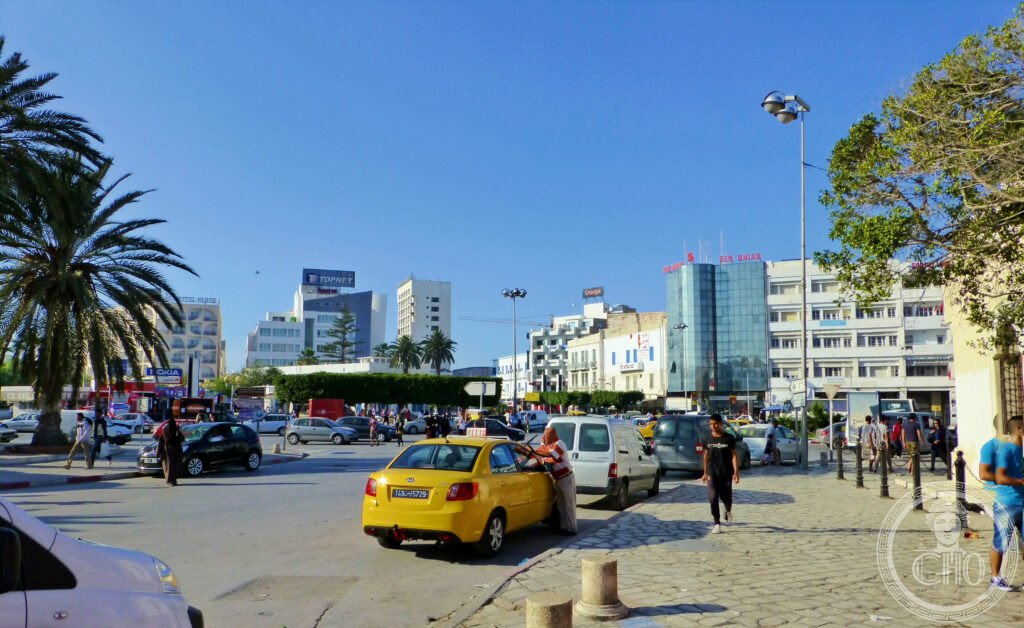
The best-preserved Aghlabid-era medina in North Africa. Sousse (ancient Hadrumetum, Phoenician Hadrumète, one of the oldest cities in Africa with documented occupation from the 9th century BC) grew from a Phoenician trading colony into a major Byzantine fortress city, then became one of the most important Arab Islamic cities in the Maghreb during the Aghlabid period (9th century), when the ribat (fortress-monastery), the Great Mosque, and the Kasbah were built. The medina today retains its Aghlabid urban structure, enclosed within nearly complete 9th–11th-century walls.
At a glance
Sousse (population of the city approximately 220,000; metropolitan area approximately 350,000) is the third largest city in Tunisia, on the east coast of Tunisia at the northern end of the Gulf of Hammamet, approximately 140 km south of Tunis. The Medina of Sousse (the walled historic core, approximately 50 hectares) is built on the site of the ancient Hadrumetum, one of the oldest Phoenician colonies in North Africa (founded approximately 9th century BC, making it contemporaneous with Carthage). UNESCO inscribed the Medina of Sousse in 1988. Sousse is also one of the most important beach resort cities in North Africa, with its modern tourist hotels concentrated in the Sousse Nord resort district 3 km north of the medina.
Key facts
- The Ribat (820 AD): the fortress-monastery of Sousse and the oldest major Islamic monument in Tunisia still in its original state. A ribat (from the Arabic رِبَاط, “a tying up” of soldiers dedicated to religious-military service — a concept unique to early Islamic North Africa and Spain, combining the functions of a fortified lighthouse, a coast-watch tower, a monastery for religious warriors, and a place of retreat for pious Muslims who wished to dedicate a period to prayer) was built at Sousse approximately 820–821 AD by the Aghlabid ruler Ziyadat Allah I. The building is a square fortress of three storeys with a circular tower at its north-east corner (the lighthouse function, guiding ships into the harbour). The interior includes a courtyard mosque, cells for the resident warrior-monks, and the remarkable rooftop terrace with a panoramic view of the medina, the Great Mosque, the harbour, and the Gulf of Hammamet. The ribat was featured in the 1979 Monty Python film Life of Brian (it stands in for the streets of ancient Jerusalem in several scenes).
- Great Mosque of Sousse (850 AD): the principal mosque of the Sousse medina and one of the finest examples of early Islamic military-religious architecture in the Maghreb. Built approximately 850 AD (similar period and style to the Great Mosque of Kairouan, the most important mosque in North Africa) on a site adjacent to the ribat, the mosque combines a large hypostyle prayer hall (with columns taken from earlier Roman and Byzantine buildings) with an unusual external fortification (the mosque is surrounded by a crenellated defensive wall with regular towers, giving it the appearance of a fort as much as a house of worship — a characteristic of early Islamic mosques in defensive positions). The mosque is not open to non-Muslims for entry (the exterior walls and the southern tower — which doubles as a minaret and a watchtower over the harbour — are visible from outside).
- The Kasbah and the Khalef Tower: the dominant monument of the Sousse medina skyline and the primary museum in the city. The Kasbah (the citadel of the medina, built 859–860 AD by the Aghlabid emir Ibrahim II, reconstructed and expanded under Fatimid and Zirid rule in the 10th–11th centuries) sits on the highest point of the medina and is now the Sousse Archaeological Museum (the most important Roman mosaic collection outside the Bardo Museum in Tunis, including the extraordinary 3rd-century mosaic of Neptune enthroned on his chariot drawn by sea-horses, from the floor of a Roman villa at Sousse). The Khalef Tower (built on the Kasbah, 11th century, 38 metres tall, circular lighthouse-tower rebuilt in its current form by the Zirid dynasty) gives a 360° panorama of the medina, the sea, and the sahel olive groves.
- Catacombs of Sousse: the largest concentration of early Christian catacombs in Africa outside Rome. The Sousse catacombs (discovered in 1888, extending beneath the western suburbs of the modern city) contain approximately 15,000 individual burial niches cut into the rock, used by the early Christian community of Hadrumetum between approximately 200 and 400 AD. Tertullian (the African Church Father who is one of the founders of Latin Christian theology, c.155–240 AD) was probably born in the region of Carthage-Hadrumetum (the exact location is debated). The catacombs are visited by arrangement (Musée Archéologique de Sousse at the Kasbah organises access).
- Carthaginian and Roman Sousse: Hadrumetum (the Roman name for Sousse) was one of the oldest Phoenician colonial cities in Africa, probably founded by the Phoenicians of Tyre in the 9th century BC (contemporary with Carthage, 200 km north). The city sided with Rome during the Second Punic War (against Carthage) and was rewarded with autonomy. Under Roman rule it was a prosperous agricultural port exporting olive oil, wheat, and garum (fermented fish sauce) to Rome. The Roman street grid is still legible beneath the medieval medina (a common feature of North African cities where the Islamic urban structure was superimposed on the Roman grid without completely erasing it).
- Heritage: UNESCO World Heritage Site, Medina of Sousse, inscribed 1988.
- GPS: 35.8245° N, 10.6346° E.
History
The Phoenician colony of Hadrumète (Hadrumetum in Latin) was established on the east coast of what is now Tunisia approximately 9th century BC, making it one of the oldest documented Phoenician colonial foundations in Africa. The city grew as a satellite of Carthage and after the destruction of Carthage (146 BC) became one of the most important Roman provincial cities in Africa. The Roman city at its peak (2nd–3rd century AD) had a population of approximately 50,000–100,000 and was a major exporter of olive oil and grain to Rome via its harbour. The Vandal conquest (429–533 AD) and Byzantine reconquest (533 AD, under Belisarius) temporarily reduced the city’s importance. The Byzantine period produced the impressive fortifications that the Arab conquerors (who arrived in 649 AD) would incorporate into the ribat and kasbah of the Islamic city. The Aghlabid period (800–909 AD) was the golden age of Sousse: the ribat, the Great Mosque, and the Kasbah were all built in the 9th century, and the medina’s distinctive whitewashed cubic architecture crystallised in this period.
What you see
The medina is entered from the medina gates (the largest, Bab Bhar — the “Sea Gate” — on the eastern side facing the harbour and the modern boulevard) or from the northern and western sides. The standard circuit: Ribat (south-east corner of the medina, near Bab Bhar; allow 45 min; the rooftop panorama is the best in Sousse). Great Mosque exterior (adjacent to the ribat, the combined fortified-mosque silhouette of the two 9th-century buildings is the most photographed view in Sousse). The medina souks (the commercial district in the interior of the medina, centred on the Rue el-Aghalba and the covered souk streets; the souks of Sousse are smaller but more authentic than those of Tunis, with a higher proportion of local customers relative to tourists). Kasbah and the Sousse Archaeological Museum (at the highest point, allow 1–1.5 hours for the mosaic collection).
The medina street pattern is essentially Aghlabid (9th century) overlaid on the Roman grid: the main axial street running east-west from the harbour gate corresponds to the Roman decumanus maximus. The regular blocks of the medina approximate the Roman insulae though substantially modified. The white cubic houses (with blank external walls, small windows with blue painted shutters, and internal courtyards — the same pattern as the medina of Tunis but smaller in scale and more fully inhabited by the local population rather than converted to restaurants and hotels) give an authentic sense of traditional Sahel urban life.
Practical information
- Admission: medina streets free. Ribat approximately 8 TND (about €2.40). Great Mosque exterior free (interior not accessible to non-Muslims). Kasbah/Archaeological Museum approximately 8 TND. Catacombs approximately 8 TND (access organised through the museum). Most souk areas have no admission charge. The combined ticket for the Ribat, Kasbah, and Catacombs is approximately 20 TND.
- Getting there: Monastir Habib Bourguiba International Airport (MIR). The airport for the Sousse-Monastir resort region. 20 km south of Sousse (25 min by TGM railway from Sousse central station, or 30 min by louage shared taxi). Direct charter and scheduled flights from London Gatwick (3h, Tunisair, TUI), Paris ORY (2.5h), Frankfurt (3h, Tunisair), Berlin (3.5h), and numerous northern European charter destinations. Tunis-Carthage Airport (TUN) is 140 km north (2h by louage or 2.5h by direct train). By train from Tunis Centrale (2h 15 min, hourly, approximately 9 TND). The Tunisian railway connects Tunis, Hammamet, Sousse, El Djem, and Sfax on a single line. By louage (shared taxi in 5-seat Peugeot 504s, the most common inter-city transport in Tunisia) from Tunis approximately 2h, approximately 12 TND.
- The Sahel olive grove circuit: the region around Sousse (the Sahel, “coast” in Arabic) is one of the most densely planted olive groves in the world. The town of Mahdia (75 km south of Sousse) was the Fatimid capital of North Africa (969 AD, when the Fatimid dynasty moved from their Mahdiyya base to conquer Egypt and found Cairo) and has a beautifully preserved small medina on a promontory. The El Djem amphitheatre (120 km south of Sousse, 1.5h by train) is the essential day trip from Sousse. The island of Djerba (300 km south, accessible by ferry from Sfax or direct flight from European cities) is the most important tourist destination in southern Tunisia.
Getting there
Monastir Airport (MIR): 20 km south, TGM train (25 min). Direct charter/scheduled flights from London (3h), Paris (2.5h). Train from Tunis (2h 15min). GPS: 35.8245, 10.6346.
Nearby
- Monastir. 20 km south of Sousse (25 min by TGM railway). The birthplace of Habib Bourguiba (the founding president of independent Tunisia, 1956–1987, buried in a monumental mausoleum adjacent to the city’s main mosque) and the site of one of the finest Aghlabid military monuments in Tunisia. The Ribat of Monastir (9th century, in a better state of preservation than the Sousse ribat, with its prominent square tower used as a lighthouse) was used as a film set by Franco Zeffirelli for his 1977 film Jesus of Nazareth and by Monty Python for Life of Brian (1979). The medina of Monastir is smaller and less developed as a tourist destination than Sousse’s but retains a more authentic local character.
- El Djem. 65 km south of Sousse (50 min by train, every 2h). The largest surviving Roman amphitheatre in Africa (capacity approximately 35,000, built approximately 238–248 AD; UNESCO WHS 1979). The town of El Djem is a small Tunisian market town and the amphitheatre dominates it completely. The third storey of the outer arcade is fully intact and gives one of the most complete visual impressions of a Roman amphitheatre exterior anywhere in the world. The adjacent El Djem Archaeological Museum has a collection of Roman mosaics from the villas of the wealthy 3rd-century olive oil merchants who commissioned the amphitheatre.
- Kairouan. 60 km west of Sousse (1h by louage). The fourth holiest city in Islam and the founding city of Arab North Africa (established 670 AD). The Great Mosque of Kairouan (Sidi Oqba, the oldest standing mosque in North Africa with its three-tiered minaret of 724–728 AD, the oldest surviving minaret in the world) is accessible to non-Muslims for the exterior and courtyard. The city’s sweet speciality. Makroudh (diamond-shaped date-filled semolina pastry, deep-fried and soaked in honey, a recipe dating from the Aghlabid period). Is sold at every bakery.
Sources
- Wikipedia, Medina of Sousse. Hadrumetum. Ribat of Sousse. Great Mosque of Sousse, accessed June 2026.
- UNESCO, Medina of Sousse, WHS reference 498, inscribed 1988.
- Hédi Slim, Ammar Mahjoubi, Khaled Belkhodja and Abdelmajid Ennabli, Histoire générale de la Tunisie, vol. 2 (L’Antiquité), Sud Éditions, 2003.
- Mohamed Talbi, L’Emirat aghlabide 184–296/800–909: Histoire politique, Adrien Maisonneuve, 1966.
Find it on the map
See this place and what’s around it →📷 Become a Cultural Heritage Online photographer
Share your photos of places: they stay published under your name as the author. The more they're seen, the more you get noticed — and soon a contest will reward the most appreciated photos.
Log in or sign up free to add a photo