
The largest and most complete medieval Islamic city in the world — a walled medina of 9,400 streets, lanes, and dead-end alleys (cul-de-sacs/derbs) covering 270 hectares, with no vehicles permitted inside its walls, where the sounds of hammers in the copper souks, the smell of the tanneries, and the call to prayer from the Kairaouine Mosque (founded 859 AD, housing the world’s oldest continuously operating university) have formed a continuous urban experience for eleven centuries.
At a glance
Fes (Arabic: فاس, Fās; French: Fès) is a city of approximately one million inhabitants in northern Morocco, 60 km south of the Mediterranean coast. The historic medina of Fes el-Bali (Old Fes) was founded in the 9th century AD by Idris II, the founder of the Idrisid dynasty, and developed into the most important city in the medieval Maghreb — a centre of Islamic scholarship, commerce, and crafts that retained its medieval spatial structure until the 20th century. The medina is car-free (donkeys and handcarts are the transport), its street pattern is the original medieval layout, and its crafts (leather tanning, copper-working, ceramics, carpet-weaving) are still practised in the same workshops and souks that have existed for centuries. UNESCO inscribed the Medina of Fes in 1981.
Key facts
- Al-Qarawiyyin University (859 AD): founded by Fatima al-Fihri, a Muslim woman from Kairouan (Tunisia), as a mosque; the teaching function was attached from the founding and has been continuous since — making Al-Qarawiyyin (the Kairaouine mosque-university) the oldest continuously operating institution of higher learning in the world, older than the University of Bologna (1088); non-Muslims may not enter the mosque but may see the courtyard through the open doors; the university building (separate from the mosque) is not open to the public.
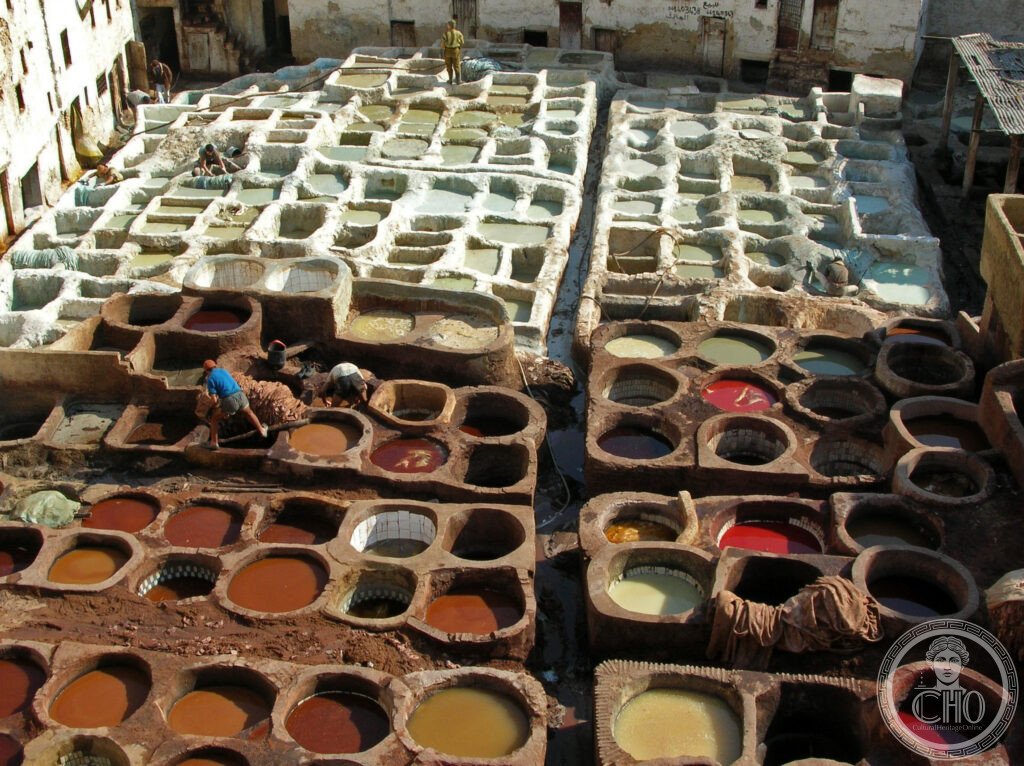
- The Chouara Tanneries: the largest of Fes’s three tannery districts, in the leather quarter near Bab Guissa; stone vats cut into the ground contain pigeon dung (to soften the hides), quicklime (to remove the hair), water, and natural dye vats (saffron = yellow, poppy = red, indigo = blue, pomegranate = brown, henna = orange); the process is essentially unchanged since the 11th century; the viewing platforms (on the upper floors of leather-goods shops overlooking the tanneries) are the iconic Fes viewpoint; sprigs of mint are handed to visitors to counteract the smell.
- The Bou Inania Madrasa (1350–55): the finest Marinid-period madrasa in Morocco, built by Sultan Abu Inan Faris; notable for its combination of three decorative languages on a single wall surface: Quranic calligraphy in cedarwood at the top; a middle register of carved stucco in geometric and floral patterns; and a base of geometric zellige (cut ceramic tile mosaic) in 2,000+ different mathematical patterns; the proportions of the central courtyard (open to the sky, with a reflecting pool) are exact fractions of one another — Islamic mathematical architecture at its highest.
- The Attarine Madrasa (1323–25): adjacent to the Kairaouine Mosque, the Attarine (Spice Sellers) Madrasa is considered the most beautiful Marinid building in Fes; the courtyard zellige, stucco, and cedar tripartite decoration is extremely fine; from the upper floor (student rooms) you can see directly into the courtyard of the Kairaouine Mosque.
- Street structure: Fes el-Bali has approximately 9,400 streets; the main artery (the Talaa Kebira and Talaa Seghira, the “Large Slope” and “Small Slope”) runs downhill from the Bab Bou Jeloud gate to the Kairaouine Mosque; the off-streets (derbs) are dead-ends leading to residential quarters; getting lost is standard practice; the medina is small enough (7 km end to end) that getting completely lost is rare.
- Heritage: UNESCO World Heritage Site, Medina of Fes, inscribed 1981.
- GPS: 34.0650° N, 4.9740° W.
History
Fes was founded in 789 AD by Idris I, the founder of the Idrisid dynasty (the first Arab dynasty in the western Maghreb), on the right bank of the Fes River; Idris II founded the left-bank city in 809 AD. The two settlements merged in the 11th century under the Almoravid dynasty. Under the Marinid dynasty (1244–1465), Fes reached its apogee as the cultural capital of the Islamic West: the Marinid sultans built the great madrasas (Bou Inania, Attarine, Sahrij, Bou Anania of Meknes) as expressions of dynastic prestige and religious patronage, and the city attracted scholars from across the Islamic world.
The French Protectorate of Morocco (1912–1956) introduced the system of keeping the old medina separate from the new French-planned town (the “Ville Nouvelle”): the medina was declared a historic monument and largely excluded from French urban planning, which froze its medieval structure while allowing the new city to develop with railways, roads, and European-style urban layout. This “protection by neglect” preserved the physical fabric but led to serious infrastructure problems (water, sewage, structural decay of riyads) that UNESCO’s 1981 inscription and the Aga Khan Trust for Culture’s restoration programme (from the 1990s) have worked to address.
Contemporary Fes faces the tension between conservation and gentrification: the medina’s riyads (traditional courtyard houses) have been bought and renovated by European buyers and converted to boutique hotels and restaurants at a rate that is displacing the traditional artisan and scholar families who gave the medina its living culture. The tanneries, the copper and bronze souks, and the carpet weavers remain working and commercially viable, but the economic pressure to substitute tourist-oriented retail for traditional production is significant.
What you see
The medina is entered from the Bab Bou Jeloud (Blue Gate, 1913 — the iconic Marinid-style gate with blue tilework on the outside, green on the inside), from which the Talaa Kebira descends to the Kairaouine. The best orientation for a first visit is to walk the Talaa Kebira from Bab Bou Jeloud to the Kairaouine Mosque (approximately 20 minutes downhill), note the landmarks (the minaret of the Bou Inania Madrasa on the left, the Attarine souk at the bottom), and then explore the side streets. The copper souk (Souk el-Attarine, the spice and copper quarter around the Kairaouine) and the wood-turning souk (in the uphill quarter near the Bab Bou Jeloud) are the most atmospheric.
The tanneries are reached via the leather souk on the north-east side of the Kairaouine, following the smell (and the shops offering mint to visitors). The viewing platforms (free to access if you walk through a leather shop — you are expected to browse but not obliged to buy) look directly into the tannery compound from above. The colour pattern of the vats changes by season: in winter (cold and damp) the natural dyes are darker and the process slower; in summer the vats glow in primary colours. The Bou Inania Madrasa (entrance fee approximately 20 MAD, €2) is the essential interior visit; the Attarine Madrasa (same entrance fee) is recommended for the view of the Kairaouine.
Practical information
- Getting there: Fes-Saiss Airport (FEZ) has direct flights from London Heathrow, Paris CDG, Brussels, Frankfurt, Amsterdam, and Casablanca; ONCF train from Casablanca (4 hours, regular service; from Marrakesh 8 hours with change); ONCF train from Tangier (5 hours); from the station, a petit taxi to Bab Bou Jeloud costs approximately 20–30 MAD (€2–3).
- Navigation: a guide (official guide hired at a licensed agency; approximately 250–400 MAD for a half-day) is recommended for first-time visitors; the medina’s 9,400 streets make self-navigation genuinely difficult even with GPS; the main routes are marked with blue and white plaques (in Arabic and French); most smartphone maps are incomplete but show the main arteries.
- Best time: March–May and September–November (temperatures 18–25°C); Ramadan is an interesting time to visit (the medina slows during the day and comes alive at night) but many restaurants are closed during the day; avoid July–August (35–40°C heat in the alleys).
Getting there
Fes-Saiss Airport (FEZ) has direct connections from major European hubs. ONCF train from Casablanca Voyageurs station (4 hours). Petit taxi from Fes train station to Bab Bou Jeloud (~20 MAD). GPS: 34.0650, -4.9740.
Nearby
- Volubilis — the most extensive Roman ruins in Morocco, 100 km north-west of Fes near Meknes; the walled city (2nd–3rd century AD) includes the Basilica, the Capitoline Temple, and the Arc de Triomphe of Caracalla (1st century AD); the mosaics in the aristocratic villas (the House of Orpheus, the House of Venus) are among the finest surviving Roman floor mosaics in North Africa; UNESCO WHS 1997; accessible by taxi from Meknes (30 minutes).
- Meknes — the “Versailles of Morocco”, the imperial city built by Sultan Moulay Ismail (r. 1672–1727) at a scale comparable to Louis XIV’s Versailles; the Bab Mansour (1732) is the most monumental decorated gate in Morocco; the Mausoleum of Moulay Ismail (one of the few Islamic monuments in Morocco accessible to non-Muslims) and the granaries (Hri Souani) built to sustain a city of 40,000 horses are the highlights; UNESCO WHS (Historic City of Meknes) inscribed 1996; 60 km west of Fes by train (45 minutes).
- Chefchaouen — the “Blue City” in the Rif mountains, 140 km north of Fes; the medina of whitewashed and blue-painted houses in a mountain setting is one of the most photogenic urban environments in Morocco; founded 1471 as a refuge for Andalusian Muslims expelled from Spain; accessible by CTM bus from Fes (3.5 hours).
Sources
- Wikipedia, Fes, Morocco; Al-Qarawiyyin; Bou Inania Madrasa, accessed June 2026.
- UNESCO, Medina of Fes, WHS reference 170, inscribed 1981.
- Jonathan Bloom and Sheila Blair, Grove Encyclopedia of Islamic Art and Architecture, Oxford University Press, 2009 — entries on Fes and the Marinid madrasas.
- Barnaby Rogerson, A Traveller’s History of North Africa, Interlink Books, 1998.
Find it on the map
See this place and what’s around it →📷 Become a Cultural Heritage Online photographer
Share your photos of places: they stay published under your name as the author. The more they're seen, the more you get noticed — and soon a contest will reward the most appreciated photos.
Log in or sign up free to add a photo