
Vienna around 1900 was not a style. It was an argument — about ornament, money, freedom and how a modern city should look — and for fifteen years the people having it were among the most talented in Europe. You can still walk that argument in a single day. The buildings sit close together, the ground is flat, and the coffee houses where half of it was planned are still serving. Here is how to do it.
It helps to remember what else was happening in the same streets at the same time. This was the Vienna where Sigmund Freud published The Interpretation of Dreams in 1900, where Gustav Mahler ran the Court Opera, where a young Arnold Schoenberg was pulling music apart and the philosopher Ludwig Wittgenstein grew up in one of the city’s richest households. The fight over how art should look was one front in a much larger argument about the modern mind. The walk below is the part of that argument you can still touch.
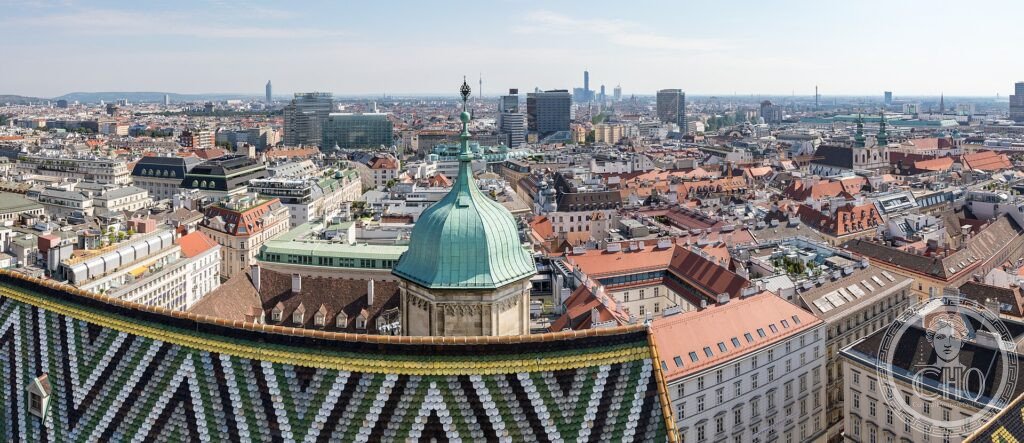
The walkout that started everything
In April 1897 a group of artists led by the painter Gustav Klimt resigned from Vienna’s conservative Künstlerhaus and founded the Secession. Their slogan, soon set in gold over the door of their own exhibition hall, was blunt: Der Zeit ihre Kunst, der Kunst ihre Freiheit — to every age its art, to art its freedom.
Begin with the painters, at the Leopold Museum in the MuseumsQuartier. Rudolf Leopold, an eye doctor, spent five decades buying Egon Schiele when respectable Vienna still called him a pornographer; his collection opened as a museum in 2001 and holds more Schiele than anywhere on earth. Schiele died in this city in October 1918, twenty-eight years old, in the influenza pandemic that had killed his pregnant wife three days before. Klimt had died the same year. The walk you are about to take is, in a way, their afterlife.
Ten minutes east stands the building that gave the movement its face: Joseph Maria Olbrich’s Secession hall of 1898, a white cube under a dome of gilded laurel leaves that the Viennese, unimpressed, nicknamed “the golden cabbage.” Go inside and down to the basement for Klimt’s Beethoven Frieze, painted in 1902 for a single exhibition and meant to be destroyed afterwards. It survived by accident.

Otto Wagner’s city
If Klimt was the movement’s painter, Otto Wagner was its city-builder. An established architect already in his fifties, Wagner turned modern when he could have coasted, and reshaped the look of Vienna’s everyday infrastructure as he went.
Walk down to the Linke Wienzeile, along the edge of the Naschmarkt, and look up at the Majolikahaus of 1899: an apartment block whose entire street front is tiled in pink majolica roses, weatherproof and unashamed. Its neighbour at number 38 wears gold medallions by Wagner’s young colleague Koloman Moser. Critics were scandalised that a serious man would tile a house like a bathroom.
A few minutes away, on Karlsplatz, two small pavilions of 1899 show what Wagner did with public money. They were entrances to Vienna’s new city railway, the metro of its day, and he gave them marble facing and gilded sunflowers as though mass transit deserved beauty. He designed the whole network down to the railings and lamps.
His masterpiece waits a quarter of an hour north: the Postal Savings Bank of 1912 on Georg-Coch-Platz. Here Wagner stopped quoting the past entirely. The marble panels are pinned to the wall with thousands of aluminium bolts left deliberately on show, and the banking hall inside, usually open to visitors, carries a curving glass roof on slim aluminium columns. It was among the first buildings anywhere to treat aluminium as architecture.

Loos and the house without eyebrows
Not everyone in Vienna 1900 wanted ornament, even the new kind. The sharpest dissent stands on Michaelerplatz, directly opposite the gate of the imperial palace: Adolf Loos’s commercial building of 1911, its upper floors stripped of every window surround. Vienna called it “the house without eyebrows,” and the story runs that Emperor Franz Joseph disliked it so much he kept the palace curtains on that side drawn. Loos had been arguing that ornament was a kind of crime; this façade is that argument built. Step into the ground-floor lobby, though, and you meet green marble and brass. The luxury is inside, where you touch it, not outside, where you show it off.
Round the corner, the Zacherlhaus of 1905 is the work of Jože Plečnik, Wagner’s most gifted pupil, who would later redesign much of Ljubljana and parts of Prague Castle. Dark granite slabs hang on an exposed frame; a bronze archangel watches from the top corner. Most visitors walk straight past it, which is reason enough to stop.
Total design: the Wiener Werkstätte
By now you have seen paintings, apartment houses, a bank and a department store. The Museum of Applied Arts (the MAK), on the Ring beside the savings bank, explains what held them together. In 1903 Josef Hoffmann and Koloman Moser founded the Wiener Werkstätte, a workshop built on a radical premise: a chair, a brooch and a building should all carry a single idea. The museum keeps their archive, along with Klimt’s full-scale working drawings for the Stoclet Frieze — the cartoons behind the gold you have been chasing all day.
Where it ends: The Kiss
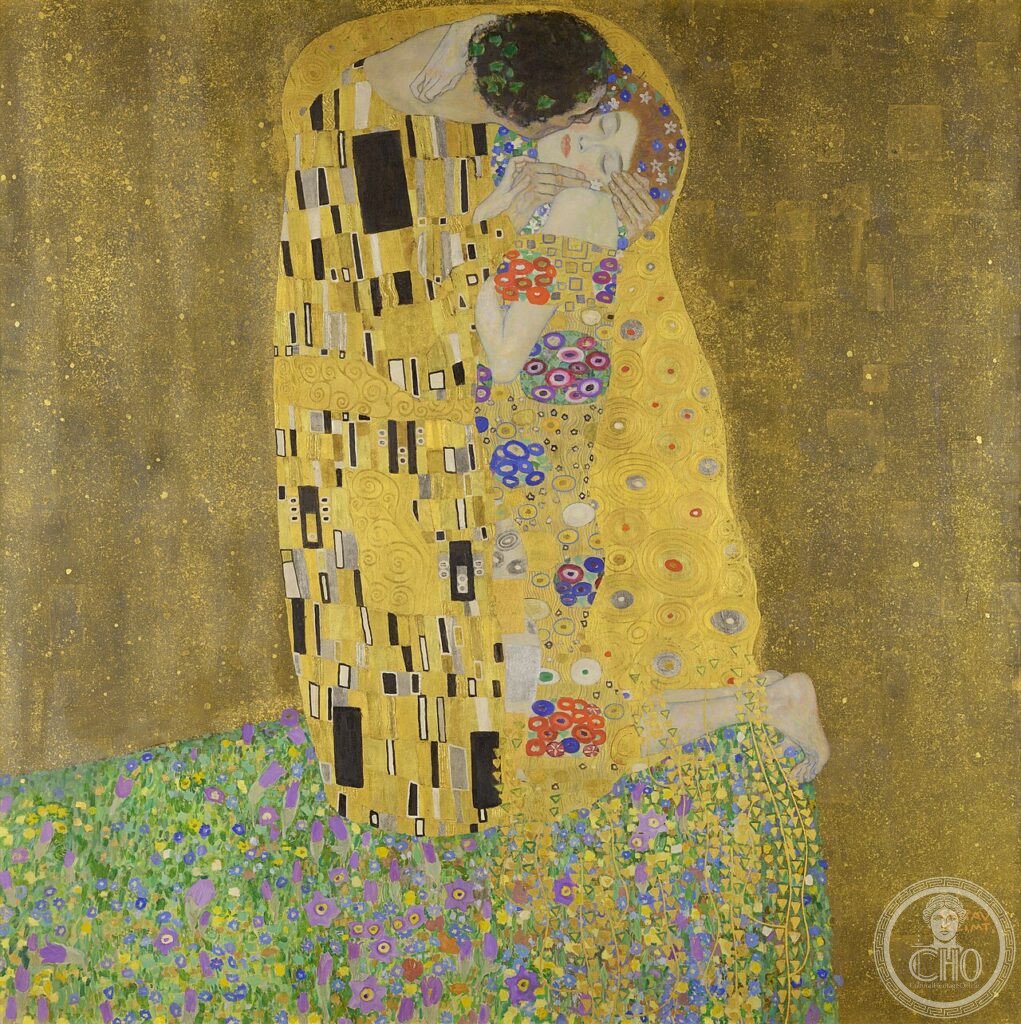
Finish where Vienna keeps its trophy. The Upper Belvedere was built in the 1720s by Johann Lucas von Hildebrandt as a summer palace for Prince Eugene of Savoy, the general who broke the Ottoman siege; the Republic later turned it into a gallery of Austrian art. A short tram ride south, in its baroque halls, hangs Klimt’s The Kiss, painted around 1908 in his “golden period” and bought by the Austrian state straight from the easel. It draws a permanent crowd, so arrive late in the day, give the quieter Schiele and Kokoschka rooms their due, then walk out into the free garden between the two palaces for one of the finest views in the city — the spires of the inner town you have just crossed, lined up beyond the parterre.
How to walk it
The whole route runs about five kilometres on flat ground and makes one full, unhurried day. Buy a single 24-hour transit ticket for the longer hops; the U-Bahn and Ring trams are fast and frequent, and bike-share and e-scooters cover the gaps if you would rather roll between the Wagner sites. But the point is to go slowly. Vienna built the coffee house into its daily rhythm — it is recognised today as living cultural heritage — and the cafés along this route are not breaks from the walk, they are part of it: Café Museum near the Secession, plain enough that Loos himself designed it; Café Central in the old town, once thick with writers and exiles; Café Sperl, barely changed since 1880; Café Prückel beside the savings bank. Order one melange, take a newspaper from the rack, and stay an hour. Nobody will move you on.
If you have more time
Two of Otto Wagner’s finest works sit outside this central loop and reward a second day. The Kirche am Steinhof of 1907, on the hill of the former psychiatric hospital in the west of the city, is his only church: a white marble drum under a copper dome, designed down to the rounded pew corners and the angled floor so it could be cleaned and used by patients. Out toward Schönbrunn, the little Hofpavillon Hietzing was the private city-railway station Wagner built for the Emperor, used by Franz Joseph just twice. Both are short trips by U-Bahn or tram and round out the picture of a man who designed a whole city’s movement, from a royal waiting room to a metro railing.
How long does the Vienna Secession walk take?
Plan a full day. The walking itself is only about five kilometres and easy, but the three museums on the route — the Leopold, the MAK and the Belvedere — reward real time, and the coffee houses are meant to be lingered in. If you would rather not rush, split it across two mornings.
Is it doable as a half-day?
Yes. Do the four stops clustered around Karlsplatz — the Secession, the Majolikahaus, the railway pavilions and a coffee at Café Museum — and save the inner city and the Belvedere for another visit.
Do I need to book the museums in advance?
For the Belvedere, booking a timed ticket online is wise in high season because of The Kiss. The Leopold and the MAK are usually fine to enter on the day. Check opening days before you set out: most Vienna museums close one day a week.
How do I get around between the stops?
On foot for most of it. For the longer hops use the U-Bahn or the Ring trams, all covered by one 24-hour ticket bought from any machine. WienMobil bike-share and dockless e-scooters are everywhere; ride them in the bike lanes rather than on the pavement, and park them out of the way.
Walk it yourself. We have turned this route into a free CHO RoadBook — the nine stops in order, a map, and downloadable GPX and KML tracks for your phone: the Vienna Secession RoadBook.
Sources
- S1 — Schorske, Carl E. Fin-de-Siècle Vienna: Politics and Culture. Alfred A. Knopf, 1980. ISBN 978-0-394-50596-1.
- S2 — Sarnitz, August. Otto Wagner 1841–1918: The Dimension of Modernity. Taschen, 2005. ISBN 978-3-8228-3773-3.
Spotted an error? Write to editorial@culturalheritageonline.com and we correct it the same day.