
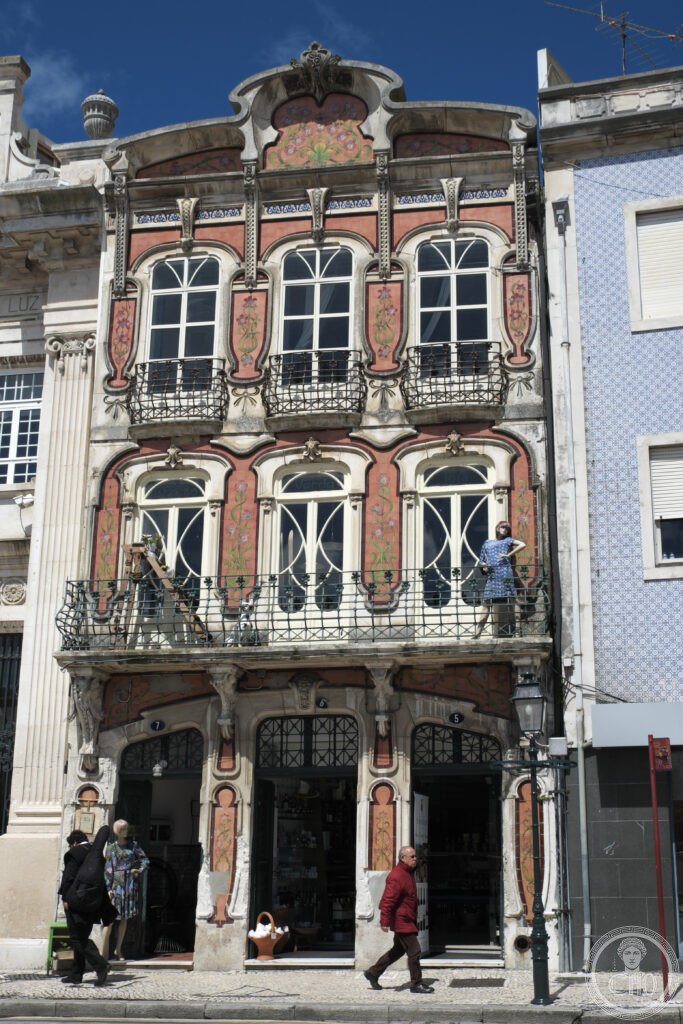
A working co-operative behind a wall of tiles — pink, purple and red, and dated to the year they were fired.
At a glance
The Casa da Cooperativa Agrícola, also known simply as the Edifício Arte Nova, stands at numbers 5 to 7 on Rua João Mendonça, one of the canal-side streets at the centre of Art Nouveau Aveiro. Its front is faced with a panel of polychrome azulejos — the glazed ceramic tiles that are the signature material of Aveiro’s Arte Nova — set off by ironwork and carved stone from Ançã. The building once served as the seat of the Cooperativa Agrícola de Aveiro, the town’s agricultural co-operative, and has been a classified Property of Public Interest since 1996.
Key facts
- Design: attributed to Francisco Augusto da Silva Rocha
- Azulejo panel: dated 1913, from the Fonte Nova factory, in tones of pink, purple and red
- Address: Rua João Mendonça, nºs 5–7
- Former use: seat of the Cooperativa Agrícola de Aveiro
- Materials: azulejo tile, ironwork, carved Ançã stone
- Status: Property of Public Interest (Imóvel de Interesse Público) since 1996
History
Aveiro adopted Art Nouveau through the material it knew best. The town had long produced glazed ceramic tile, and when the new style arrived around 1900 its architects pressed the azulejo into floral and sinuous patterns across whole facades. The Casa da Cooperativa Agrícola is a clear case: its tiled front, in pink, purple and red, was supplied by the local Fonte Nova factory and carries the date 1913.
The house was built in the early twentieth century, possibly to a design by Francisco Augusto da Silva Rocha, the architect responsible for several buildings of the same style in the city; the attribution is not firmly documented. For a time it housed the Cooperativa Agrícola de Aveiro, the agricultural co-operative whose name it still carries.
In 1996 the building was classified as a Property of Public Interest, recognising it as one of the set of Arte Nova houses that earned Aveiro its place on the Réseau Art Nouveau Network.
What you see
The facade is the lesson: a field of polychrome azulejos framed by stone and iron, where the tile is not an accent but the wall itself. The carved stone comes from Ançã, the soft limestone quarried near Coimbra and prized across central Portugal, and the ironwork follows the curving lines of the period.
Stand back across the street to read the whole composition, then look closely at the lower courses, where the date and the maker’s hand can be traced in the glaze.
Practical information
- The facade is the attraction and is visible from the street at any time.
- It sits on the same street as the Casa dos Ovos Moles, a short walk apart.
- Soft afternoon light brings out the colour of the tiles.
- Time needed: a few minutes.
Getting there
Rua João Mendonça is in the historic centre of Aveiro, a few minutes on foot from the central canal and from the train station on the line between Porto and Coimbra.
Nearby
- Casa dos Ovos Moles, further along Rua João Mendonça.
- Casa dos Arcos and the Casa do Major Pessoa (Museu Arte Nova).
- Aveiro — the capital of Portuguese Arte Nova (city guide).
Sources
- Wikipédia (PT), “Casa da Cooperativa Agrícola em Aveiro”.
- e-cultura.pt, “Aveiro, cidade Arte Nova”.
- Portuguese cultural-heritage inventory (DGPC / base Ulysses).
Find it on the map
See this place and what’s around it →📷 Become a Cultural Heritage Online photographer
Share your photos of places: they stay published under your name as the author. The more they're seen, the more you get noticed — and soon a contest will reward the most appreciated photos.
Log in or sign up free to add a photoIs this page about you?
This page is read by travellers and heritage enthusiasts who find it on Google. Tell us how you are connected to this place and we will take it from there.