
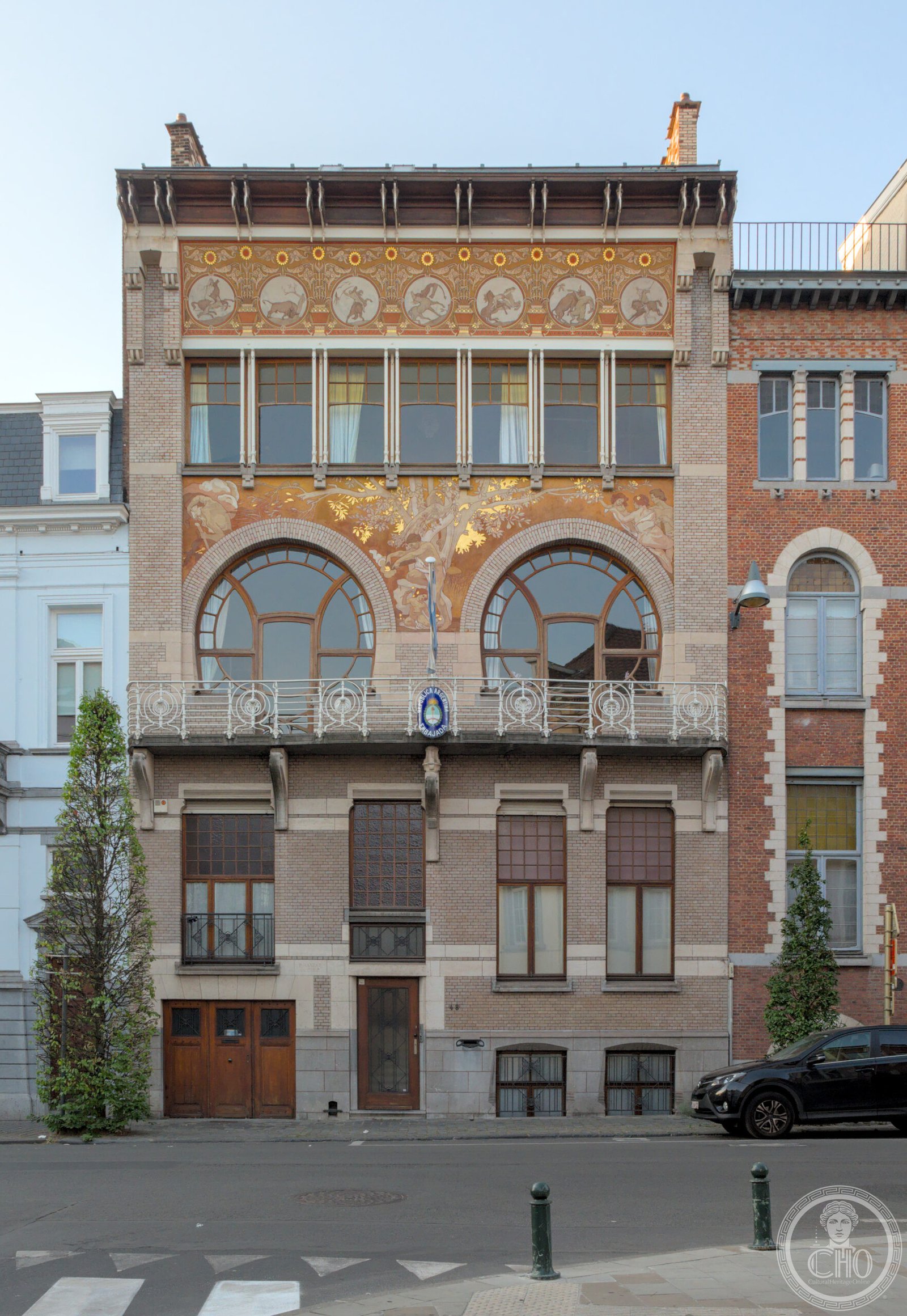
A house designed for a painter, where the front wall does what the rooms behind it ask — and nothing the rule book wants.
At a glance
The Hôtel Ciamberlani, or Hôtel Albert Ciamberlani, was designed in 1897 by Paul Hankar, one of the pillars of Belgian Art Nouveau, for the Symbolist painter Albert Ciamberlani. It stands at 48 rue Defacqz in Ixelles, Brussels, beside another Hankar house, the Hôtel René Janssens at number 50. Like the rest of the Art Nouveau movement, Hankar broke with the classical tradition: the facade is frankly asymmetrical, its openings sized and placed to suit the rooms behind.
Key facts
- Architect: Paul Hankar
- Built: 1897
- For: the Symbolist painter Albert Ciamberlani
- Address: 48 rue Defacqz, Ixelles, Brussels
- Neighbour: Hôtel René Janssens (no. 50), also by Hankar
- Feature: exposed iron beam and asymmetrical facade
History
By 1897 Paul Hankar had already built his own house a few doors away on the rue Defacqz, and the street was becoming a showcase of the new architecture. Albert Ciamberlani, a Symbolist painter, commissioned Hankar to build him a house and studio that would suit an artist’s life and light.
Hankar set the building beside the Hôtel René Janssens, another of his houses, so that the two share a stretch of frontage; the rear of the plot once connected to the stables of a related Ciamberlani property. The result is one of the clearest demonstrations of Hankar’s belief that a facade should express the building behind it.
The house stands among the masterpieces of Brussels Art Nouveau that line this part of Ixelles and Saint-Gilles, close to Horta’s Hôtel Tassel and Hôtel Solvay.
What you see
The symmetry of a classical house is deliberately broken. On the ground floor the door is pushed to one end of the front, and on the facade the metal structure — a standard rolled-iron beam — is left openly visible, a piece of engineering turned into ornament.
The windows lighting the salon and its balcony are set in horseshoe arches, their slender wooden frames dividing the glass in a pattern with an East-Asian flavour. The upper facade carries Hankar’s characteristic sgraffito decoration, painted to a programme fit for a painter’s house.
Practical information
- The building is private; only the facade is visible from the street.
- It stands on rue Defacqz, close to the Hankar House.
- Combine with a walk of the Defacqz / Faider Art Nouveau quarter.
- Time needed: 10 minutes for the exterior.
Getting there
The house is on rue Defacqz in Ixelles, a short walk from the Louise area and reachable by tram and the Louise metro station.
Nearby
- The Hankar House, on the same street.
- Horta’s Hôtel Tassel and Hôtel Solvay.
- The Horta Museum in Saint-Gilles.
Sources
- Wikipedia (FR), “Hôtel Albert Ciamberlani”.
- Brussels regional heritage inventory (irismonument / urban.brussels).
- Belgian Art Nouveau heritage documentation.
Find it on the map
See this place and what’s around it →Record researched and written by Luigi De Marchi for Cultural Heritage Online, 2026.
📷 Become a Cultural Heritage Online photographer
Share your photos of places: they stay published under your name as the author. The more they're seen, the more you get noticed — and soon a contest will reward the most appreciated photos.
Log in or sign up free to add a photoIs this page about you?
This page is read by travellers and heritage enthusiasts who find it on Google. Tell us how you are connected to this place and we will take it from there.