
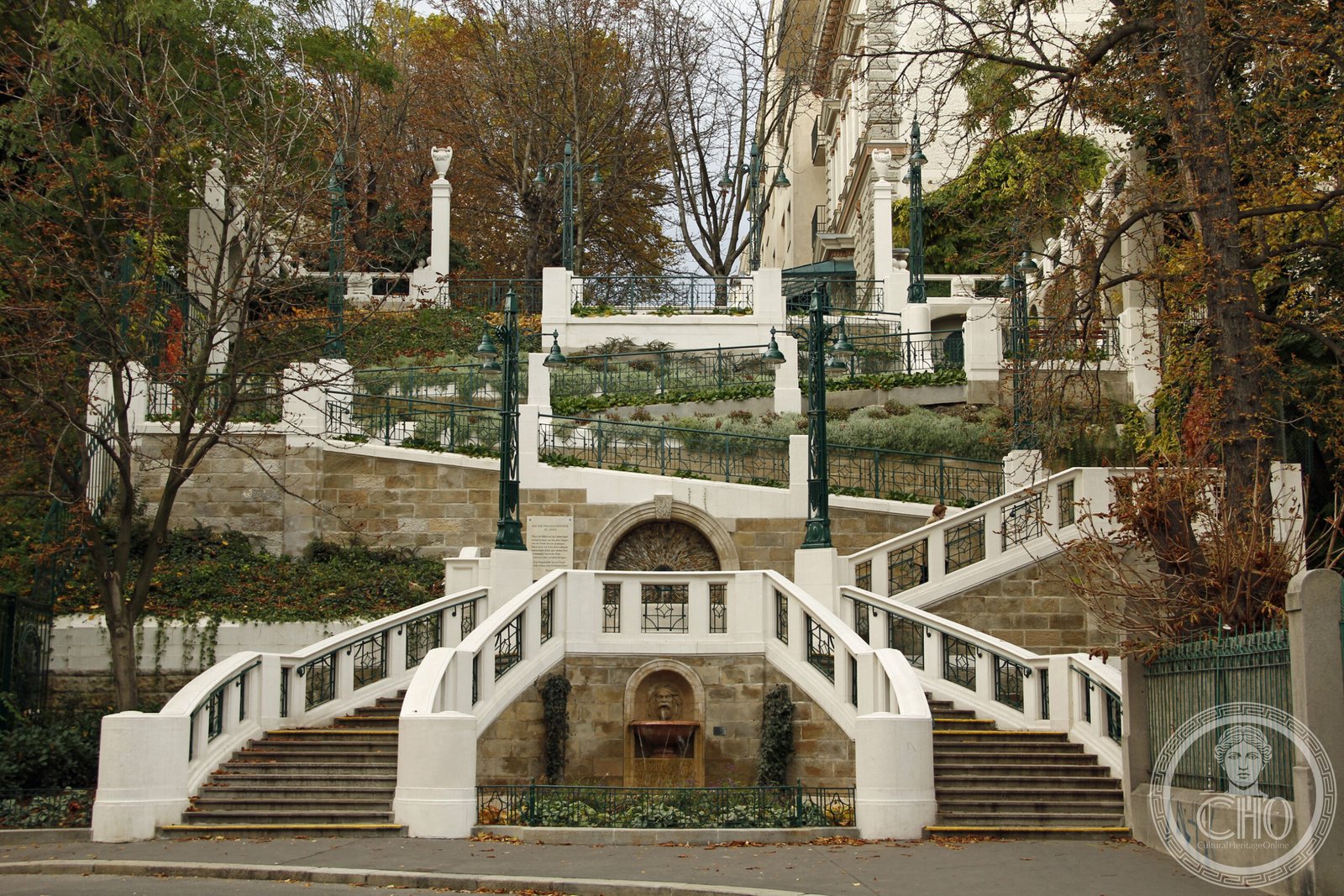
Not a building but a street made vertical. The city turned a slope into a stage.
At a glance
The Strudlhofstiege, or Strudlhof Steps, is an outdoor staircase in the Alsergrund, Vienna’s 9th district, linking Liechtensteinstrasse with Währinger Strasse across a steep change in level. Designed around 1910 by the municipal architect Theodor Johann Jaeger and built from luminescent Mannersdorf limestone, it is counted among the city’s Jugendstil — Austrian Art Nouveau — masterpieces. Terraces, ramps, lamps, and a fountain turn a simple problem of access into a piece of public theatre.
Key facts
- Architect: Theodor Johann Jaeger (1874–1943), municipal planning office
- Built: around 1910
- Material: luminescent Mannersdorf limestone
- Style: Jugendstil (Austrian Art Nouveau)
- District: Alsergrund (9th), between Liechtensteinstrasse and Währinger Strasse
- Named after: the painter Peter Strudel’s former art school
- Status: listed object
History
The staircase takes its name from Peter Strudel, a painter who came to Vienna from Cles in Trentino and opened a painting school here in 1688 — one of the first art colleges in central Europe and a forerunner of today’s Academy of Fine Arts. The school closed after his death and the original Strudlhof was demolished.
The adjacent street was named Strudlhofgasse in 1907. Soon afterwards the city administration, under Mayor Karl Lueger, resolved to build a staircase at the end of it to ease the descent to the lower Lichtental level. The design came from Theodor Johann Jaeger, an architect in the municipal planning office.
Built from glowing Mannersdorf limestone, the steps became one of Vienna’s best-loved Jugendstil works. They later gained literary fame as the title and setting of Heimito von Doderer’s 1951 novel Die Strudlhofstiege.
What you see
Jaeger handled the slope as a series of curved terraces and flights that double back on themselves, linked by ramps and balustrades. Lamps on slender standards and a small fountain punctuate the descent, and the pale limestone seems to hold the light, especially in the evening.
The whole composition is more landscape than monument. There is no facade to read; instead the Jugendstil shows itself in the flowing curves of the railings and the careful staging of each level, so that walking down becomes a designed experience.
Practical information
- A public staircase, open and free at all hours.
- Best seen in the late afternoon, when the limestone glows.
- Steps and ramps; not fully step-free, but the ramps ease the gradient.
- Time needed: 15–20 minutes.
Getting there
The steps are in Alsergrund, north of the city centre. The closest tram and U-Bahn access is around Schottentor and the Liechtensteinstrasse tram stops, a short walk away.
Nearby
- The Liechtenstein Garden Palace and its park.
- The university quarter and the Votivkirche, toward the Ringstrasse.
Sources
- Wikipedia, “Strudlhofstiege”.
- City of Vienna heritage information.
- Bundesdenkmalamt listing.
Find it on the map
See this place and what’s around it →Record researched and written by Luigi De Marchi for Cultural Heritage Online, 2026.
📷 Become a Cultural Heritage Online photographer
Share your photos of places: they stay published under your name as the author. The more they're seen, the more you get noticed — and soon a contest will reward the most appreciated photos.
Log in or sign up free to add a photoIs this page about you?
This page is read by travellers and heritage enthusiasts who find it on Google. Tell us how you are connected to this place and we will take it from there.