
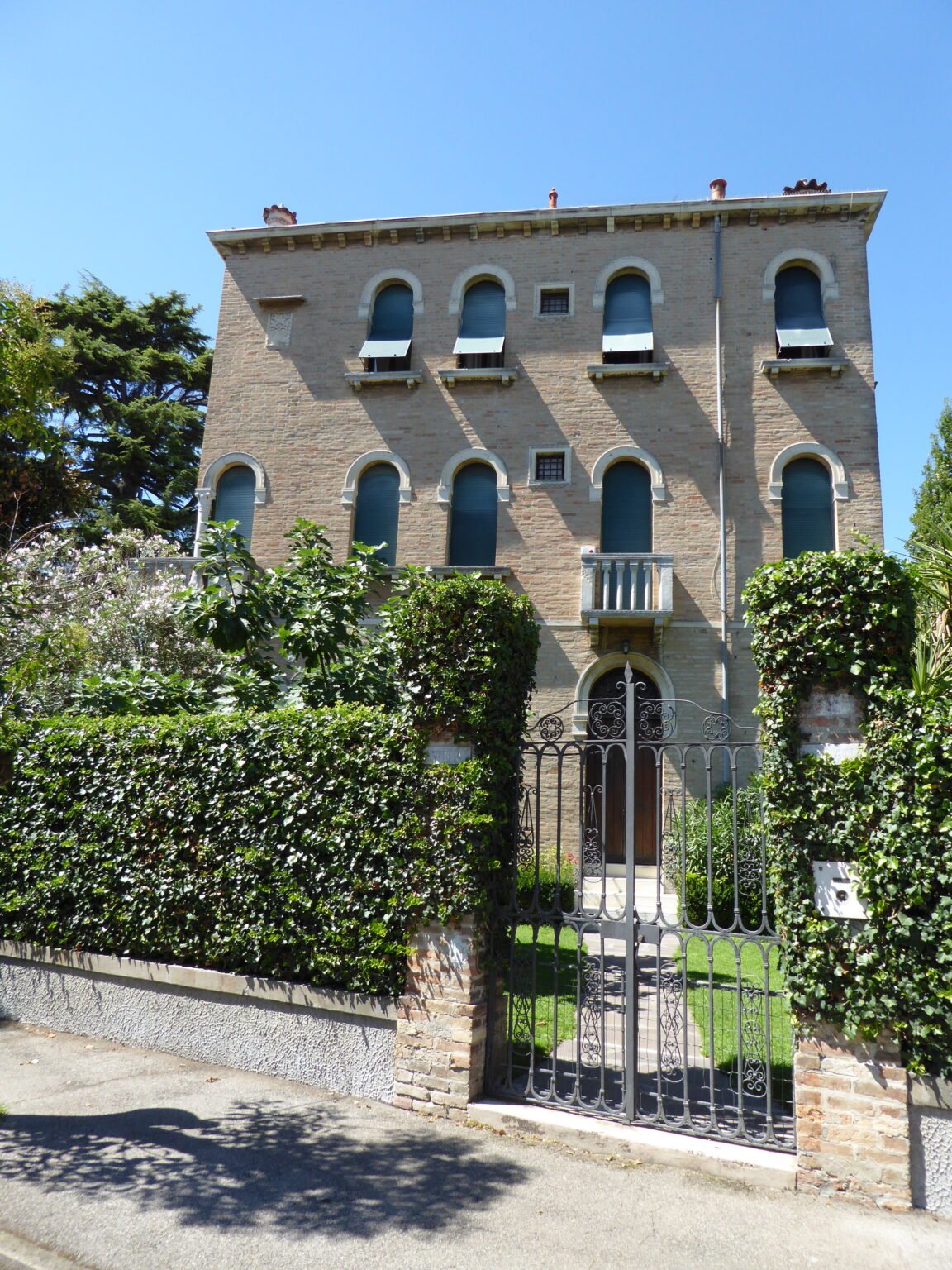
A brick villa in a deep garden near the southern shore, simple and almost monastic — and, by one account, a house where D’Annunzio, Duse and Rilke once passed the season.
At a glance
This Villa Romanelli stands near riva di Corinto, toward the quieter southern end of the Lido, and should not be confused with the earlier Villa Romanelli that Domenico Rupolo built on via Dandolo. The architect Angelo Davanzo raised it between 1908 and 1911 for Pietro Romanelli. It is built entirely of exposed brick, its windows turned in round arches, and it sits in a large garden that still keeps something of its early-century calm.
Key facts
- Architect: Angelo Davanzo
- Built: 1908–1911
- Client: Pietro Romanelli
- Style: neo-Byzantine
- Fabric: exposed brick throughout, with white-stone window cornices
- Plan: irregular, three storeys, about 152 m², two entrances
- Location: riva di Corinto 4, corner of via Rodi 4
History
Angelo Davanzo built this villa for Pietro Romanelli in the years around 1910, when the Lido was at the height of its fame. The island drew an international public to its beaches and hotels, and with them came writers, performers and artists looking for quiet and inspiration among its gardens.
According to a 1989 study cited by the city’s heritage survey of the Lido, the Villa Romanelli stood at the centre of that intellectual life, and counted among its guests some of the most celebrated figures of the age — from Gabriele D’Annunzio and the dancer Isadora Duncan to the actress Eleonora Duse and the poet Rainer Maria Rilke. The claim belongs to the villa’s local memory rather than to a documented register, but it places the house squarely in the cultural Lido of the early twentieth century.
Whatever the truth of the guest list, the building’s restraint is real. Where the resort’s hotels reached for spectacle, Davanzo answered with a sober brick villa in the Byzantine manner, the kind of house that rewarded long summers rather than first impressions.
What you see
The villa is faced entirely in exposed brick, plain and essential, with a horizontal stone band marking the floor line. Its windows — single, paired and grouped in threes — are all turned in full round arches and framed in white stone. The same stone carries the floral patere and formelle, the round and rectangular relief panels, that decorate all four faces of the house.
The effect is closer to a small Romanesque or Byzantine building than to a holiday villa. Around it spreads a wide garden, kept faithful to the atmosphere of the opening years of the century, so that the brick walls rise out of greenery much as they did when Pietro Romanelli first moved in.
Practical information
- Access: private residence — it can be admired only from the street, not visited inside.
- Best seen: from riva di Corinto, where the brick fronts face the garden edge.
- Time needed: a few minutes; it lies apart from the central villa cluster, toward the south.
- Setting: a calm residential stretch near the southern Lido shore.
Getting there
From central Venice, take a vaporetto to the Lido Santa Maria Elisabetta landing, then continue south by bus or bicycle toward riva di Corinto; it is some distance from the Gran Viale. From Marco Polo Airport, the Alilaguna water bus reaches the Lido directly, or a land transfer to Tronchetto connects with the lagoon vaporetti.
Nearby
- Villa Romanelli — the earlier 1906 villa by Domenico Rupolo, on via Dandolo.
- Hotel Excelsior — the 1908 beach palace on the seafront.
- Villino Mon Plaisir — Guido Sullam’s colourful 1904 villa near the Gran Viale.
- Liberty and Rationalist Architecture in Venice Lido — a walking route through the island.
Sources
- Comune di Venezia, L’architettura del Lido — synthetic record and building description for Villa Romanelli (Isolana).
- G. Sonino (1989), cited in the above survey — the villa’s role in the island’s intellectual life and its reported guests.
- Hero photograph: Wikimedia Commons (author Abxbay), CC BY-SA 4.0.
Find it on the map
See this place and what’s around it →📷 Become a Cultural Heritage Online photographer
Share your photos of places: they stay published under your name as the author. The more they're seen, the more you get noticed — and soon a contest will reward the most appreciated photos.
Log in or sign up free to add a photoIs this page about you?
This page is read by travellers and heritage enthusiasts who find it on Google. Tell us how you are connected to this place and we will take it from there.