
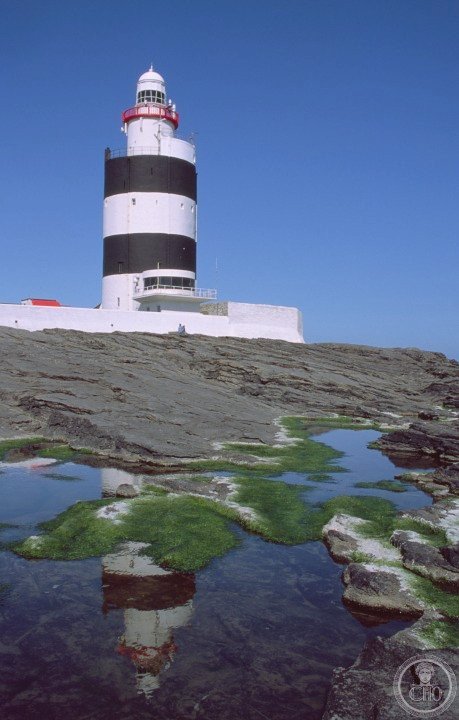
The world’s oldest operational lighthouse – eight centuries of light from a Norman tower the monks first tended at Ireland’s storm-blunt headland.
At a glance
- Type
- Lighthouse (operational)
- Period
- c. 1210-1245
- Style
- Norman medieval tower
- Location
- Hook Head, County Wexford, Ireland
- Coordinates
- 52.1239, -6.9292
- Founder
- William Marshal, Earl of Pembroke
Overview
Hook Lighthouse has burned, oiled, gasified, and electrified its warning for nearly 800 years – the oldest lighthouse in continuous operation on earth. William Marshal, the greatest knight of medieval Europe, raised the four-metre-thick tower around 1245 to guide ships to his new port of Ross; the monks of St Dubhan, fire-keepers on the head since the 5th century by tradition, became its first keepers.
History
The phrase by Hook or by Crooke – Cromwell’s vowed approaches to Waterford – fixed the head in the language. Monastic keepers yielded to civil; the light ran whale oil, gas, paraffin, and power, automated only in 1996. Around it the head’s wrecks, the Loftus Hall’s hauntings, and whale-watching seas keep the maritime drama current.
Architecture and Design
Three vaulted chambers stack within the Norman drum – keepers’ rooms in the wall’s thickness – beneath the later lantern; the black-and-white bands are the day-mark. The visitor centre’s tours climb the original mural stair past eight centuries’ graffiti.
Cultural significance
Hook is pharology’s ancestor-shrine and Ireland’s Ancient East’s flagship – continuity of purpose unmatched in maritime heritage, the medieval machine still doing its job nightly.
Visiting today
Guided tours run daily year-round; storm-watching and whale seasons have their devotees. The Ring of Hook’s beaches and Tintern Abbey fill the peninsula day.
Getting there
Hook Head lies 45 minutes from Wexford town or the Passage East ferry from Waterford; driving is essential.
Sources and resources
Find it on the map
See this place and what’s around it →Record researched and written by Luigi De Marchi for Cultural Heritage Online, 2026.
📷 Become a Cultural Heritage Online photographer
Share your photos of places: they stay published under your name as the author. The more they're seen, the more you get noticed — and soon a contest will reward the most appreciated photos.
Log in or sign up free to add a photoIs this page about you?
This page is read by travellers and heritage enthusiasts who find it on Google. Tell us how you are connected to this place and we will take it from there.