
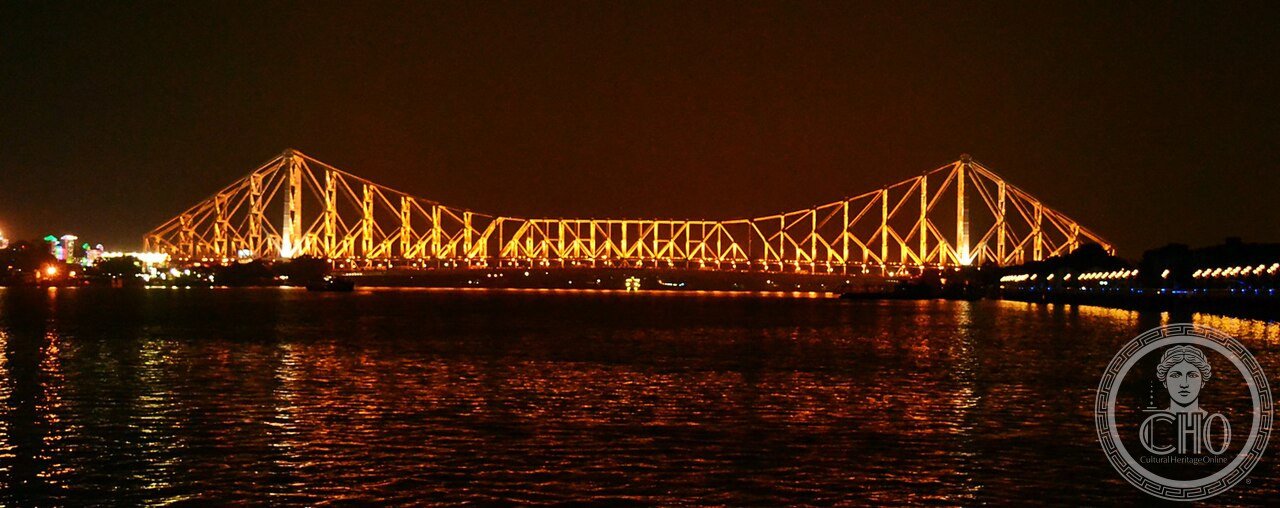
The busiest cantilever bridge on earth – a riverspan without nuts or bolts, carrying Kolkata’s millions over the Hooghly since the war year 1943.
At a glance
- Type
- Cantilever bridge
- Period
- 1936-1943
- Style
- Riveted steel cantilever
- Location
- Hooghly River, Kolkata-Howrah, India
- Coordinates
- 22.5851, 88.3468
- Engineers
- Rendel, Palmer and Tritton; built by Braithwaite Burn and Jessop
Overview
The Howrah Bridge leaps the Hooghly in a single 457-metre cantilever span – no piers in the holy river’s flood – assembled from 26,500 tonnes of steel joined entirely by rivets, opened quietly in wartime 1943 against Japanese air raids. Its daily burden of 100,000 vehicles and uncounted hundreds of thousands on foot makes it the busiest cantilever bridge in the world – Kolkata’s pulsing gate.
History
Replacing the 1874 pontoon bridge, the new span used Tata steel when war cut British supply – a swadeshi point of pride. It carried Partition’s refugees, every festival’s surge to the river, and the city’s whole modern history; renamed Rabindra Setu for Tagore in 1965, it remains Howrah Bridge to every tongue. The nightly illumination and the flower market heaving beneath compose Kolkata’s defining scenes.
Architecture and Design
Twin 85-metre towers anchor suspended and cantilever arms whose riveted lattice reads as Calcutta’s Eiffel – engineering as civic icon. The footways’ ceaseless procession, porters’ headloads among taxis, enacts the city; conservation battles paan-spit corrosion with annual repainting in signature silver.
Cultural significance
The bridge is Kolkata’s symbol across cinema (Ray to Bollywood), literature, and the diaspora’s memory – the handshake of Howrah’s station side with the metropolis, and engineering heritage of the late colonial-industrial age at world scale.
Visiting today
Walk it early morning with the flower market’s marigold tide below (photography of the bridge structure is formally restricted – discretion advised); ferries beneath give the river’s view.
Getting there
Howrah station’s exits feed the bridge directly; from the city side, Burrabazar’s lanes deliver the east ramp.
Sources and resources
Find it on the map
See this place and what’s around it →📷 Become a Cultural Heritage Online photographer
Share your photos of places: they stay published under your name as the author. The more they're seen, the more you get noticed — and soon a contest will reward the most appreciated photos.
Log in or sign up free to add a photoDo you manage this place?
This page is read by travellers and heritage enthusiasts who find it on Google. Keep it accurate — and make it work for you. Free for non-profit heritage institutions.