
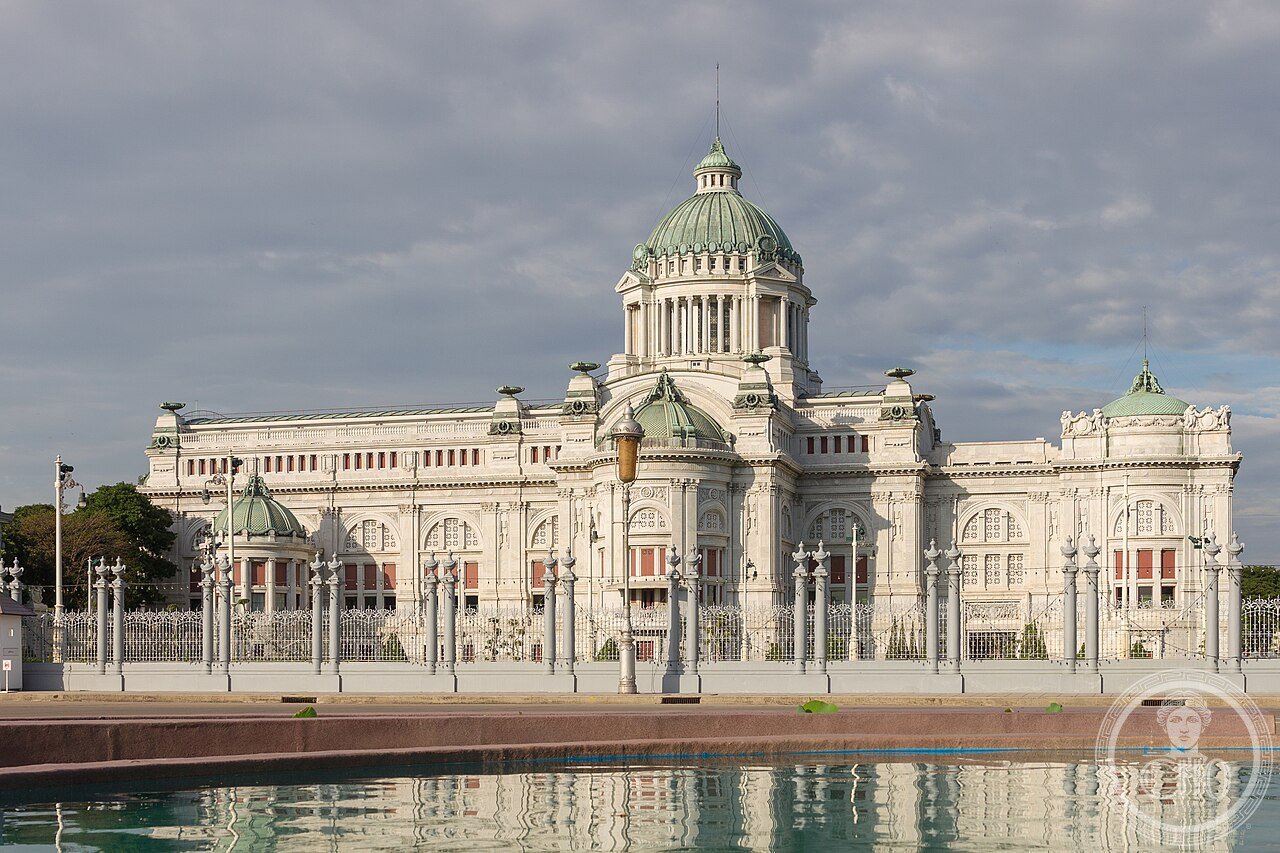
The most magnificent European-style palace in Southeast Asia, Bangkok’s Ananta Samakhom Throne Hall is a Carrara marble dome modeled on the Pantheon and built by King Rama V as Thailand’s royal parliament – now the annual venue for the Nobel Peace Prize ceremony.
At a glance
- Type
- Royal throne hall / museum
- Period
- 1907-1915
- Style
- Italian Renaissance, Baroque
- Location
- Dusit Palace, Bangkok, Thailand
- Coordinates
- 13.7729, 100.5133
- Architect
- Annibale Rigotti and Mario Tamagno (Italian)
Overview
The Ananta Samakhom Throne Hall is the most magnificent European-style palace building in Southeast Asia. Commissioned by King Rama V (Chulalongkorn) and designed by Italian architects Annibale Rigotti and Mario Tamagno following an international competition, construction began in 1907 using Carrara marble imported directly from Italy. The building was completed in 1915 under King Rama VI. Its central dome, rising 49.5 metres, was modeled on the Pantheon in Rome and is covered in marble mosaic depicting scenes from the Chakri dynasty. Six smaller domes flank the central structure in a composition that immediately announces the building’s royal ambition to any visitor approaching along the Dusit Palace avenue.
History
King Rama V built the Ananta Samakhom as part of a larger modernization program that sought to demonstrate Thailand’s parity with European nations and thereby resist colonial encroachment. Italian craftsmen were brought to Bangkok to execute the marble inlay, bronze railings, and painted ceiling medallions. The completed hall served its royal ceremonial function until 1932, when the democratic revolution ended Thailand’s absolute monarchy. From 1932 until 1974 the building served as Thailand’s National Assembly (parliament). After the new parliament building opened, the Ananta Samakhom reverted to its role as a ceremonial space for royal functions. Today it is open to the public as a museum within the Dusit Palace compound.
Architecture and Design
Rigotti and Tamagno drew directly on the tradition of Italian Renaissance domes, particularly the Pantheon and the Vittoriano monument in Rome. The exterior is clad entirely in Carrara marble; the central dome is supported on a drum pierced by arched windows and surmounted by a gilded royal emblem. The six flanking domes create a rhythmic skyline that reads powerfully from the Royal Plaza. Inside, the painted ceiling medallions depict the first six reigns of the Chakri dynasty, executed by Italian artists brought to Bangkok for the commission. The floor is laid in polychrome marble in patterns that reflect the dome geometry above. Bronze railings, door furniture, and light fittings were all custom-cast in Italy.
Cultural significance
The Ananta Samakhom is the supreme symbol of the Chakri monarchy’s engagement with European modernity in the early twentieth century. Its construction was a deliberate diplomatic statement: by building a palace more magnificent than many European royal buildings, Rama V signaled that Thailand was a sovereign nation capable of self-governance. The building’s subsequent history as a parliament anchored the democratic revolution of 1932, giving it a dual significance as both royal monument and constitutional landmark. It is recognized as a heritage site of national importance under Thai law.
Visiting today
The Ananta Samakhom Throne Hall is open to the public on most days within the Dusit Palace compound; admission is charged and dress code applies (shoulders and knees must be covered). The museum inside documents the building’s history and the Chakri dynasty. Audio guides are available. The surrounding Dusit Palace gardens and the nearby Vimanmek Mansion (the world’s largest golden teak building) can be visited on a combined ticket. Allow 90 minutes for a thorough visit.
Getting there
The Dusit Palace compound is located in the Dusit district of Bangkok, approximately 2 km north of the historic Rattanakosin island. The nearest BTS Skytrain station is Victory Monument (then taxi or bus). Bus routes 70, 515, and 516 stop on Sri Ayutthaya Road at the palace entrance. From Suvarnabhumi Airport the journey by taxi takes 45-60 minutes; from Don Mueang Airport approximately 30-40 minutes.
Sources and resources
Find it on the map
See this place and what’s around it →Record researched and written by Luigi De Marchi for Cultural Heritage Online, 2026.
📷 Become a Cultural Heritage Online photographer
Share your photos of places: they stay published under your name as the author. The more they're seen, the more you get noticed — and soon a contest will reward the most appreciated photos.
Log in or sign up free to add a photoIs this page about you?
This page is read by travellers and heritage enthusiasts who find it on Google. Tell us how you are connected to this place and we will take it from there.