
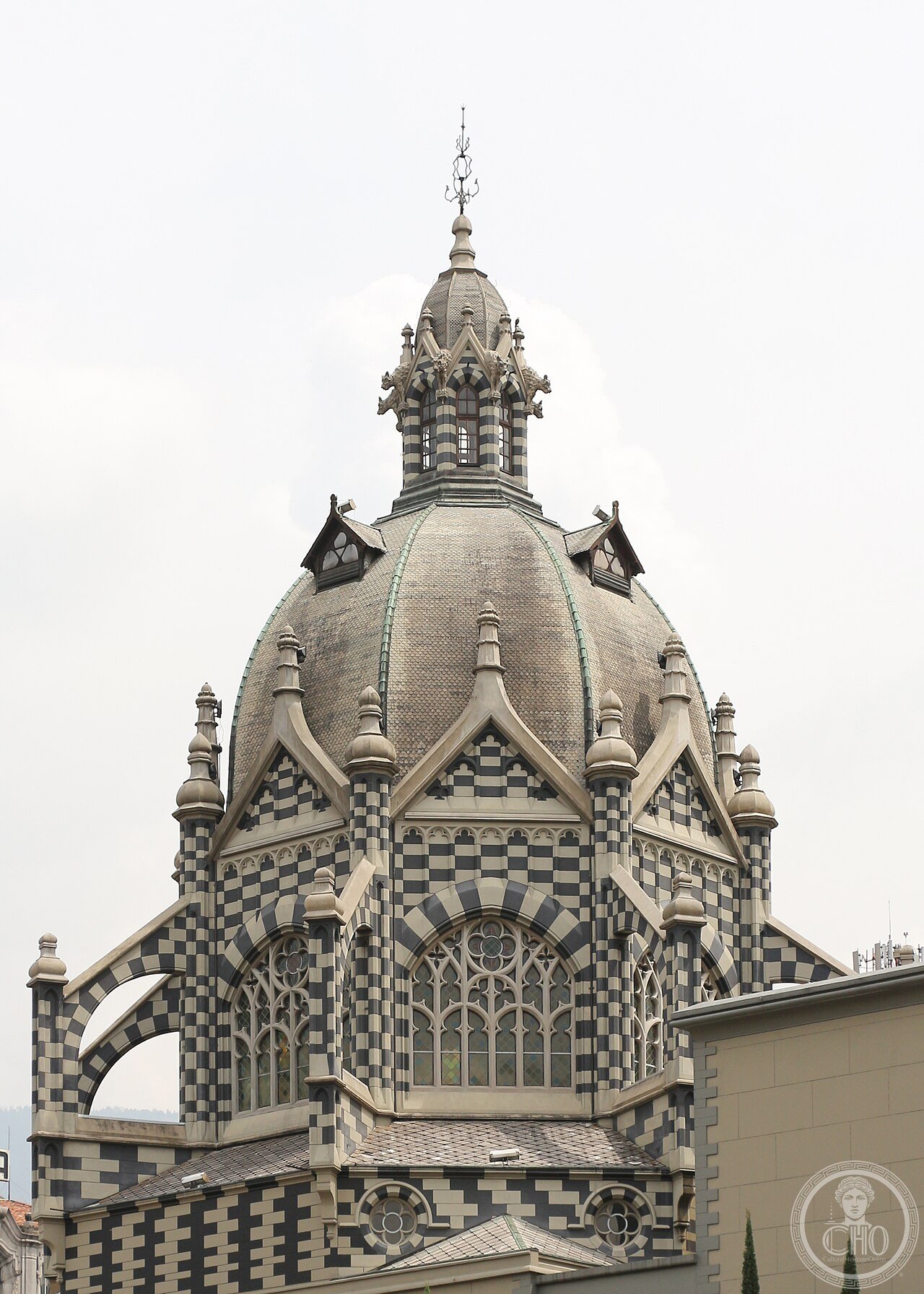
Palacio de la Cultura Rafael Uribe Uribe
A fantastical fusion of Moorish and Gothic stonework in the heart of Medellin, the Palacio de la Cultura is the most extraordinary 20th-century civic building in Colombia and a symbol of the city’s enduring cultural ambition.
At a glance
- Type
- Government palace turned cultural center
- Period
- 1925-1938
- Style
- Moorish Revival / Gothic hybrid
- Location
- Calle 51, Plaza Botero, Medellin, Antioquia, Colombia
- Coordinates
- 6.2526, -75.5696
- Architect
- Nel Resto; completed by Agustin Goovaerts (Belgian)
Overview
The Palacio de la Cultura Rafael Uribe Uribe stands facing Plaza Botero in downtown Medellin as one of the most architecturally extraordinary civic buildings in Latin America. Clad entirely in dark basalt stone, its silhouette blends pointed Gothic arches with Moorish multifoil arcading and elaborate ornamental stonework to create an effect unlike anything else in the Americas. Named after the liberal politician and general Rafael Uribe Uribe (assassinated 1914), the palace originally housed the seat of the Antioquia departmental government before becoming a major cultural institution encompassing the Regional Historical Archive, exhibition halls, and a public library.
History
Construction began in 1925 under the direction of local architect Nel Resto, who conceived a design rooted in Moorish Revival traditions then fashionable across Europe and the Americas. Financial constraints slowed progress, and the project was handed to Belgian architect Agustin Goovaerts, who had already designed several landmark buildings in Bogota and Medellin. Goovaerts introduced Gothic pointed arches and refined the ornamental programme, blending the two medieval traditions into a coherent whole. The building was inaugurated in 1938 as the Casa de la Republica de Antioquia. When the departmental government relocated to a modern complex in the 1980s, the Palacio was converted into a cultural palace, preserving its 20th-century fabric while opening its galleries and reading rooms to the public. Today it is administered by the Gobernacion de Antioquia.
Architecture and Design
The exterior is clad in dark volcanic basalt quarried near Medellin, giving the facade an unusually somber tone that sets it apart from the white-painted colonial buildings typical of Andean cities. The main elevation presents a central tower flanked by lower wings, all articulated with pointed Gothic lancet arches at the upper levels and horseshoe Moorish arches framing the ground-floor openings. Ornamental stone carvings fill every surface: geometric interlace, foliate capitals, and heraldic medallions. The interior courtyard is the building’s greatest spatial achievement: a two-story cloister of horseshoe arches carried on slender columns, a central fountain, and floor-to-ceiling polychrome tile work that directly references the Alhambra Palace in Granada. The staircase hall is lit by stained-glass windows depicting figures from Antioquia’s history.
Cultural significance
The Palacio de la Cultura is the most-visited cultural building in Antioquia and the defining architectural symbol of Medellin’s historic center. It stands adjacent to Plaza Botero, the open-air sculpture park donated by Fernando Botero containing 23 of his monumental bronze figures, creating an extraordinary concentration of cultural heritage on a single city block. The building has become inseparable from Medellin’s global narrative of urban transformation: a city that moved from the epicenter of cartel violence in the 1990s to a celebrated model of social urbanism, design, and cultural investment. The Palacio anchors the memory of a sophisticated civic culture that predated and survived that dark chapter.
Visiting today
The Palacio is open to the public Monday to Friday, with free admission to the courtyard, the permanent historical archive exhibitions, and rotating contemporary art shows. The Regional Historical Archive on the upper floors holds colonial-era manuscripts and maps of Antioquia. The building is a five-minute walk from the San Antonio metro station and immediately adjacent to the Botero sculptures on Plaza Botero. A cafe operates in the ground-floor arcade facing the plaza. Photography of the interior courtyard is freely permitted.
Getting there
Metro Line A, San Antonio station (central Medellin). The Palacio faces Plaza Botero on Calle 51 between Carreras 52 and 53. From El Poblado (tourist district) take Metro Line A northbound to San Antonio, a 10-minute ride. Taxis and Uber are widely available from all districts. The entire historic center is walkable from San Antonio station.
Sources and resources
Find it on the map
See this place and what’s around it →📷 Diventa un fotografo di Cultural Heritage Online
Condividi le tue foto dei luoghi: restano pubblicate con la tua firma come autore. Più vengono viste, più ti fai conoscere — e presto un concorso premierà le foto più apprezzate.
Accedi o registrati gratis per aggiungere una fotoDo you manage this place?
This page is read by travellers and heritage enthusiasts who find it on Google. Keep it accurate — and make it work for you. Free for non-profit heritage institutions.