
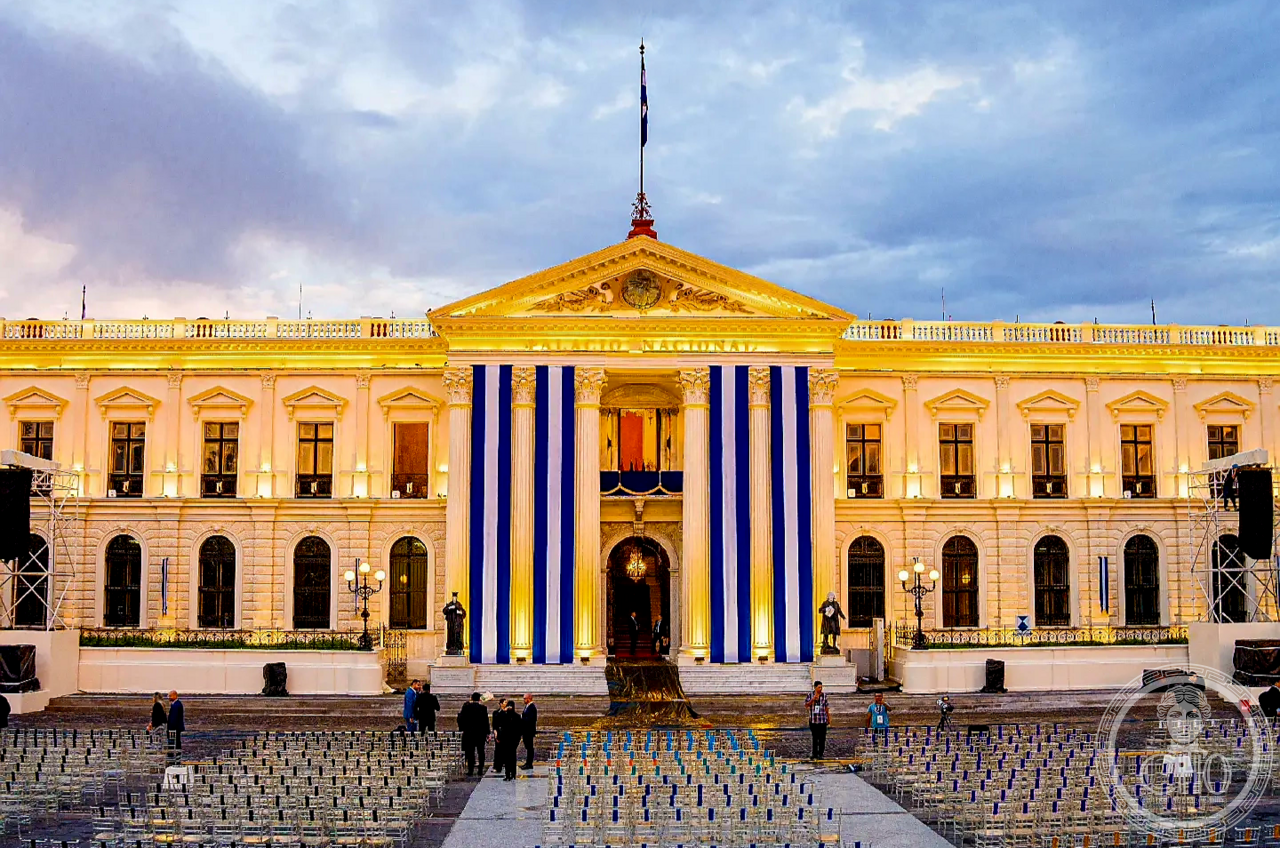
National Palace of El Salvador
The most important historic monument in Central America, San Salvador's National Palace took sixteen years to build and survived catastrophic earthquakes to become the nation's finest example of eclectic European revivalism – now housing the national history museum in four legendary ceremonial salons.
At a glance
- Type
- Government palace / National museum
- Period
- 1895-1911
- Style
- Neo-Gothic / Renaissance Revival
- Location
- Historic center, San Salvador, El Salvador
- Coordinates
- 13.6994, -89.1916
- Architect
- Jose Felipe Peralta, with Italian craftsmen
Overview
The National Palace of El Salvador rises from the heart of San Salvador's historic center as a massive Gothic Revival and Renaissance palace completed in 1911 after sixteen years of construction. Italian craftsmen were brought to El Salvador to execute the tiled ceilings, stained glass, and marble floors; the exterior presents Gothic arched windows, turrets, Renaissance cornices, and a colonnaded loggia in pale stone. The building contains four grand ceremonial salons named for the metals used in their decoration: the Gold Room, Silver Room, Rose Room, and Blue Room. In 2004 the executive branch relocated to a modern facility and the palace was converted into the National Museum, housing the permanent collection of Salvadoran history and pre-Columbian artifacts.
History
El Salvador's earlier government buildings were repeatedly destroyed by the earthquakes that periodically devastate the capital. When construction of the current palace began in 1895 under President Carlos Ezeta, the project was conceived as a permanent, earthquake-resistant seat of government that would also project Central American ambitions onto the world stage. The sixteen-year construction period reflected both technical challenges and political instability; multiple presidents oversaw different phases of the work. Italian master craftsmen were contracted specifically for the interior decoration, giving the building a character distinct from purely local traditions. The 1986 San Salvador earthquake, which killed 1,500 people and devastated large parts of the city, left the palace with only minor structural damage – a vindication of its construction. Its conversion to a museum in 2004 preserved the building while opening it permanently to the public.
Architecture and Design
Architect Jose Felipe Peralta designed the palace in an eclectic style that draws simultaneously from Gothic Revival and Italian Renaissance sources, a combination characteristic of ambitious Latin American institutional architecture at the turn of the twentieth century. The exterior features pointed Gothic arched windows, corner turrets, a Renaissance-derived cornice, and a colonnaded loggia across the main facade in pale yellow-gray stone. The interior is organized around four ceremonial salons, each decorated with a different precious or semi-precious material: the Gold Room was used for presidential inaugurations and features gilded surfaces and carved mahogany; the Silver Room, Rose Room, and Blue Room served different ceremonial functions. Italian craftsmen executed the coffered and tiled ceilings, stained glass windows, and marble floors that distinguish these spaces from anything else in Central America.
Cultural significance
The National Palace is the primary architectural monument of El Salvador and the building most closely associated with the country's national identity. Its survival through successive earthquakes while the city around it was repeatedly rebuilt gives it an almost mythological status in Salvadoran consciousness. The four ceremonial salons – particularly the Gold Room where every president from 1911 to 2004 was inaugurated – represent the physical continuity of Salvadoran statehood through civil wars, dictatorships, and democratic transitions. The palace's conversion to the National Museum in 2004 transformed it from a symbol of executive power into a monument open to all citizens, reinforcing its role as a shared national heritage site.
Visiting today
The National Palace / National Museum is open to the public with free entry. The four ceremonial salons are the primary attraction, along with the permanent collection of Salvadoran pre-Columbian artifacts and historical objects. The palace occupies an entire city block on the Plaza Gerardo Barrios in the historic center of San Salvador, facing the Metropolitan Cathedral. It is best combined with visits to the cathedral, the nearby Teatro Nacional, and the Parque Libertad.
Getting there
The National Palace is located on Plaza Gerardo Barrios in central San Salvador, accessible by multiple urban bus routes (routes 30, 42, and 101 stop nearby). The historic center is approximately 3 km from the Zona Rosa hotel district; taxis and rideshare services are readily available. The palace is directly adjacent to the Metropolitan Cathedral of the Holy Savior and a short walk from the Teatro Nacional de El Salvador.
Sources and resources
Find it on the map
See this place and what’s around it →📷 Diventa un fotografo di Cultural Heritage Online
Condividi le tue foto dei luoghi: restano pubblicate con la tua firma come autore. Più vengono viste, più ti fai conoscere — e presto un concorso premierà le foto più apprezzate.
Accedi o registrati gratis per aggiungere una fotoDo you manage this place?
This page is read by travellers and heritage enthusiasts who find it on Google. Keep it accurate — and make it work for you. Free for non-profit heritage institutions.