
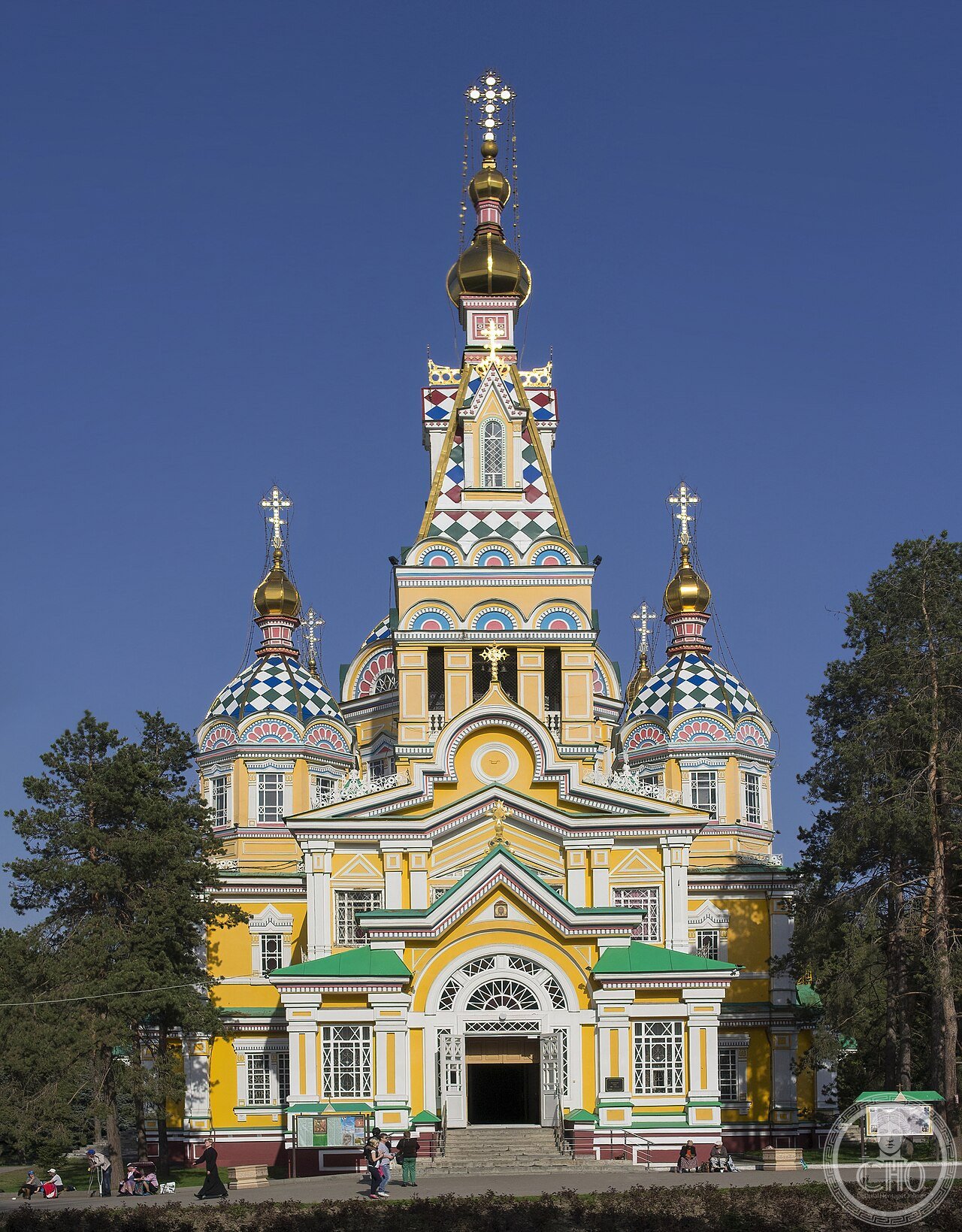
One of the world tallest wooden structures at 56 metres, built entirely without nails and the only building in the region to survive the catastrophic 1910 Kebin earthquake – a feat of earthquake-resistant timber engineering wrapped in vivid Tsarist-era ornament.
At a glance
- Type
- Russian Orthodox Cathedral
- Period
- 1904-1907
- Style
- Russian Revival
- Location
- Panfilov Park, Almaty, Kazakhstan
- Coordinates
- 43.2517, 76.9499
- Architect
- Paul Zenkov
Overview
The Ascension Cathedral of Almaty, universally known as Zenkov Cathedral after its designer, is one of the tallest wooden buildings in the world at 56 metres and was constructed entirely without metal nails, using traditional timber joinery techniques. Built in the Russian Revival style between 1904 and 1907 in what was then the city of Verniy, it served as the spiritual centre of the Russian settler community in Central Asia. Today, painted in vibrant pastel greens, whites, and sky blues, it stands in Panfilov Park as the most recognisable and photographed building in Almaty, attracting visitors from across Kazakhstan and the wider region.
History
Russian military engineer Paul Zenkov designed the cathedral at the request of the Russian imperial administration in Verniy (renamed Almaty in the Soviet era). Construction began in 1904 and was completed in 1907, using locally sourced Tian Shan fir timber harvested from the mountain forests above the city. The choice of timber over brick was deliberate: Verniy sat in a seismically active zone and had already suffered a major earthquake in 1887. When the Kebin earthquake (magnitude 7.7) struck in 1910, it devastated brick and stone buildings across the Semirech region. The wooden cathedral suffered only minor plaster cracks and remained structurally intact – a remarkable vindication of Zenkov design. During Soviet rule, the cathedral was seized in 1929 and converted successively into a Pioneer House for communist youth activities, a local history museum, and a film archive. It was returned to the Russian Orthodox Church in 1995 after Kazakhstan independence.
Architecture and Design
The cathedral exemplifies the Russian Revival style, drawing on Byzantine and Old Russian church architecture filtered through the academic eclecticism of the late 19th century. Five onion domes – the central one rising 56 metres – crown a cruciform plan with an elaborate wooden bell tower at the western end. The exterior is clad in intricately carved wooden panels painted in a palette of sky blue, pistachio green, and white, with gilded dome caps that catch the afternoon light from the Tian Shan range behind. The construction used no metal nails: all joints are traditional wooden pegs and interlocking tenon joints, giving the structure its remarkable flexibility during seismic events. The interior features elaborate iconostasis work, painted vaults, and hanging chandeliers original to the 1907 construction.
Cultural significance
The Zenkov Cathedral represents the architectural ambition of Russian imperial expansion into Central Asia – an attempt to transplant Orthodox Christian culture into a predominantly Muslim, nomadic landscape. Its survival of the 1910 earthquake while surrounding masonry collapsed has given it an almost mythic status in the region as a building that embodies the superiority of traditional timber construction over imported European brick technology. Today it is a symbol of Almaty itself and of the multi-ethnic, multi-faith character of modern Kazakhstan, where it coexists alongside mosques and Soviet-era monuments as an equal part of the city identity.
Visiting today
The cathedral is open for worship and visitors daily. Services are conducted in Russian by the Russian Orthodox community of Almaty. The surrounding Panfilov Park is one of the city main green spaces and contains the Memorial of Glory – a monument to the 28 Panfilov guardsmen of World War II – making the park itself a heritage destination. Photography of the exterior and interior (outside service times) is generally permitted. The cathedral is within easy walking distance of the Almaty metro and the central Arbat pedestrian boulevard.
Getting there
The cathedral stands in Panfilov Park in central Almaty, accessible on foot from most central hotels. The nearest metro station is Alatau on Green Line 1. Multiple bus routes serve Panfilov Park. Almaty International Airport is approximately 15 km northeast of the city centre, connected by bus, taxi, and the airport express. From the airport, taxis to the centre take 20-40 minutes depending on traffic.
Sources and resources
Find it on the map
See this place and what’s around it →Record researched and written by Luigi De Marchi for Cultural Heritage Online, 2026.
📷 Become a Cultural Heritage Online photographer
Share your photos of places: they stay published under your name as the author. The more they're seen, the more you get noticed — and soon a contest will reward the most appreciated photos.
Log in or sign up free to add a photoIs this page about you?
This page is read by travellers and heritage enthusiasts who find it on Google. Tell us how you are connected to this place and we will take it from there.