
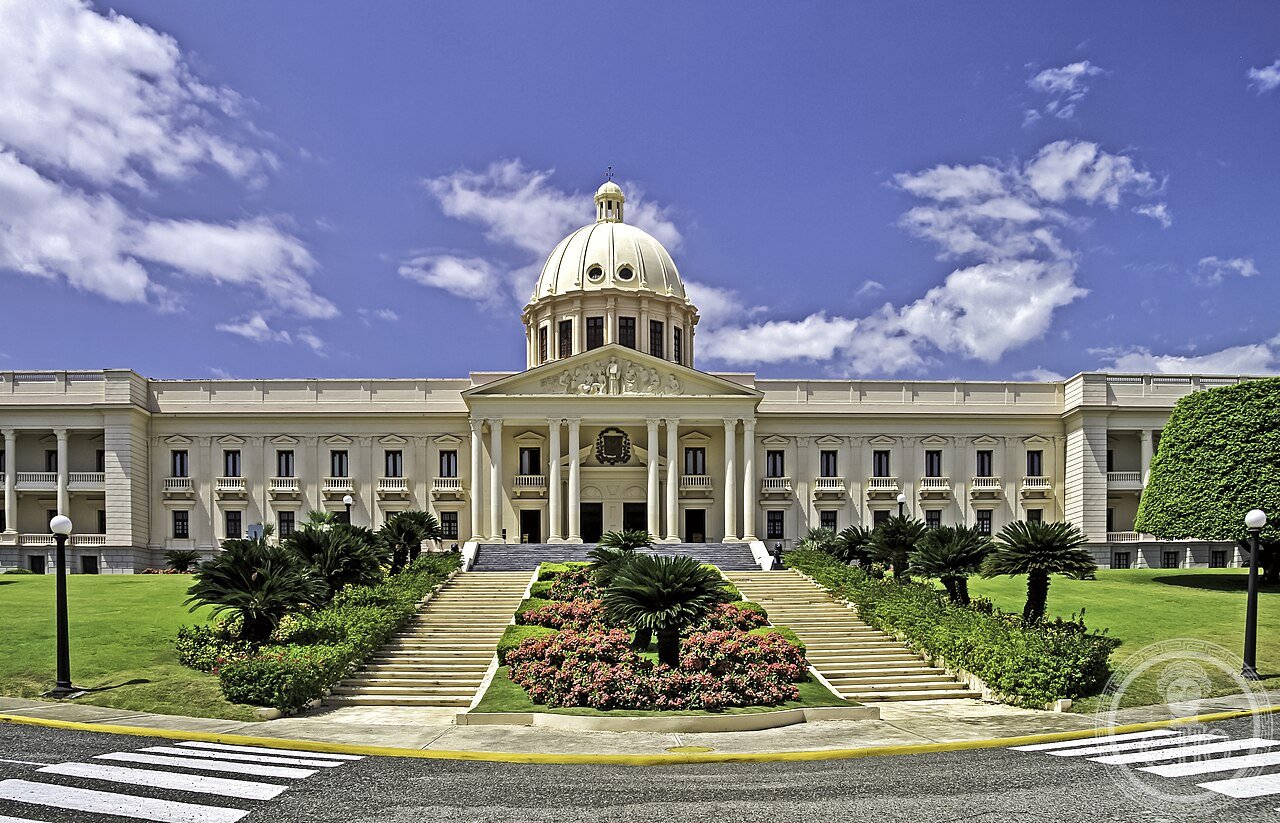
The grand white palace at the heart of Santo Domingo has served as the seat of Dominican executive power since 1947, blending colonnaded Neoclassicism with Art Deco ornament and sheltering the Hall of Caryatids – one of the most remarkable interiors in the Caribbean.
At a glance
- Type
- Presidential palace
- Period
- 1944-1947
- Style
- Neoclassical / Art Deco
- Location
- Gazcue, Santo Domingo, Dominican Republic
- Coordinates
- 18.4741, -69.9008
- Architect
- Henry Gazue
Overview
The National Palace of the Dominican Republic stands in the historic Gazcue neighborhood of Santo Domingo, near the UNESCO World Heritage Colonial City. Italian-born architect Henry Gazue designed the building for dictator Rafael Trujillo in an eclectic style that combines a colonnaded Neoclassical facade with Art Deco ornamental details throughout the interior. The central dome rises above a T-shaped plan; 270 mahogany doors and windows line the corridors. Its most celebrated space – the Hall of Caryatids – features 44 sculpted female figures supporting the ceiling in a direct reference to the Erechtheion of Athens. The building has served as the site of every Dominican presidential inauguration since its completion.
History
Rafael Trujillo, who ruled the Dominican Republic from 1930 to 1961, ordered construction of a new presidential palace as a centerpiece of his modernization program. The previous government house was considered inadequate for the image of a modernizing state. Italian architect Henry Gazue was commissioned; construction ran from 1944 to 1947. Trujillo used the palace as a stage for state ceremonies and foreign visits, presenting himself as the builder of modern Dominican institutions. After Trujillo's assassination in 1961, the palace continued as the seat of executive power through democratic transitions and successive governments. The building's location near the Colonial City – the first permanent European settlement in the Americas – places it at the intersection of colonial and modern Dominican identity.
Architecture and Design
Henry Gazue combined Neoclassical vocabulary with Art Deco interior decoration in a manner typical of 1940s Latin American state architecture. The exterior presents a symmetrical facade with a central columned portico, white-rendered walls, and a shallow dome above the crossing of the T-shaped plan. The interior moves from formal Neoclassicism at the entrance into increasingly ornate Art Deco spaces deeper in the building. The Hall of Caryatids is the masterwork: 44 carved female figures, each different, support an elaborately coffered ceiling above a polished marble floor. The 270 mahogany doors and windows throughout the palace represent one of the largest commissions of fine woodwork in Caribbean institutional architecture. The overall composition is grand but not oversized – calibrated to Dominican proportions rather than imperial ones.
Cultural significance
The National Palace occupies an ambiguous but central place in Dominican collective memory: it was built as a monument to authoritarian power yet has outlasted the dictatorship to become the stage for democratic transitions and constitutional ceremonies. Every Dominican president since 1947 has been inaugurated here, making the building a continuous thread through a turbulent political history. Its proximity to the Colonial City – where the first Spanish colonial institutions in the Americas were built – creates a palimpsest of governance stretching from 1496 to the present. The Hall of Caryatids is widely regarded as the finest institutional interior in the country.
Visiting today
Entry is free; guided tours are available by appointment through the Ministry of the Presidency. The palace is located in the Gazcue neighborhood, within easy reach of the Zona Colonial (approximately 1 km). The Hall of Caryatids and the central dome rotunda are the primary spaces included in public tours. The building is best combined with a visit to the adjacent UNESCO Colonial City, the Cathedral of Santa Maria la Menor, and the Alcazar de Colon.
Getting there
The National Palace is located on Avenida Dr. Delgado in Gazcue, Santo Domingo. It is accessible by public concho (shared minibus) along Avenida Independencia or by taxi from the Zona Colonial (5-10 minutes drive). The palace is a short walk from the Parque Independencia, which marks the boundary between the Colonial City and the modern center.
Sources and resources
Find it on the map
See this place and what’s around it →📷 Become a Cultural Heritage Online photographer
Share your photos of places: they stay published under your name as the author. The more they're seen, the more you get noticed — and soon a contest will reward the most appreciated photos.
Log in or sign up free to add a photoDo you manage this place?
This page is read by travellers and heritage enthusiasts who find it on Google. Keep it accurate — and make it work for you. Free for non-profit heritage institutions.