
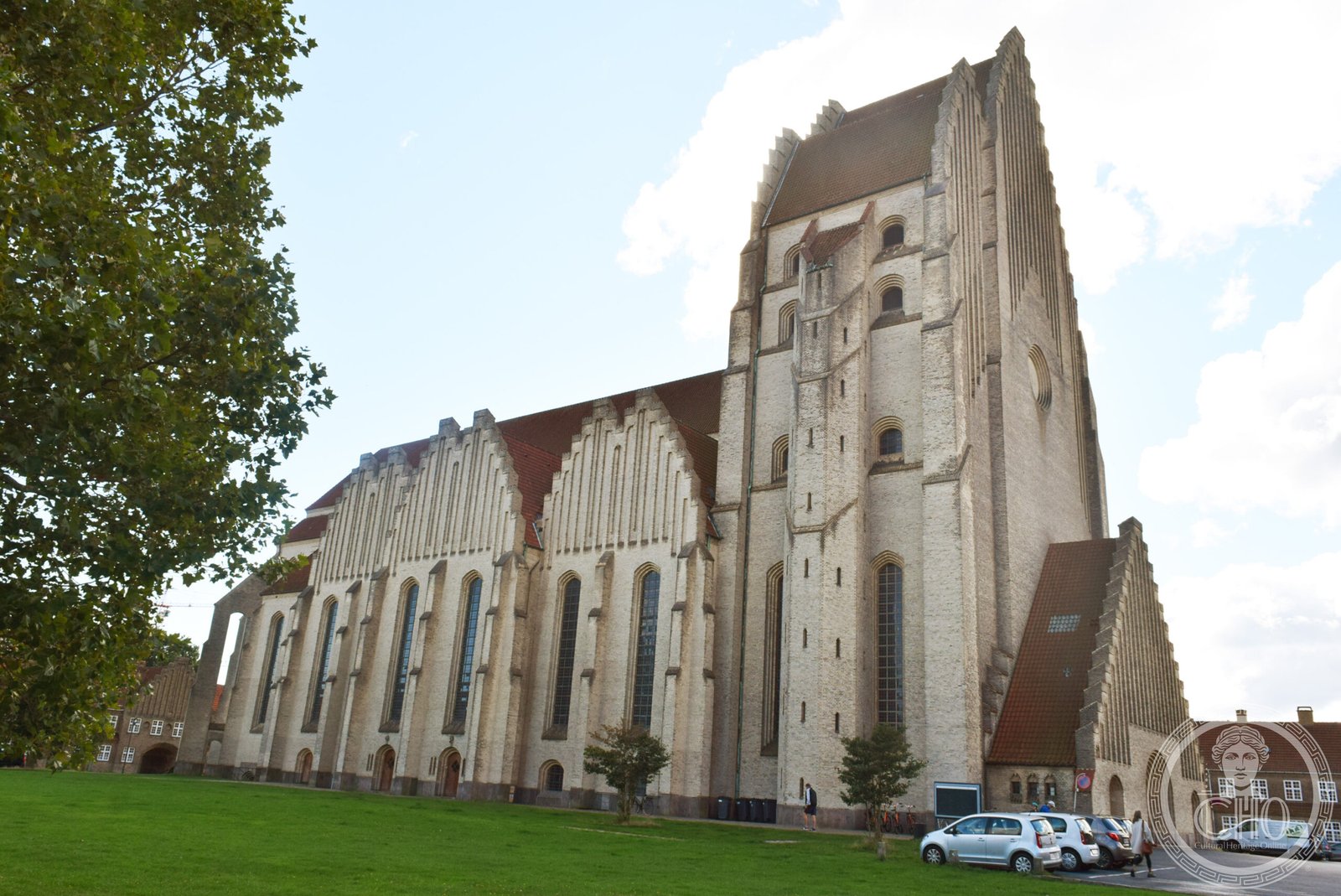
Grundtvig’s Church — Grundtvigs Kirke in Danish — stands in the Bispebjerg district of Copenhagen as one of the most extraordinary pieces of sacred architecture of the twentieth century. Designed by Peder Vilhelm Jensen-Klint beginning in 1913 and completed by his son Kaare Klint in 1940, the church is built entirely from 6.5 million handmade yellow Danish bricks arranged in vertical fluted rhythms that evoke the pipes of a massive church organ. The composition is simultaneously medieval — rooted in the Nordic Gothic brick church tradition — and radically Expressionist, in dialogue with the bold brick Expressionism then emerging in Hamburg and Amsterdam. The church was conceived as a memorial to the theologian, bishop, and folk-culture reformer N.F.S. Grundtvig (1783–1872), who founded the Danish Folk High School movement and shaped modern Danish national identity. Its 49-metre nave, luminous interior, and awe-inspiring organ-pipe gable have made it a pilgrimage site for architects and a beloved landmark for Copenhageners. Entry is free and the church remains an active Lutheran parish.
At a glance
- Type
- Lutheran church
- Period
- 1927–1940 (designed from 1913)
- Style
- Expressionist / Brick Gothic
- Location
- På Bjerget 14B, 2400 Copenhagen NV, Denmark
- Coordinates
- 55.7166° N, 12.5336° E
- Architect(s)
- P.V. Jensen-Klint; completed by Kaare Klint
Overview
Grundtvig’s Church is the largest and most ambitious Danish church built since the Reformation, and the most internationally celebrated work of Danish early-twentieth-century architecture. Jensen-Klint spent two decades refining the design before the foundation stone was laid in 1921, and the building was completed only in 1940 — six years after the architect’s death in 1930. The result is a building that belongs simultaneously to the past and the avant-garde: a Nordic brick Gothic tradition pushed to Expressionist extremes. The church gave Kaare Klint his first major commission and shaped Danish Functionalist design thinking for a generation.
History
The idea of a church honouring N.F.S. Grundtvig was first proposed at the centenary of his birth in 1883, but Jensen-Klint did not receive the commission until 1913. He rejected historicist revival styles in favour of a creative reinterpretation of the North German and Danish brick Gothic tradition. A competition design was approved in 1921 and the foundation stone laid the same year; construction of the nave began in 1927. Jensen-Klint died in 1930 having completed only the nave shell. His son Kaare Klint — already famous as the founder of the furniture design programme at the Royal Danish Academy — took over and completed the tower, side aisles, and interior furnishings, consecrating the church in 1940. The surrounding Bispebjerg neighbourhood was simultaneously developed as an exemplary garden-suburb workers’ quarter, and the church anchors this ensemble.
Architecture & Design
The defining element is the west facade: a stepped gable of extraordinary verticality in which rows of yellow brick fins rise like organ pipes, accelerating toward the sky. The 49-metre nave is the tallest in Denmark. Inside, the walls are entirely of exposed yellow brick — no applied ornament whatsoever — and the effect is of an immense luminous cave of warm golden light filtered through clear and pale-tinted windows. Kaare Klint designed the interior furnishings — pews, altarpiece, baptismal font, light fixtures — in a spare Nordic Classicist idiom that complements the Expressionist shell. The organ, installed in 1965, has 4,958 pipes; the case was designed by Kaare Klint. Some 6.5 million handmade bricks were used in construction, all Danish-fired to a specific yellow-buff colour.
Cultural significance
Grundtvig’s Church is a monument to Danish cultural identity as much as to religious faith. N.F.S. Grundtvig’s Folk High School movement — which democratised education and emphasised Nordic mythology, living tradition, and communal song — is foundational to the Danish social model. The church embodies the same values in bricks: democratic, rooted, handcrafted, and Nordic. For architects it represents a pivotal moment in European Expressionism, standing alongside Hans Poelzig’s Grosses Schauspielhaus and Fritz Höger’s Chilehaus as proof that brick could be a vehicle for radical modernity. It influenced Louis Kahn, who cited it as a formative inspiration for his later brick monumentalism.
Visiting today
The church is open to visitors daily, typically 09:00–16:00 (check current hours on the parish website as they vary seasonally). Entry is free. Sunday services are held at 10:00. Photography is permitted. The interior acoustics are exceptional and organ concerts are held regularly. Guided tours can be arranged for groups. Allow at least 45 minutes to explore the interior and exterior fully.
Getting there
Bus lines 5C and 350S stop at Grundtvigs Kirke, a short walk from the entrance. The nearest S-tog station is Bispebjerg, approximately 15 minutes on foot. From Copenhagen Central Station (København H), take bus 5C northbound — journey time approximately 25 minutes. By bicycle, the church is 20 minutes from the city centre via the Nørrebrogade cycle lane. Copenhagen Airport (CPH) is approximately 40 minutes away by S-tog.
Sources & resources
Find it on the map
See this place and what’s around it →📷 Diventa un fotografo di Cultural Heritage Online
Condividi le tue foto dei luoghi: restano pubblicate con la tua firma come autore. Più vengono viste, più ti fai conoscere — e presto un concorso premierà le foto più apprezzate.
Accedi o registrati gratis per aggiungere una fotoDo you manage this place?
This page is read by travellers and heritage enthusiasts who find it on Google. Keep it accurate — and make it work for you. Free for non-profit heritage institutions.