
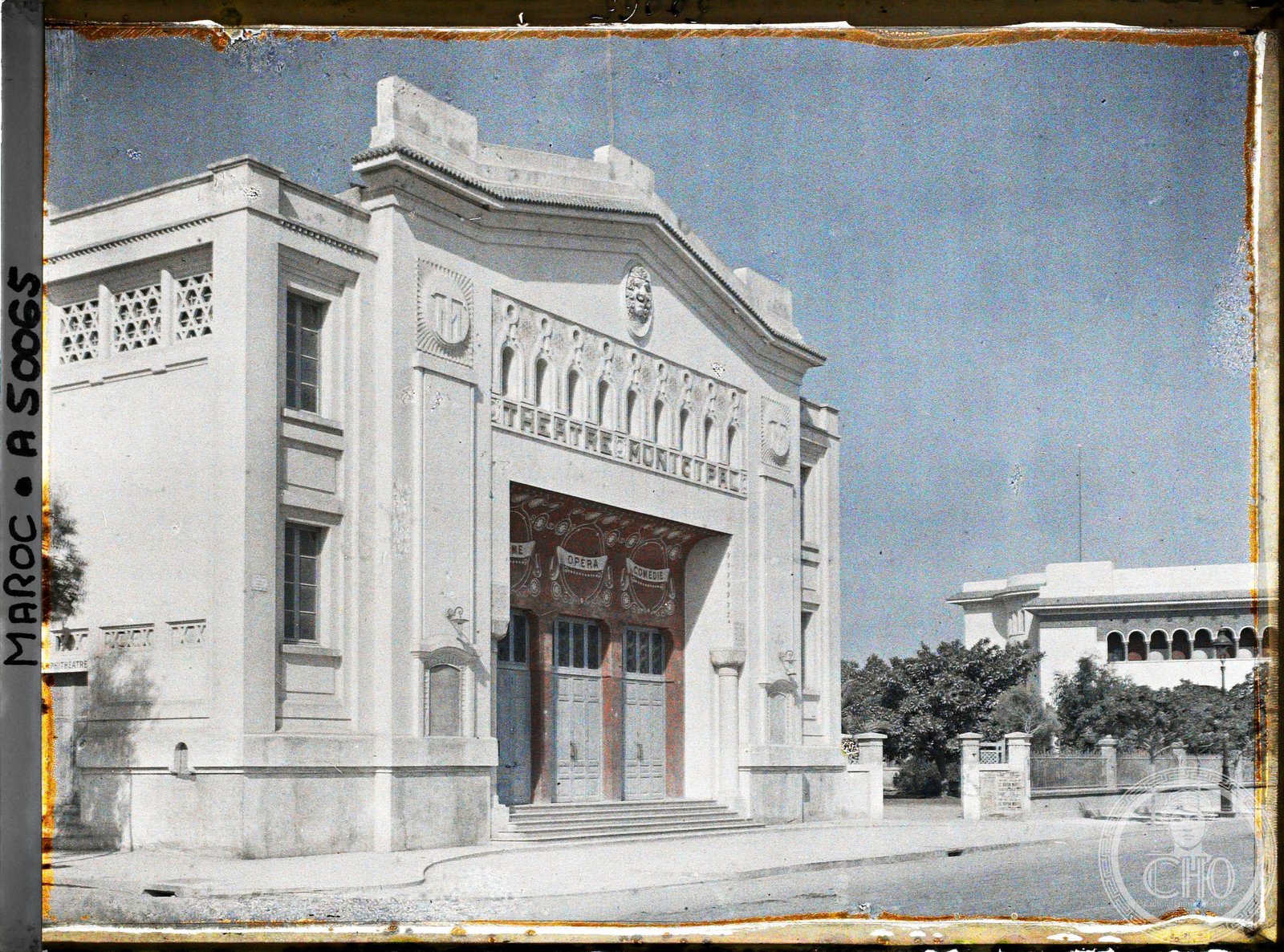
Théâtre Municipal de Casablanca
Inaugurated in the early 1920s under the patronage of Maréchal Hubert Lyautey, the Resident-General who shaped the modern face of French Morocco, the Théâtre Municipal de Casablanca stood for decades as one of the earliest and most elegant Art Deco public buildings in North Africa. Situated on the grand Boulevard Mohamed V—the spine of the European quarter laid out under Lyautey’s urban vision—the theatre brought opera, drama, and colonial social life to a rapidly growing port city. Its ornate facade combined French Beaux-Arts confidence with early Deco ornamental vocabulary, signalling Casablanca’s ambition to be a Mediterranean capital of culture as much as commerce. The building was demolished in 1984, but its legacy endures in the architectural DNA of the boulevard that remains a UNESCO-recognised heritage zone.
At a glance
- Type
- Municipal Theatre (demolished 1984)
- Period
- c. 1920–1922
- Style
- French Colonial / Art Deco
- Location
- Boulevard Mohamed V, Casablanca, Morocco
- Coordinates
- 33.5950° N, 7.6187° W
- Architect(s)
- French colonial architects working under the Direction des Travaux Publics
Overview
The Théâtre Municipal was the cultural centrepiece of the European city that French urban planners built alongside the historic medina of Casablanca from 1912 onward. Lyautey’s policy of building a separate new city rather than penetrating the medina gave the theatre a prominent role on the main ceremonial boulevard. It served the French settler community and an international audience of merchants, diplomats, and visitors, hosting theatrical and operatic productions through the colonial period and into Moroccan independence in 1956. It continued operating until its demolition in 1984, when it was replaced by more recent development.
History
Casablanca’s transformation under the French Protectorate (established 1912) was one of the most rapid urban expansions in the history of the Arab world. Lyautey commissioned architect Henri Prost to design the new European city on a grid of wide boulevards, and the Municipal Theatre was among the first public monuments built to anchor this plan. Inaugurated in the early 1920s, it opened with Lyautey himself presiding over the ceremony. Through the 1930s and 1940s the theatre was the premier cultural venue in Morocco. After independence the building served Moroccan audiences. By the 1980s, changing urban priorities led to its demolition, a loss mourned by preservationists who had begun to recognise the Art Deco boulevard as an exceptional heritage ensemble.
Architecture & Design
The theatre’s design reflected the eclectic French colonial aesthetic of the early 1920s, combining a classical tripartite façade—rusticated base, piano nobile with arched windows, and decorative attic—with emerging Art Deco ornamental motifs: stylised foliage, geometric friezes, and bold mouldings. The building’s scale and material quality were intended to project authority and permanence, anchoring the new city’s ceremonial boulevard. Photographs from the colonial period show an imposing street presence that contributed to the coherent architectural character of Boulevard Mohamed V, now recognised by UNESCO as part of Casablanca’s twentieth-century heritage.
Cultural significance
The Théâtre Municipal de Casablanca represents the ambition of French colonial urbanism to transplant European cultural institutions into North Africa, and the complex negotiations of identity—colonial, settler, Moroccan—that those institutions embodied. Boulevard Mohamed V, of which the theatre was the social heart, was inscribed on the UNESCO World Heritage List in 2012 as an outstanding example of twentieth-century urban planning and Art Deco architecture. The theatre’s absence today makes it a symbol of the fragility of colonial-era heritage and the contested nature of architectural memory in post-independence Morocco.
Visiting today
The original theatre no longer stands, having been demolished in 1984. Visitors interested in the context of the building can walk Boulevard Mohamed V, a UNESCO World Heritage Site, where many contemporaneous Art Deco buildings from the 1920s–1940s survive. The Mohammed V Theatre, a mid-century replacement venue nearby, continues to host performances. The Casablanca Art Deco trail along the boulevard is one of the richest concentrations of interwar architecture in Africa.
Getting there
Boulevard Mohamed V is in central Casablanca, served by the city’s tramway network (Tram T1 and T2) with stops along or near the boulevard. Casa-Port and Casa-Voyageurs railway stations are both within walking distance. Mohammed V International Airport is approximately 30 kilometres from the city centre, connected by direct train (ONCF) to Casa-Voyageurs in under 45 minutes. Taxis and rideshare services operate throughout the city.
Sources & resources
Find it on the map
See this place and what’s around it →📷 Diventa un fotografo di Cultural Heritage Online
Condividi le tue foto dei luoghi: restano pubblicate con la tua firma come autore. Più vengono viste, più ti fai conoscere — e presto un concorso premierà le foto più apprezzate.
Accedi o registrati gratis per aggiungere una fotoDo you manage this place?
This page is read by travellers and heritage enthusiasts who find it on Google. Keep it accurate — and make it work for you. Free for non-profit heritage institutions.