
Four hundred kilometres of the Rhine River formed the northwestern edge of the Roman world for more than four centuries — a frontier where legions guarded the wealthiest provinces of the Empire against the Germanic world beyond the far bank.
At a glance
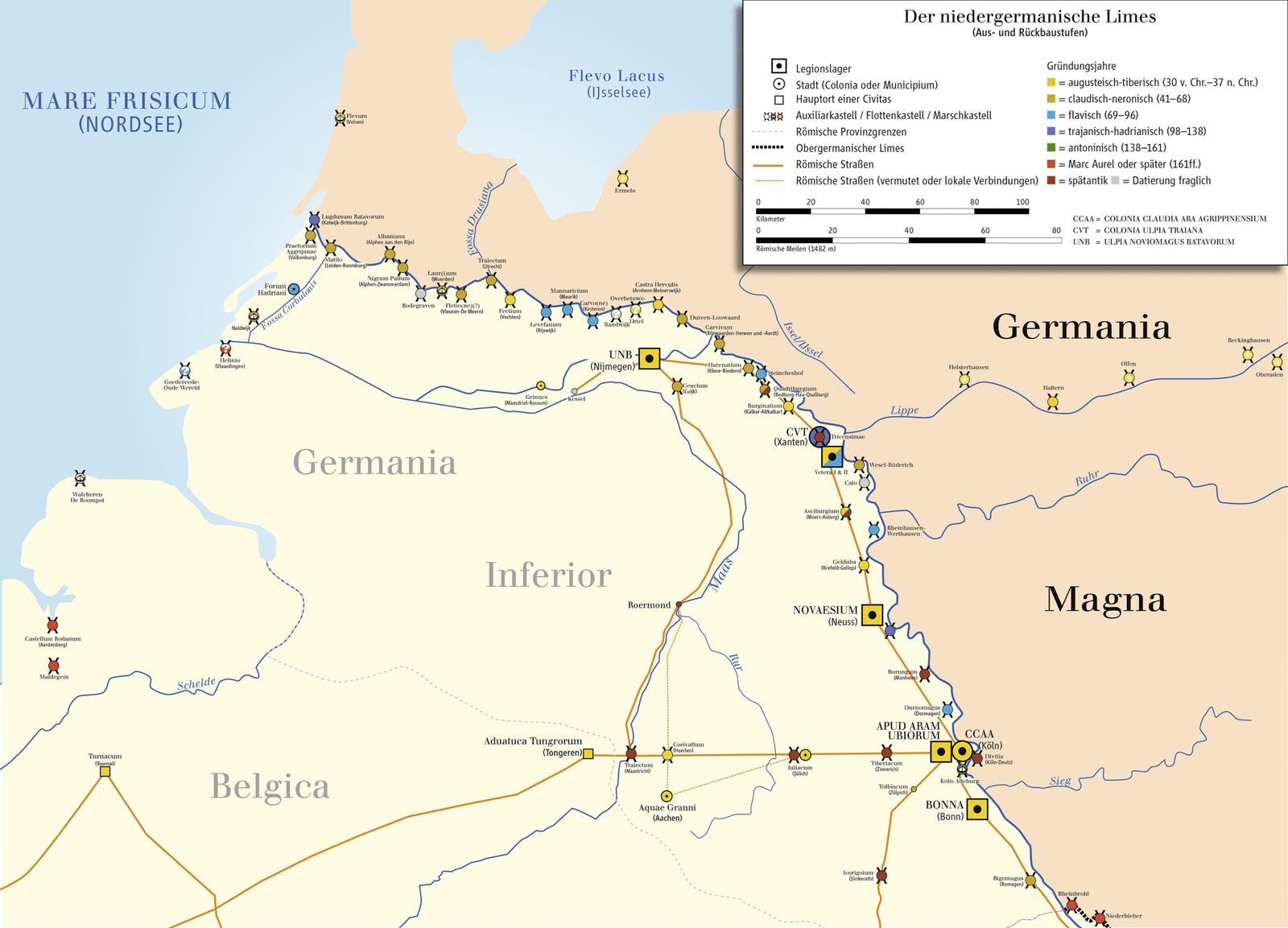
Inscribed as a UNESCO World Heritage Site in 2021 as an extension of the existing Frontiers of the Roman Empire serial property, the Lower German Limes (Limes Germanicus Inferior) traces the Rhine from the North Sea coast through the Netherlands and into the German state of North Rhine-Westphalia. Unlike Hadrian’s Wall or the Upper German Limes, this frontier used the Rhine itself as its primary defensive barrier — the river was the wall. Along the southern bank the Romans built a continuous chain of legionary fortresses, auxiliary forts, watchtowers, signal stations, harbours, and roads, backed by the civilian settlements (canabae and vici) that inevitably grew wherever soldiers gathered.
The inscription encompasses over 100 individual monuments and archaeological sites stretching across the Netherlands and Germany, representing the most extensive surviving evidence of Rome’s Rhine frontier system anywhere in Europe.
Key facts
- UNESCO inscription: 2021, extension of the Frontiers of the Roman Empire WHS.
- Length of frontier: approximately 400 km along the Rhine.
- Countries: Netherlands and Germany (North Rhine-Westphalia).
- Operational period: c. 12 BCE to 406 CE.
- Principal sites: Xanten (Colonia Ulpia Traiana), Nijmegen (Noviomagus Batavorum), Valkenburg, Woerden, Vechten, Lobith.
- River used as barrier: Rhine (Rhenus).
- Garrison: Two full Roman legions (Legio I Minervia at Bonn, Legio XXX Ulpia Victrix at Xanten) plus numerous auxiliary units.
History
Rome’s encounter with the Germanic world beyond the Rhine was shaped decisively by one of the greatest military disasters in Roman history. In 9 CE, three Roman legions under Publius Quinctilius Varus were ambushed and annihilated by a Germanic coalition led by the Cheruscan chieftain Arminius in the forests of the Teutoburg Forest. The Battle of Teutoburg Forest ended Rome’s ambition to extend its empire to the Elbe River and forced a fundamental strategic recalculation: the Rhine would become the permanent frontier.
The Lower German Limes took its definitive shape under the Julio-Claudian and Flavian emperors. The system reached its greatest sophistication under Trajan and Hadrian in the early 2nd century CE, when a continuous chain of forts was completed along the entire southern bank of the Rhine. The frontier zone was not merely military — it was an economic and cultural boundary across which enormous volumes of trade moved, and where Roman and Germanic cultures interacted and blended.
The frontier held for nearly four centuries, subject to periodic raiding, diplomatic negotiation, and occasional penetration by Germanic federates. It finally collapsed in 406–407 CE when a massive coalition of Germanic peoples (Vandals, Alans, Suebi) crossed the frozen Rhine during one of the coldest winters in recorded history, effectively ending Roman control of the frontier zone.
What you see today
The most impressive surviving monument of the Lower German Limes is the Archaeological Park Xanten (Archäologischer Park Xanten), built on the site of Colonia Ulpia Traiana — one of the largest Roman cities north of the Alps, with a population of up to 15,000 at its height. The park features reconstructed Roman buildings including a monumental city gate, an amphitheatre capable of holding 12,000 spectators, a harbour temple, a guesthouse, and a craftsmen’s quarter. The on-site Regional Museum (LVR-RömerMuseum) houses one of the finest collections of Roman material culture in northern Europe.
In the Netherlands, Nijmegen (Roman Noviomagus Batavorum) preserves remains of the Castra Hunerberg legionary fortress and displays Roman artefacts in the Museum Het Valkhof. The riverside town of Valkenburg (Roman Praetorium Agrippinae) contains exceptionally well-preserved wooden fort structures from the 1st and 2nd centuries CE, preserved by waterlogged conditions. The Roman fort at Woerden (Laurum) yielded one of the best-preserved Roman river patrol boats ever found.
The Rhine itself, though much altered by modern engineering, still broadly follows the course that Roman soldiers patrolled for four centuries. The flat river plain, the polder landscapes of the Netherlands, and the wooded hills of the German Rhineland retain something of the frontier atmosphere — a landscape defined by the tension between the Roman world to the south and the Germanic wilderness to the north.
Practical information
- Main visitor centre: Archaeological Park Xanten, Trajanstraße 4, 46509 Xanten, Germany.
- Opening hours: March–November daily, hours vary by season; Museum open year-round (closed Mondays).
- Admission (Xanten): Combined park and museum ticket approximately €11 adults, reduced rates available.
- Netherlands sites: Museum Het Valkhof (Nijmegen) and Museum Castellum Hoge Woerd (Vleuten-De Meern near Utrecht) are key visitors’ points.
- Cycling routes: The Limes Cycling Route (Limesfietsroute) traces the frontier for 400 km through the Netherlands — one of the great historical cycling journeys in Europe.
- Language: German (Germany), Dutch (Netherlands); English widely spoken at major sites.
Getting there
- By rail to Xanten: Train to Xanten station via Kleve or Duisburg; Xanten is approximately 60 km northwest of Düsseldorf.
- By car: Xanten is reached via Autobahn A57 (exit Xanten); ample parking at the Archaeological Park.
- Nearest airports: Düsseldorf International (DUS, 70 km) and Amsterdam Schiphol (AMS, 150 km) are the principal international gateways.
- Nijmegen: Direct rail connections from Amsterdam (1h10), Utrecht (45 min), and Arnhem (15 min).
- Cross-border itinerary: The Limes Cycling Route links major Netherlands and German sites over 5–8 days by bicycle.
Nearby
- Cologne (Köln): 80 km south of Xanten — Roman Colonia Agrippinensium, with the Romano-Germanic Museum (Römisch-Germanisches Museum) housing the Dionysus Mosaic and the tomb of Poblicius.
- Bonn: 100 km south — site of the Castra Bonnensia legionary fortress, with the LVR-LandesMuseum Bonn containing extensive Roman collections.
- Trier (Augusta Treverorum): UNESCO-inscribed Roman city (1986), 200 km south — the best-preserved ensemble of Roman monuments in Germany, including the Porta Nigra and the Imperial Baths.
- Arnhem and Gelderland battlefields: The site of Operation Market Garden (1944) lies within sight of the Roman frontier landscape around Nijmegen.
Sources
- UNESCO World Heritage Centre — Frontiers of the Roman Empire – The Lower Germanic Limes (whc.unesco.org, 2021).
- LVR-Archäologischer Park Xanten — official site and museum catalogue.
- Willems, W.J.H. & van Enckevort, H. — Ulpia Noviomagus: Roman Nijmegen (2009).
- Wikipedia — Lower Germanic Limes, Colonia Ulpia Traiana, Noviomagus Batavorum.
Find it on the map
See this place and what’s around it →📷 Become a Cultural Heritage Online photographer
Share your photos of places: they stay published under your name as the author. The more they're seen, the more you get noticed — and soon a contest will reward the most appreciated photos.
Log in or sign up free to add a photo