
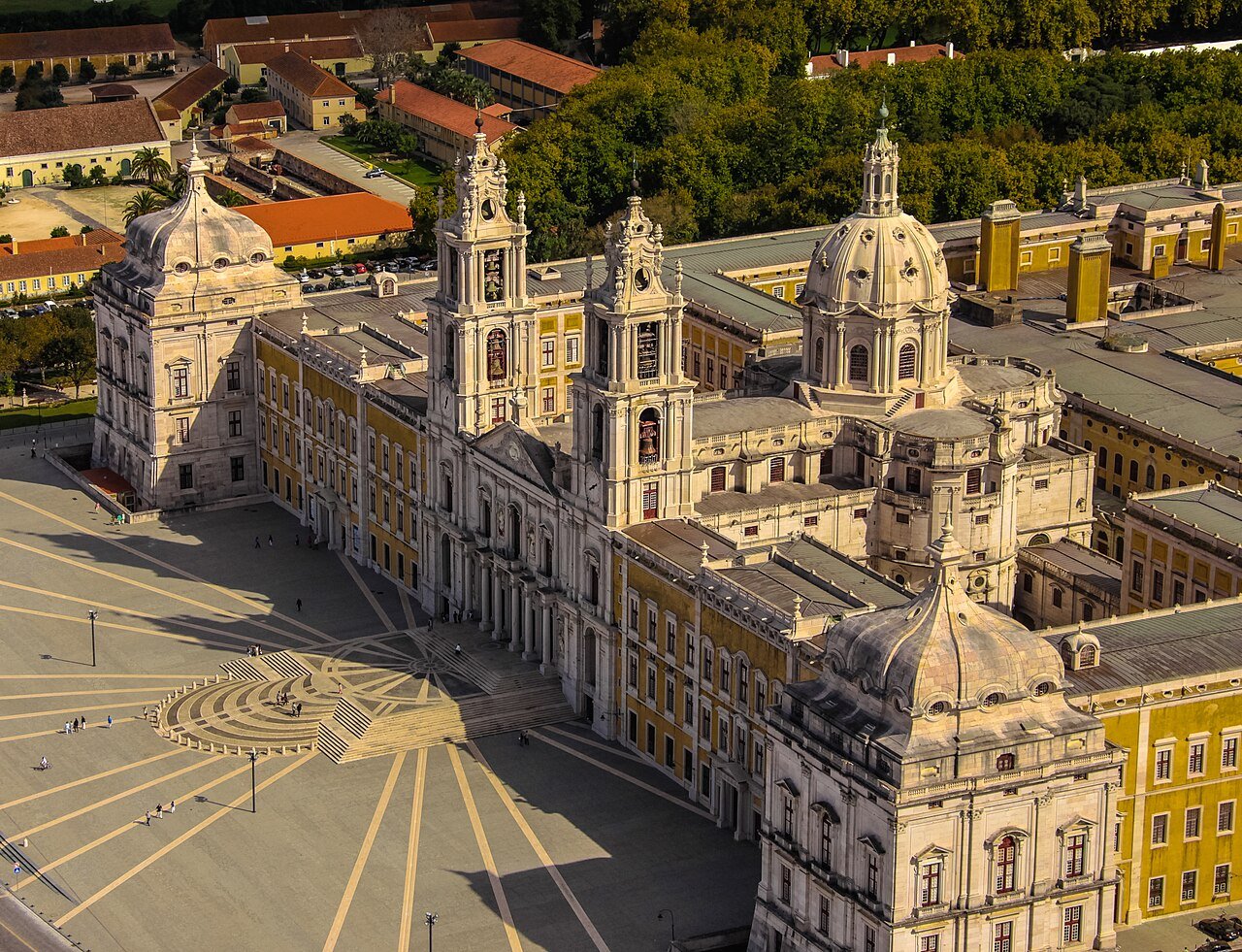
Built on the scale of a small city, the Royal Building of Mafra is Portugal’s most ambitious act of royal piety — a vast Baroque complex of palace, basilica, Franciscan convent and royal hunting park, raised by King João V using the wealth of the Brazilian gold rush. UNESCO World Heritage Site 2019, the largest Baroque monument in Portugal.
At a glance
When Brazilian gold began flowing into Lisbon after 1700, King João V resolved to build something on the scale of Spain’s Escorial. The result — begun in 1717 on a hilltop 40 km northwest of Lisbon — covers four hectares of floor area and at its peak engaged 45,000 workers. The UNESCO-inscribed complex encompasses palace, basilica, Franciscan convent, the formal Cerco Garden, and the Tapada: an 827-hectare hunting park still enclosed by its original 18-kilometre stone wall.
Key facts
- UNESCO inscription: 2019 — Cultural Heritage
- Built: 1717–1755 CE
- Patron: King João V of Portugal
- Style: Portuguese Baroque (inspired by the Escorial)
- Scale: approx. 4 hectares floor area; 1,200 rooms; 156 stairways
- Organs: 6 pipe organs in the basilica, still functional, among the finest 18th-century organs in Europe
- Carillon: 114 bronze bells — largest carillon collection in the world, 92 melodies
- Tapada: 827 hectares enclosed by 18 km of stone wall, active nature reserve
- Workers at peak: approximately 45,000
History
In 1711, João V vowed to build a Franciscan convent if God granted him children. A son arrived in 1714. As Brazilian gold revenues swelled — the Minas Gerais gold rush was at its peak — the initial plan for thirteen friars expanded into a royal palace, a basilica rivalling those of Rome, and a vast hunting park. The basilica was consecrated on the king’s 41st birthday in 1730; construction continued until 1755.
Italian marble arrived by ship, Flemish and Dutch bell-founders cast the carillon in Mechelen and Liège (1730–1733), and German organ-builders installed the six basilica organs. The project trained an entire generation of Portuguese Baroque architects who would later rebuild Lisbon after the 1755 earthquake. When Napoleon approached in 1807, the royal family fled to Brazil; the palace became a military barracks and the convent functioned until its dissolution in 1834.
What you see
The 232-metre façade is one of the longest Baroque palace fronts in Europe. The marble-clad basilica occupies the centre, flanked symmetrically by the royal apartments and the convent, with corner towers marking the four angles of the great rectangle — a plan deliberately echoing the Escorial’s grid.
Inside the basilica, every surface is faced in coloured marbles — pink, grey, white and black — in geometric patterns rising to the barrel vault. The six organs still perform regularly; when all six play together, the sound is considered extraordinary. The convent library holds approximately 36,000 volumes in a barrel-vaulted hall lined with gilded shelving. In the Tapada, deer and wild boar still roam within the 18-kilometre enclosure alongside Baroque-era fountains and hunting lodges.
Practical information
- Address: Terreiro Dom João V, 2640-492 Mafra, Portugal
- Hours: Wednesday–Monday 09:30–17:30 (last entry 17:00); closed Tuesday
- Admission: Combined ticket approx. €6; EU citizens under 26 free
- Carillon concerts: Sundays — confirm current times on site
- Photography: permitted without flash in most areas
- Tapada: guided tours only — tapadademafra.pt
Getting there
Mafra is 40 km northwest of Lisbon. Mafrense bus from Campo Grande station (Lisbon), approx. 1 hour, roughly hourly. By car: A8 motorway northwest from Lisbon, exit at Mafra; parking available in the town centre. No direct train service to Mafra.
Nearby
- Sintra (35 km south) — UNESCO-listed royal palaces; easily combined as a day trip
- Ericeira (12 km west) — Atlantic fishing village; World Surfing Reserve
- Óbidos (60 km north) — perfectly preserved medieval walled town
- Palácio de Queluz (30 km southeast) — the Portuguese Versailles
Sources
- UNESCO World Heritage List — Royal Building of Mafra (whc.unesco.org/en/list/1344)
- Wikipedia — Mafra National Palace (en.wikipedia.org/wiki/Mafra_National_Palace)
- Palácio Nacional de Mafra official site (pnmafra.pt)
- Tapada de Mafra (tapadademafra.pt)
Find it on the map
See this place and what’s around it →📷 Become a Cultural Heritage Online photographer
Share your photos of places: they stay published under your name as the author. The more they're seen, the more you get noticed — and soon a contest will reward the most appreciated photos.
Log in or sign up free to add a photo