
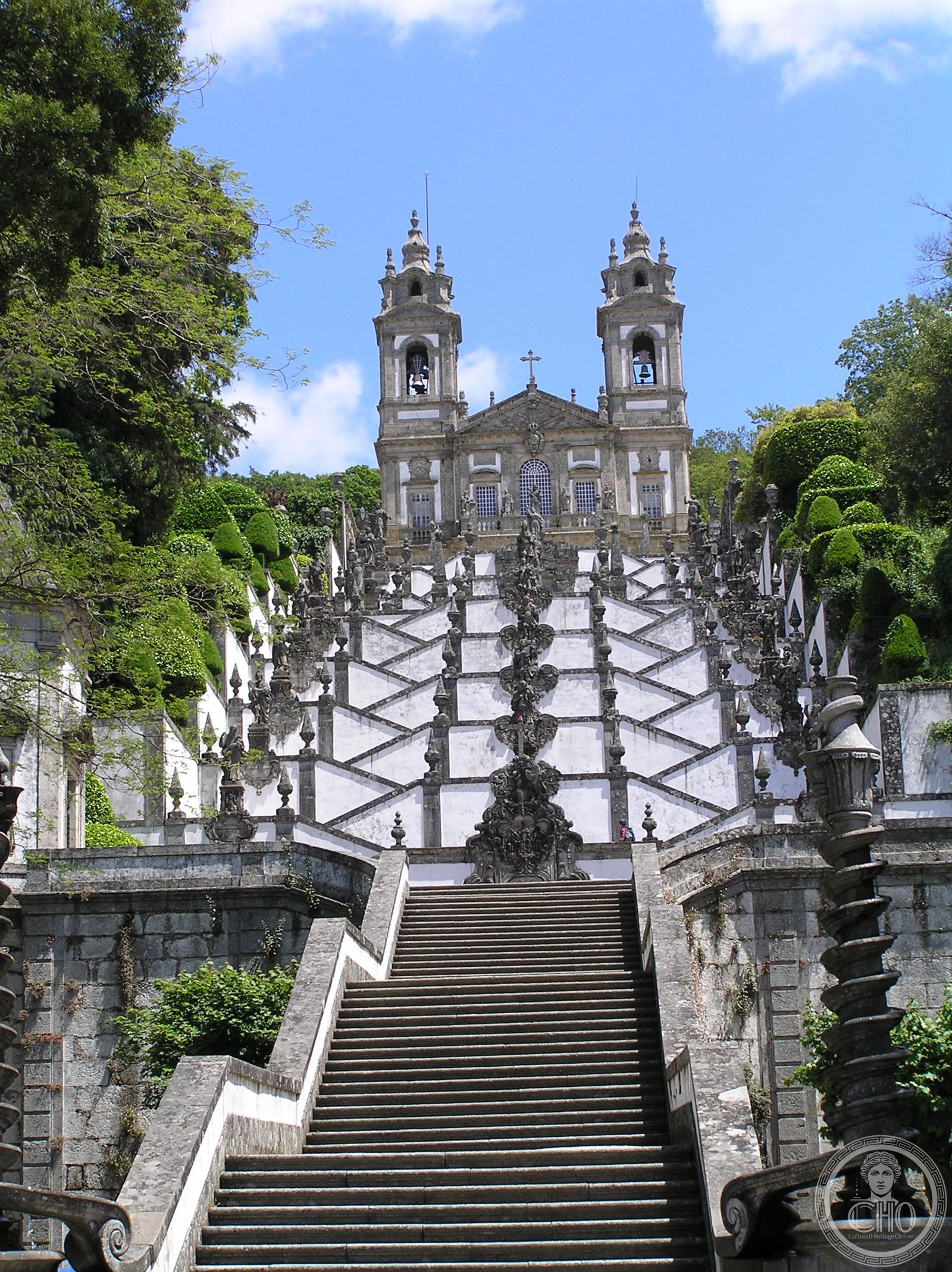
Rising 116 metres above Braga, the Sanctuary of Bom Jesus do Monte is one of the great pilgrimage landscapes of Europe — a celebrated Baroque staircase flanked by chapels, allegorical fountains and diorama scenes from the Passion, ascending to a neoclassical church that has drawn pilgrims on their knees since the 18th century. UNESCO World Heritage Site 2019.
At a glance
The sanctuary stands in the hills above Braga, northern Portugal’s oldest city. Its three-section staircase — the Staircase of the Five Senses, the Staircase of the Three Virtues, and the upper approach — descends 577 steps from the church terrace to the town below. At each landing, a fountain and chapel mark a station; the chapels contain dioramas of the Passion scenes, and pilgrims traditionally ascend on their knees as an act of penance. The sanctuary also contains one of the oldest funiculars in the world, still powered by a counterbalanced water system dating to 1882.
Key facts
- UNESCO inscription: 2019 — Cultural Heritage
- Built: Staircase from 1722; present church 1784–1834
- Style: Baroque staircase; neoclassical church
- Height: 116 metres above Braga
- Steps: 577 from bottom to church terrace
- Funicular: Elevador do Bom Jesus, built 1882, hydraulic counterbalance, one of the oldest in the world
- Staircase sections: Five Senses (lower) → Three Virtues (middle) → church approach (upper)
- Pilgrimage feast: second week of June each year
- Influence: directly inspired pilgrimage staircases across Brazil
History
A chapel on the hill above Braga is documented as early as the 14th century, and the site has been a pilgrimage destination since the Middle Ages. The elaborate staircase system was conceived in the early 18th century and built in stages: the earliest section dates to around 1722 under Archbishop Rodrigo de Moura Teles; later archbishops extended and embellished the staircase throughout the century.
The present Baroque-to-neoclassical church at the summit was built between 1784 and 1834, replacing an older structure. By then the staircase had become one of the most celebrated pilgrimage routes in the Iberian Peninsula. Portuguese missionaries and colonisers carried the model to Brazil, where staircases modelled on Bom Jesus — most famously the Sanctuary of Bom Jesus de Matosinhos in Rio de Janeiro — became a defining element of Brazilian Baroque architecture.
The hydraulic funicular was inaugurated in 1882, one of the earliest examples of a counterbalanced water-powered funicular anywhere. It uses a simple but elegant system: a full water tank at the top descends by gravity, pushing up the car at the bottom; on arrival, the tank is emptied and refilled at the summit. It predates electric funiculars in Portugal and remains in daily operation.
What you see
The staircase is best understood as a total landscape composition rather than a building. The lowest section — the Staircase of the Five Senses — has five landings, each with a fountain dedicated to one of the human senses: sight (water flows from stone eyes), hearing (water plays on stones to produce sound), smell (aromatic plants surround the basin), taste (a drinking fountain) and touch (a rough stone that pilgrims press their hands against). Each landing also contains a chapel with a polychrome terracotta diorama depicting a Passion scene.
The middle section, the Staircase of the Three Virtues, rises more steeply and has three landings with fountains representing Faith, Hope and Charity. The upper approach leads directly to the church terrace, where a large courtyard opens before the neoclassical façade. The interior of the church is comparatively plain; the experience of Bom Jesus is primarily outdoor, atmospheric and processional.
The funicular station is at the foot of the staircase. Cars run continuously during opening hours; the 3-minute ascent alongside the staircase offers a visual preview of the composition before you descend on foot.
Practical information
- Address: Bom Jesus do Monte, 4715-056 Braga, Portugal
- Access: Free to walk at all times; staircase always open
- Church: open daily; check hours at bomjesus.pt
- Funicular: Elevador do Bom Jesus — runs daily 08:00–20:00 (approx.); small fee
- Pilgrimage feast: second week of June; large crowds
- Photography: unrestricted outdoors
- Accessibility: funicular accessible; staircase is steep and uneven
Getting there
Braga is served by train from Porto (approx. 1 hour, frequent service). From Braga city centre, take city bus to Bom Jesus (approx. 20 minutes) or taxi (approx. 10 minutes). The sanctuary is 5 km from the city centre. No direct bus from Porto without changing in Braga.
Nearby
- Braga Cathedral (5 km) — the oldest cathedral in Portugal, begun 11th century
- Citania de Briteiros (15 km) — remarkable Iron Age Celtic hillfort settlement
- Guimarães (22 km) — UNESCO-listed birthplace of the Portuguese nation
- Sanctuary of Nossa Senhora da Penéda (50 km north) — dramatic remote pilgrimage sanctuary in the Gerês National Park
Sources
- UNESCO World Heritage List — Sanctuary of Bom Jesus do Monte in Braga (whc.unesco.org/en/list/1562)
- Wikipedia — Bom Jesus do Monte (en.wikipedia.org/wiki/Bom_Jesus_do_Monte)
- Bom Jesus official site (bomjesus.pt)
- Elevador do Bom Jesus information (bragaromântica.pt)
Find it on the map
See this place and what’s around it →
📷 Become a Cultural Heritage Online photographer
Share your photos of places: they stay published under your name as the author. The more they're seen, the more you get noticed — and soon a contest will reward the most appreciated photos.
Log in or sign up free to add a photo