
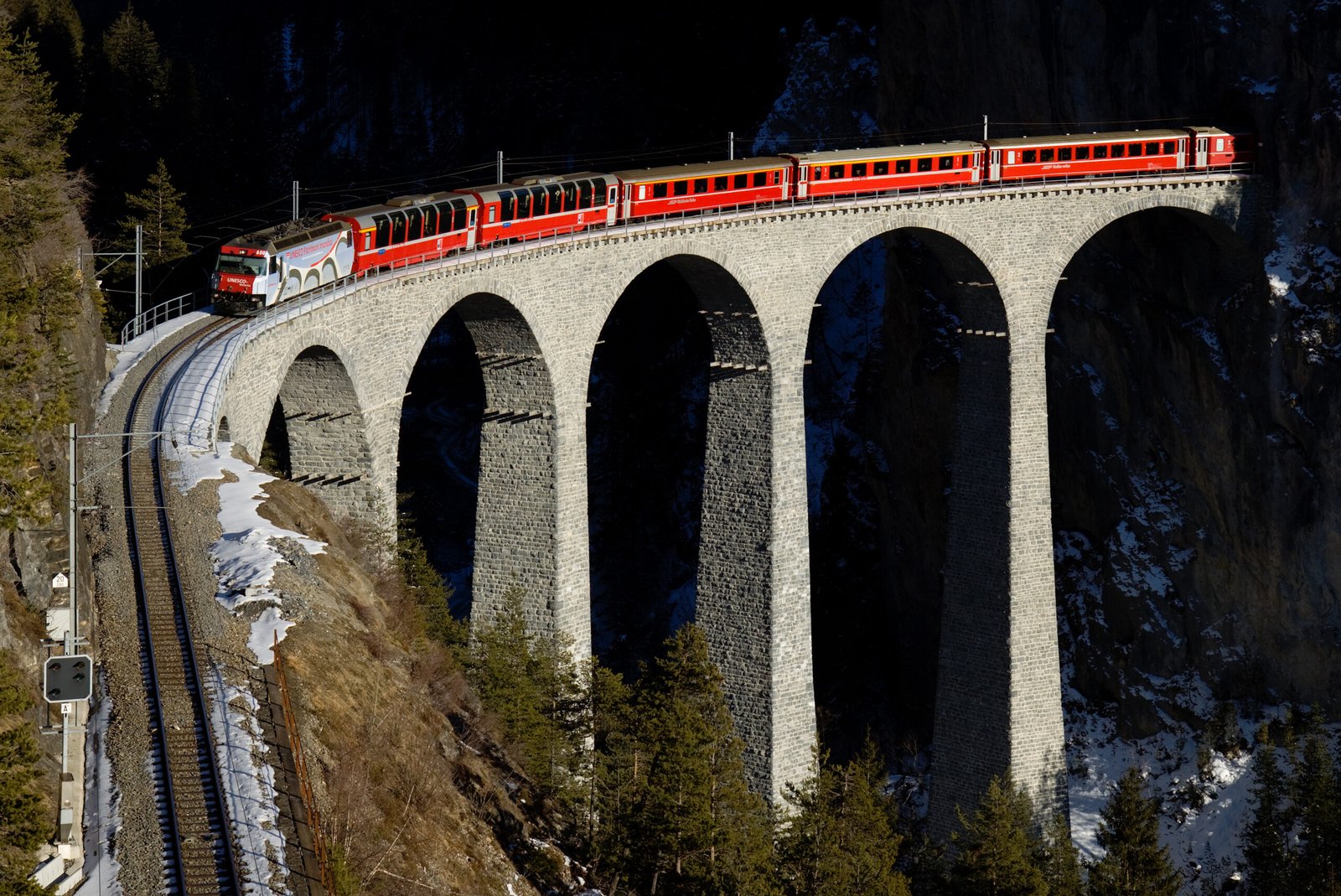
Two historic mountain railway lines of the Rhaetian Railway (RhB), inscribed as a UNESCO World Heritage Site in 2008, represent the pinnacle of early 20th-century Alpine railway engineering. Threading through some of the most dramatic mountain scenery in Europe via spiral tunnels, soaring viaducts, and a cog-free pass crossing at 2,253 metres, these lines are both living transport infrastructure and a masterwork of human ingenuity over extreme terrain.
At a glance
The UNESCO designation covers two distinct lines of the Rhaetian Railway: the Albula Line (96 km, 1904) running from Thusis through wild gorges to St. Moritz, and the Bernina Line (61 km, 1910) crossing the Bernina Pass from Pontresina to Tirano in Italy. Together they form a 157-km arc through the Swiss Alps and into the Italian Valtellina. Both lines are still in daily commercial service — ordinary commuters, schoolchildren, and skiers travel them alongside tourists — making them rare living examples of heritage engineering. The Albula section features the iconic Landwasser Viaduct and three spiral loops; the Bernina section crosses the highest cog-free railway pass in the Alps and descends through subtropical Poschiavo to Italy.
Key facts
- UNESCO inscription: 2008, Cultural Landscape (transboundary Switzerland/Italy)
- Lines: Albula Line (96 km, 1899–1904) and Bernina Line (61 km, 1910)
- Operator: Rhaetian Railway (Rhätische Bahn / Ferrovia Retica), Chur, Switzerland
- Gauge: Metre gauge (1,000 mm); fully electrified
- Highest point: Ospizio Bernina, 2,253 m — highest cog-free, rack-free railway pass in the Alps
- Key structures: Landwasser Viaduct (65 m high, curved masonry), Brusio Circular Viaduct, Albula Tunnel (5.9 km, 1,820 m elevation), three spiral loops at Bergün and Brusio
- Famous service: Glacier Express (St. Moritz–Zermatt via Albula); Bernina Express (Chur/Davos–Tirano)
History
The Rhaetian Railway was built by the canton of Graubünden (Grisons) to connect its isolated mountain communities to the Swiss railway network. The challenge was extraordinary: the Alps presented gradients and altitudes that conventional railways could not handle, yet the engineers were constrained by the requirement for rack-free operation (meaning the locomotive could not grip a central toothed rail for extra traction) to keep speeds and operating costs manageable.
The Albula Line, built between 1899 and 1904 under chief engineer Friedrich Hennings, solved the altitude problem through geometry: spiral tunnels bored into the mountainside allow the train to gain height by spiralling upward inside the rock. At Bergün, three consecutive spiral loops lift the line 416 metres over just 15 km of track. The Albula Tunnel (5.9 km) was the highest Alpine main-line tunnel at its opening and required extraordinary construction effort at altitude.
The Bernina Line (1910) was even more audacious: it crosses the Bernina Pass at 2,253 metres without any rack mechanism, descending 1,800 metres in 61 kilometres through 55 tunnels and 196 bridges. The Brusio Circular Viaduct — a stone spiral viaduct that loops around itself to lose height — became one of the most photographed railway structures in the world.
Both lines were electrified early (Bernina from opening in 1910, Albula in 1919), making them among the world’s first electrified mountain railways. The Glacier Express tourist train began running in 1930, connecting the Albula to the Matterhorn region via one of Europe’s great scenic rail journeys.
What you see
The Landwasser Viaduct is the defining image of the Albula Line: a curved, six-arch limestone masonry viaduct 65 metres high that plunges directly into a tunnel portal at its far end. Trains appear to fly through the air before being swallowed by the cliff. The viaduct was built in just two years (1901–1902) without scaffolding reaching the valley floor — the arches were constructed using wooden centering suspended from the piers.
The Bernina Line offers a completely different spectacle: at the summit, the train crawls past glaciers (the Morteratsch Glacier viewpoint is a stop on the line) and frozen lakes before descending through the lush Poschiavo valley to the Italian market town of Tirano, where the train runs through city streets alongside road traffic. The contrast between Arctic and Mediterranean in a two-hour journey is unlike any other rail experience in Europe.
The Brusio Circular Viaduct, visible from the village of Brusio on the Italian approach, is the other great set-piece: a stone oval through which the train spirals downward, crossing its own track below. It is best photographed from the hillside above in late afternoon light.
Practical information
- Services: Regular RhB services year-round; Bernina Express and Glacier Express panorama trains (reservation required, supplement applies) run seasonally
- Tickets: Swiss Travel Pass covers all RhB services (panorama train supplement still applies); Interrail valid with supplement
- Bernina Express: Chur or Davos to Tirano (Italy); 4 hours; runs May–October daily, reduced winter schedule
- Glacier Express: St. Moritz to Zermatt; 8 hours; year-round but book well in advance in summer
- Best seat: On the Bernina, sit on the right (south) side going from Pontresina to Tirano for glacier and Brusio viaduct views
- Photography stop: Alvaneu or Solis for Landwasser Viaduct exterior views; access by road or hiking trail
Getting there
- Albula Line start (Thusis): Train from Chur (30 min); Chur is on the main Swiss rail network from Zurich (75 min)
- Bernina Line start (Pontresina/St. Moritz): Albula Line from Chur to St. Moritz (2 h), then Bernina Line south; or from Tirano (Italy) northbound
- Tirano (Italy, south terminus): Train from Milan (2.5 h via Lecco and Sondrio); Tirano is also the start of the Bernina Express northbound
- By car: Davos is accessible from Zurich via the A3 motorway and Landquart; car-loading trains (Autoverlad) available through the Vereina Tunnel to Engadine/St. Moritz in winter
- GPS (Davos Platz station): 46.5868, 9.7640
Nearby
- Swiss National Park (30 km from St. Moritz): Switzerland’s only national park, ancient forest and alpine meadows in the Engadine valley
- Chur (RhB headquarters): Switzerland’s oldest city, with a Romanesque cathedral and the Rhaetian Museum; the heart of Graubünden and gateway to both lines
- Tirano (Italy, south terminus): The Bernina Express terminus; the Basilica di Madonna di Tirano (1505) is one of Lombardy’s finest Renaissance pilgrimage churches
- Poschiavo valley: Between the Bernina Pass and Tirano; the village of Poschiavo has a unique architectural heritage of returning emigrants’ houses and an intact Spanish quarter
Sources
- UNESCO World Heritage List: Rhaetian Railway in the Albula/Bernina Landscapes (No. 1276)
- Wikipedia: Rhaetian Railway in the Albula/Bernina Landscapes
- Rhaetian Railway official site: rhb.ch
- Bernina Express: berninaexpress.ch
Find it on the map
See this place and what’s around it →📷 Become a Cultural Heritage Online photographer
Share your photos of places: they stay published under your name as the author. The more they're seen, the more you get noticed — and soon a contest will reward the most appreciated photos.
Log in or sign up free to add a photo