
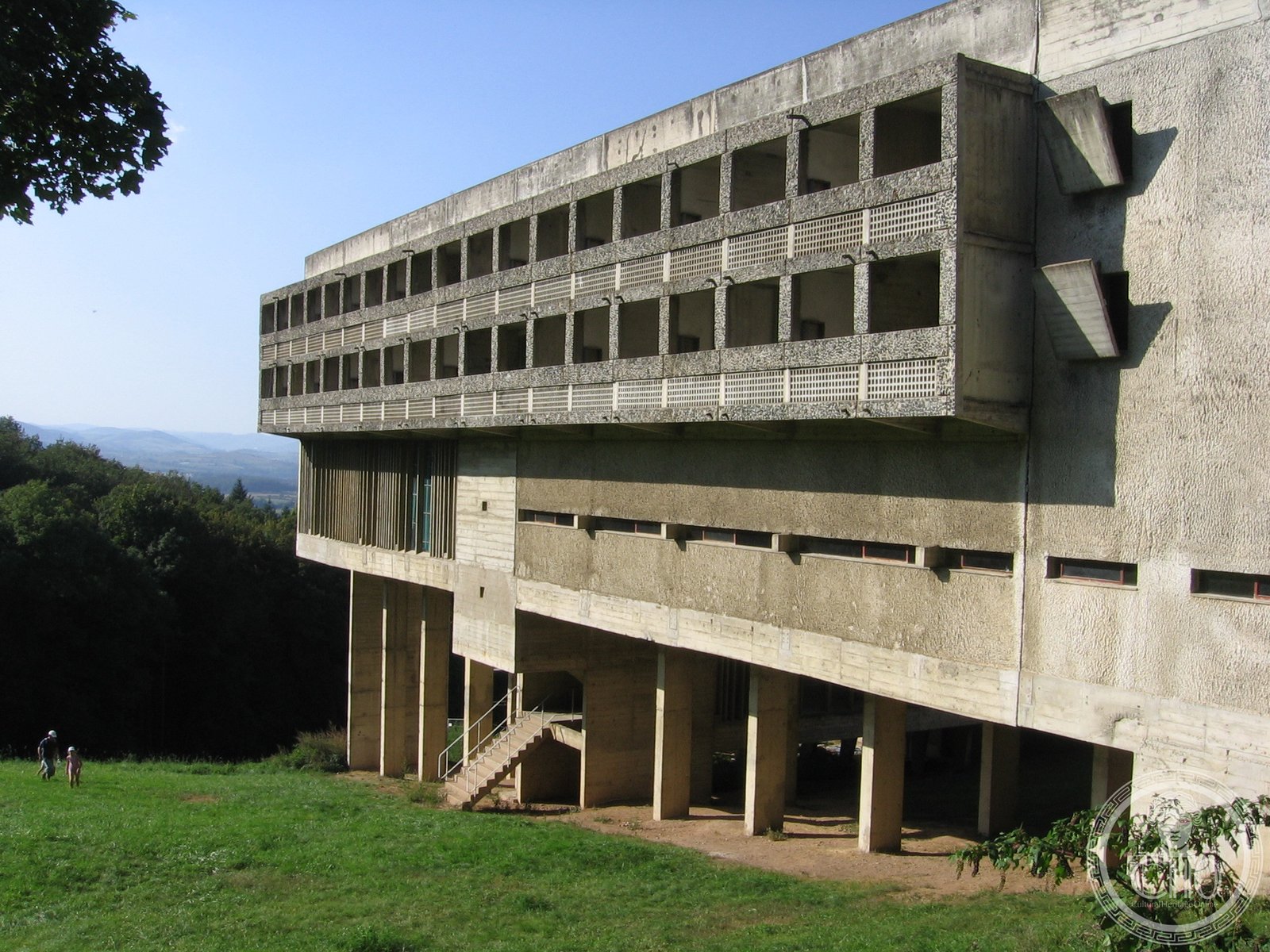
Le Corbusier’s last major completed work — a Dominican friary on a hillside near Lyon — distils a lifetime of architectural thought into raw concrete, coloured light, and monastic silence. UNESCO World Heritage Site since 2016.
At a glance
Built 1956–1960 near Lyon at the invitation of Father Marie-Alain Couturier OP, La Tourette is a functioning Dominican friary and one of seventeen buildings inscribed in the UNESCO Le Corbusier serial nomination (2016). The complex clings to a steep hillside on pilotis, its square cloister appearing to float above the Ain valley.
Key facts
- Architect: Le Corbusier (Charles-Edouard Jeanneret), assisted by Iannis Xenakis
- Client: Dominican Order, via Father Marie-Alain Couturier OP
- Construction: 1956–1960
- Location: Eveux-sur-l’Arbresle, Ain, Auvergne-Rhone-Alpes, France
- UNESCO WHS: 2016, Le Corbusier serial nomination (17 buildings, 7 countries)
- Status: Active Dominican friary; visits by advance booking
History and context
Father Couturier had championed the idea that the Church should commission living masters for sacred works — he had already brought Matisse to Vence and Leger to Audincourt. When the Dominican Province of Lyon planned a new study house, he proposed Le Corbusier, then in his late sixties and never having built a monastery.
Le Corbusier accepted as an architectural challenge: how to build a place of prayer and collective life using only concrete, glass, light, and proportion. He visited the hillside site at Eveux in 1953. Construction began in 1956 and finished in 1960 — five years before his death. La Tourette is the final full realisation of his life’s vocabulary: pilotis, promenade architecturale, roof garden, brise-soleil, and light as a building material.
What you see
The friary pivots around a square cloister of approximately 57 metres per side. Because the site slopes steeply, the cloister hangs on pilotis at the lower end while resting on the ground at the upper end — giving visitors the sensation of walking on a suspended platform above the valley. Some 100 monastic cells occupy the upper floors, each a minimal room proportioned by Le Corbusier’s Modulor system.
The assembly church is a concrete box lit from above by six light cannons and from the sides by Iannis Xenakis’s pan de verre ondulatoire — undulating glass screens that cast a shifting dapple of light across the interior walls. Most remarkable are the three underground oratories, buried in the hillside like caves, each lit by a concrete tube projecting a single beam of red, yellow, or blue into the dark. The experience is among the most powerful in twentieth-century architecture.
Practical information
- Address: Couvent de la Tourette, 69210 Eveux-sur-l’Arbresle, France
- Visits: Advance booking required; active monastery — silence in residential areas
- Accommodation: Retreat stays available overnight; advance booking essential
- Website: couventdelatourette.fr
- Photography: Permitted in most areas; restricted in oratories during prayer
Getting there
Eveux-sur-l’Arbresle is approximately 25 km northwest of Lyon. TER trains from Lyon Part-Dieu to L’Arbresle (30–40 min); local bus or taxi for the final 3 km. By car, signposted from the A89 motorway. Parking on site. The hillside approach involves steps and uneven terrain.
Nearby
- Lyon — 25 km southeast; Vieux Lyon and Fourviere UNESCO WHS, Musee des Confluences, Musee des Beaux-Arts
- Vence, near Nice — Chapelle du Rosaire by Henri Matisse (1951), another Couturier commission
- L’Arbresle — nearest town with market and amenities
Sources
Find it on the map
See this place and what’s around it →📷 Become a Cultural Heritage Online photographer
Share your photos of places: they stay published under your name as the author. The more they're seen, the more you get noticed — and soon a contest will reward the most appreciated photos.
Log in or sign up free to add a photo