

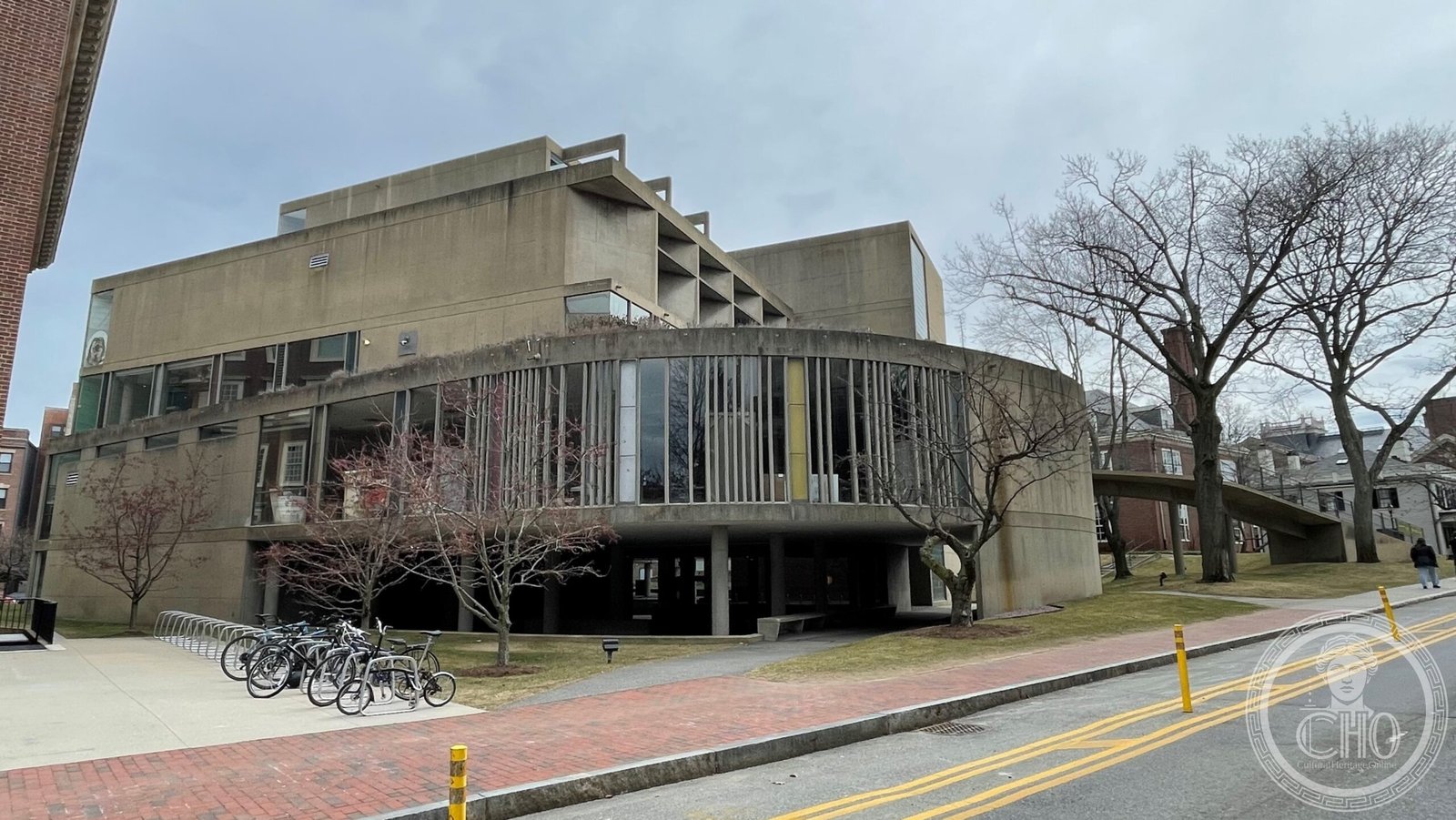
The only building Le Corbusier ever designed in North America — squeezed between two Harvard buildings and entered by a ramp that cuts straight through it — is a complete manifesto of his late vocabulary, still in daily use as Harvard’s active visual arts centre. It is not part of the UNESCO inscription of Le Corbusier’s work, which covers seventeen buildings in seven countries, none of them in the United States.
At a glance
Built 1960–1963 on Quincy Street in Cambridge, Massachusetts, the Carpenter Center for the Visual Arts is the sole building Le Corbusier designed in the entire Western Hemisphere. It stands between the Fogg Art Museum and a Victorian house, entered by a serpentine ramp that threads through the building from street to street. The 2016 UNESCO serial inscription of Le Corbusier’s work covers seventeen buildings in seven countries and does not include this one; the Carpenter Center remains an active visual arts school and public gallery at Harvard University.
Key facts
- Architect: Le Corbusier (Charles-Edouard Jeanneret, 1887–1965), with local associate Jose Luis Sert
- Client: Harvard University, funded by a gift from Alfred St. Vrain Carpenter
- Construction: 1960–1963
- Location: 24 Quincy Street, Cambridge, Massachusetts, USA
- UNESCO WHS: not included — the 2016 Le Corbusier serial inscription covers 17 buildings in 7 countries, none in the United States
- Status: Active visual arts centre and gallery; free public access through the ramp
- Le Corbusier on site: He never visited during construction — all design was done from Paris, with drawings sent back and forth
History and context
In 1959 Harvard approached Le Corbusier through Jose Luis Sert, the Catalan architect who was then Dean of Harvard’s Graduate School of Design and had worked with Le Corbusier in the 1930s. The commission was to design a new visual arts centre on a tight infill site between existing buildings — a challenge that would have daunted a younger architect.
Le Corbusier was seventy-two years old and in full command of his vocabulary. He accepted, but on the condition that Sert act as local associate to manage the construction — Le Corbusier would design from Paris, reviewing drawings and models without ever travelling to Cambridge. The building was constructed entirely without his presence on site. He died in 1965, two years after its completion, making Carpenter Center both his last building in the New World and one of his final completed works.
The building was named after Alfred St. Vrain Carpenter, whose gift to Harvard made the project possible. It opened in 1963 and has been in continuous use as a visual arts school and gallery ever since.
What you see
The building’s dominant gesture is the ramp — a broad, gently rising concrete promenade that enters from Quincy Street, rises through the building’s core, and exits onto Prescott Street on the other side. The ramp is not a service element but a public thoroughfare, an extension of the sidewalk that takes anyone who uses it on a guided sequence through the building’s activity: studio windows on either side allow passers-by to look into art classes in progress, while the ramp itself bends and tilts to frame views of the campus.
The building mass is a composition of interlocking cylinders and rectangular slabs lifted on pilotis. The curved studio facades on the upper floors are protected by deep concrete brises-soleil (sunshades), which filter the Cambridge light while giving the building its sculptural character when seen from below. The concrete is raw board-formed béton brut throughout, left without finish or paint.
The roof terrace is a working space for outdoor sculpture and study. The interior rooms include curved studios designed for optimal north light, a film screening room, and gallery spaces. The building is a complete demonstration of Le Corbusier’s Five Points of Architecture in a single small structure: pilotis, free plan, free facade, ribbon windows, and roof garden.
Practical information
- Address: 24 Quincy Street, Cambridge, MA 02138, USA
- Ramp access: The public ramp through the building is open at all times; no admission required
- Gallery: The Sert Gallery hosts temporary exhibitions; hours vary — check the CCVA website
- Website: carpenter.center.harvard.edu
- Admission: Free for the ramp and public areas; gallery admission may apply for some exhibitions
Getting there
The Carpenter Center is located at 24 Quincy Street in Harvard Square, Cambridge, Massachusetts. The nearest subway station is Harvard on the MBTA Red Line — a five-minute walk from the station exit. By car, parking in Harvard Square is limited and metered; use Cambridge Street garages. The building is best approached on foot from the subway.
Nearby
- Harvard Art Museums (Fogg, Busch-Reisinger, Arthur M. Sackler) — immediately adjacent; world-class collections in all three branches
- Harvard Yard — a five-minute walk; historic campus core including the John Harvard statue and Memorial Hall
- MIT Campus — 2 km east; Stata Center by Frank Gehry and Kresge Auditorium by Eero Saarinen
Sources
Find it on the map
See this place and what’s around it →📷 Become a Cultural Heritage Online photographer
Share your photos of places: they stay published under your name as the author. The more they're seen, the more you get noticed — and soon a contest will reward the most appreciated photos.
Log in or sign up free to add a photo