
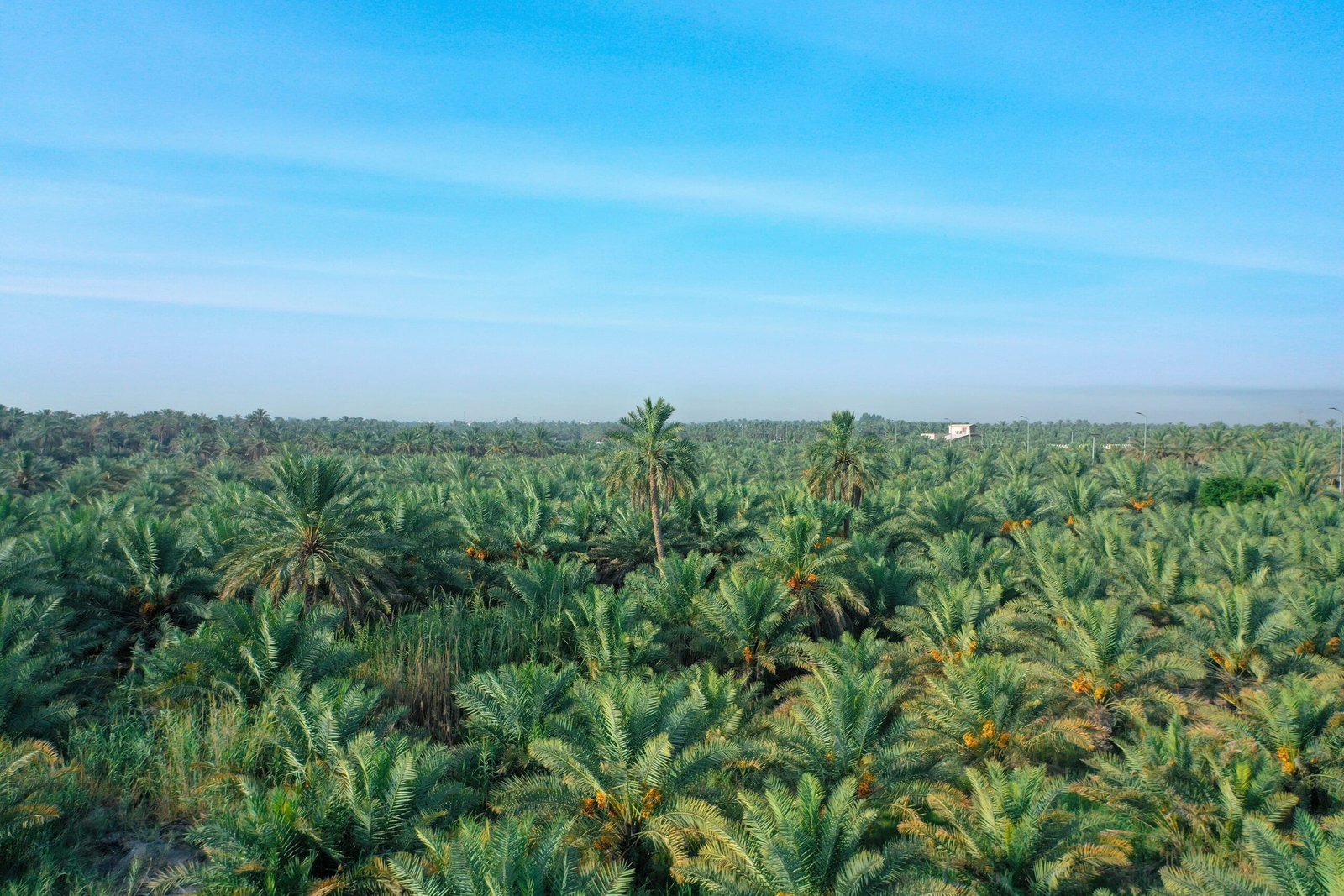
An inland sea of 2.5 million date palms fed by ancient underground springs, Al-Ahsa has sustained civilizations for six millennia and stands today as the world’s largest natural oasis — a UNESCO World Heritage Site where Bronze Age irrigation canals still water the same groves that fed the Dilmun and Abbasid empires.
At a glance
Al-Ahsa Oasis covers approximately 85.4 km² in the Al-Ahsa governorate of Saudi Arabia’s Eastern Province, roughly 60 km inland from the Persian Gulf coast. Its extraordinary survival over 6,000 years rests on a natural artesian aquifer system: underground freshwater springs emerge from beneath the desert, feeding a network of falaj (gravity-fed irrigation channels) that water millions of date palms without pumping. The UNESCO World Heritage inscription of 2018 recognized both the engineering miracle of the natural irrigation system and the unbroken continuity of human adaptation to a desert oasis environment across sixty centuries.
Key facts
- UNESCO inscription: 2018 (World Heritage Site).
- Area: ~85.4 km² (the world’s largest natural oasis).
- Date palms: approximately 2.5 million trees, dozens of local cultivars.
- Continuous occupation: over 6,000 years (c. 4000 BCE to present).
- Irrigation system: falaj channels, some dating to c. 5000 BCE.
- Oldest mosque: Jawatha Mosque, c. 629 CE — one of the world’s oldest mosques outside the Hejaz.
- Oldest bazaar: Al-Qaisariyah market, operating since the 14th century CE.
- Location: Al-Ahsa Governorate, Eastern Province, Saudi Arabia.
- Coordinates: 25.3833° N, 49.5833° E.
History
The springs of Al-Ahsa first drew settled communities around 4000 BCE, making this one of the earliest permanently inhabited sites in the Arabian Peninsula. The oasis became the heartland of the Dilmun civilization (c. 2300–300 BCE), the Bronze Age trading culture that controlled Persian Gulf maritime routes between Mesopotamia, the Indus Valley, and Oman. Ancient Mesopotamian cuneiform texts from Ur describe Dilmun as a paradise island and a source of copper, ivory, and exotic goods — a world in which Al-Ahsa’s oasis abundance was legendary.
Under the Abbasid Caliphate (8th–10th centuries CE), Al-Ahsa was one of the most prosperous regions of the Islamic world, its date exports and agricultural surplus enriching the caliphate’s treasury. The Ottoman Empire controlled the oasis from 1521 to 1670 CE, leaving behind administrative buildings and fortifications that are still partially visible. The region was incorporated into the Saudi state in the early 20th century. Today Al-Ahsa remains a living, productive agricultural landscape: its date groves are among the world’s most productive, and the traditional market and falaj system continue to function as they have for millennia.
What you see
The oasis is a mosaic of palm groves, historical monuments, traditional villages, and agricultural fields integrated into a single landscape. The Jawatha Mosque — a modest stone structure built around 629 CE — is one of the oldest mosques in the world outside the Hejaz region, predating the Islamic expansion into Persia by only a few years. The Ibrahim Fortress (Qasr Ibrahim) is a well-preserved Ottoman-era palace-fortress whose carved stone gateway is among the finest examples of Gulf military architecture. The Uqair archaeological site on the coast preserves remains of an ancient harbour used by Dilmun traders. The Al-Qaisariyah bazaar in Al-Ahsa city — a covered market operating continuously since the 14th century — sells dates, traditional textiles, gold, and spices in an architectural setting largely unchanged since the Mamluk period.
The falaj irrigation network is the oasis’s living infrastructure: kilometres of stone-lined channels carry spring water from the artesian source points through the groves in a precisely calculated gravity system. The largest springs — Al-Asfar, Baqiq, Al-Hasa — are visible as pools surrounded by reed beds amid the palms. Date-palm processing houses (traditional warehouses where dates are sorted, dried, and pressed) are scattered throughout the groves, some operating in forms virtually unchanged from medieval practice.
Practical information
- Open: The oasis landscape is accessible year-round; individual sites have varying hours. The Ibrahim Fortress is open Sunday–Thursday 09:00–17:00.
- Entry: Most areas are free to access; Qasr Ibrahim has a nominal entry fee.
- Best season: October–March (cooler temperatures; autumn date harvest season is October).
- Date harvest: August–October; some farms allow visitors to observe or participate.
- Al-Qaisariyah bazaar: Morning sessions; closed Friday afternoons.
- Language: Arabic; English spoken at major tourist sites.
- Currency: Saudi Riyal (SAR).
- Dress code: Modest dress required; women should carry a headscarf.
Getting there
Al-Ahsa is served by Al-Ahsa Regional Airport (HOF), with direct flights from Riyadh (1 hour), Jeddah, and limited international routes. From Riyadh by road: approximately 400 km via the Dammam Expressway (3.5–4 hours). The nearest major city is Dammam (Eastern Province capital), roughly 80 km northwest. Within the oasis, a car is essential — the date groves and historical sites are spread across a wide area. Taxis and ride-sharing (Uber/Careem) are available in Al-Ahsa city. The Saudi tourism authority (Saudi Tourism) operates guided tours that include the main heritage sites.
Nearby
- Uqair Archaeological Site — ancient Dilmun harbour on the Gulf coast, 65 km east.
- Tarout Island — one of the world’s oldest continuously inhabited islands, site of a Dilmun-era castle, 120 km north.
- Dammam and Al-Khobar — Eastern Province cities, 80 km northwest, with international hotels and the King Fahd Causeway to Bahrain.
- Bahrain — accessible via the 25 km King Fahd Causeway from Al-Khobar; home to the related Dilmun sites of Qal’at al-Bahrain and the Dilmun Burial Mounds (both UNESCO).
Sources
- UNESCO World Heritage Centre — Al-Ahsa Oasis, an Evolving Cultural Landscape (WHC nomination file, 2018).
- Wikipedia — Al-Ahsa Oasis (en.wikipedia.org/wiki/Al-Ahsa_Oasis).
- Saudi Heritage Commission — Al-Ahsa digital documentation (hmcorp.gov.sa).
- Laurence Potts, The Oasis of Al-Hasa, Aramco World, various issues.
Find it on the map
See this place and what’s around it →📷 Become a Cultural Heritage Online photographer
Share your photos of places: they stay published under your name as the author. The more they're seen, the more you get noticed — and soon a contest will reward the most appreciated photos.
Log in or sign up free to add a photo