
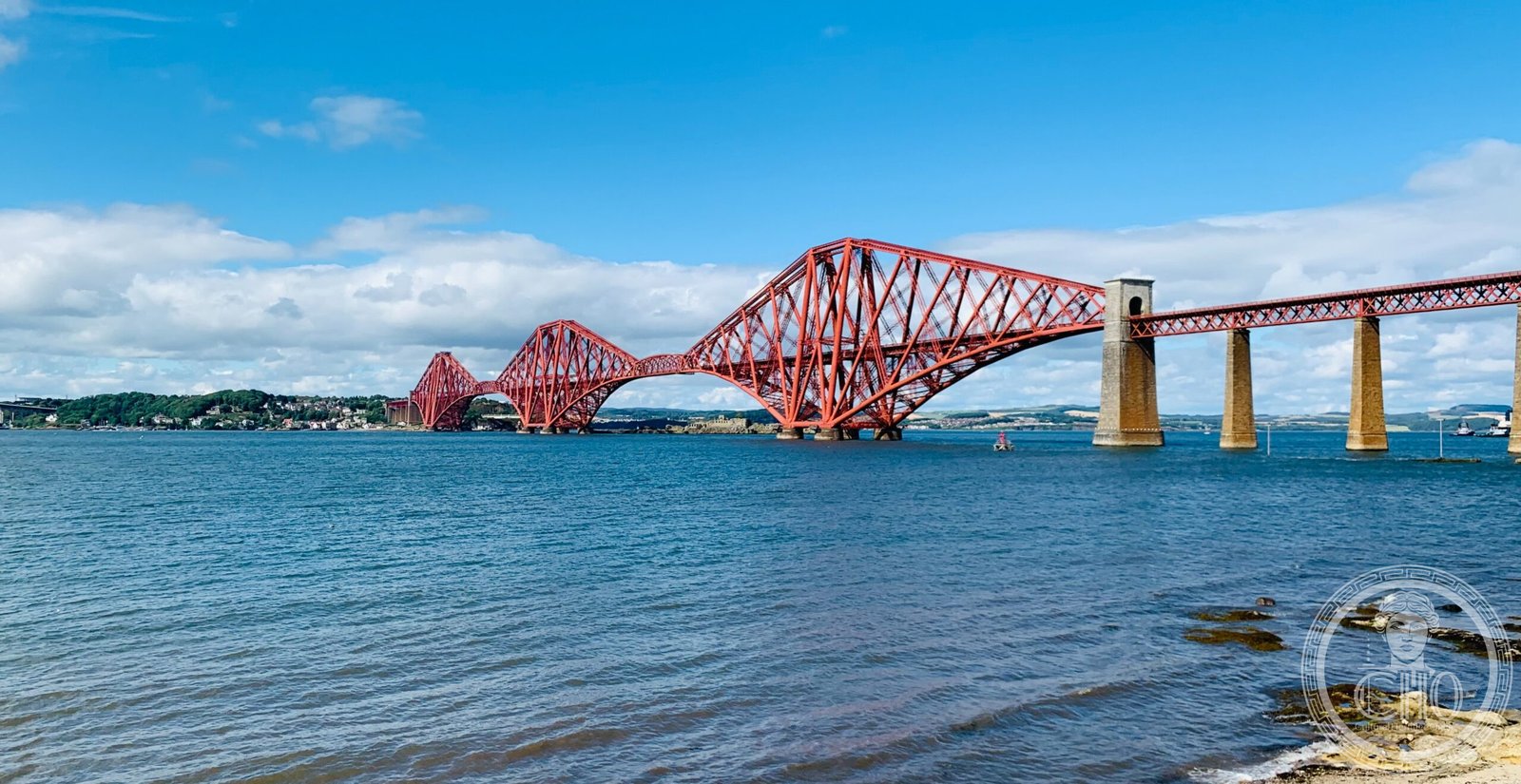
Scotland’s defining silhouette and a UNESCO World Heritage Site since 2015 — the Forth Bridge’s three giant cantilever towers transformed Victorian engineering after the Tay Bridge disaster, and the 2.5-km structure has carried East Coast Main Line trains across the Firth of Forth every day since 1890.
At a glance
When the Forth Bridge opened on 4 March 1890, it was the longest bridge and the largest steel structure in the world. Designed by Sir John Fowler and Sir Benjamin Baker in direct response to the catastrophic collapse of the Tay Bridge in 1879 — which killed 75 people and destroyed public confidence in large-scale iron bridge engineering — the Forth Bridge introduced the balanced cantilever principle at a scale never previously attempted. Its three diamond-shaped towers, each 104 metres tall and connected by two suspended central spans, carry the railway 46 metres above the water of the Firth of Forth. UNESCO inscribed the bridge in 2015 as “an icon of the Industrial Age… an outstanding example of a major technological feat.”
Key facts
- Total length: 2.528 km (2,528 metres)
- Height of cantilever towers: 104 metres above high water
- Height of rail above high water: 46 metres (at the apex of the central spans)
- Steel used: approximately 55,000 tonnes
- Rivets used: approximately 6.5 million
- Bolts used: 740,000
- Construction workforce: approximately 4,600 workers at peak
- Deaths during construction: 73 workers killed
- Designers: Sir John Fowler (1817–1898) and Sir Benjamin Baker (1840–1907)
- Construction period: 1882–1890 CE
- UNESCO inscription: 2015
- Status: still in daily operation, carrying East Coast Main Line trains
History
The need to bridge the Firth of Forth had been debated for decades before the Tay Bridge disaster of 28 December 1879 forced the issue. The Tay Bridge — then the longest bridge in the world — collapsed during a storm while a passenger train was crossing it, killing all 75 people aboard and exposing fundamental weaknesses in the prevailing approach to large iron bridge design. Public and parliamentary confidence in long-span bridge engineering collapsed with it.
Fowler and Baker’s cantilever design was a deliberate engineering manifesto: every element of the structure would be visibly in tension or compression, the loads clearly expressed in the geometry. The famous demonstration model — in which Baker himself sat in a suspended seat supported by two men extending their arms outwards, illustrating the cantilever principle — became one of the most reproduced engineering images of the Victorian era. Construction began in 1882. At its peak, the workforce of 4,600 men worked by gaslight through the Scottish winters. Seventy-three died — a figure that was considered acceptable at the time but haunts the bridge’s history.
The bridge opened on 4 March 1890. Queen Victoria crossed it on 28 March, knighting Benjamin Baker at the Queensferry station. The “Forth Bridge” painting cycle — the proverbial never-ending task of maintaining the painted steel surface — was finally broken in 2011, when a longer-lasting paint system applied over several years ended the need for continuous repainting that had become part of Scottish folklore.
What you see
The bridge’s three main cantilever towers — at Inchgarvie island in the middle of the Firth, and at the shores on each side — are recognisable from miles away. Each tower consists of two massive tubular legs (diameter 3.7 metres) connected by horizontal struts and diagonal bracing, the whole diamond-shaped structure balanced on its central column like a scale. The two central suspended spans (each 107 metres) hang between the cantilever arms. The total visual composition, spanning nearly 2.5 km, remains extraordinary even against the background of the later Forth Road Bridge (1964) and the Queensferry Crossing (2017) visible immediately upstream.
The scale is difficult to comprehend from the shore. The tubular legs are large enough to contain internal staircases. The bridge carries two railway tracks on a through-truss deck 46 metres above the water. Looking up from the water — accessible by ferry or sightseeing boat — the lattice of steel members overhead produces a geometrically complex pattern of triangulated forms that Baker intended to express confidence and safety to passengers still traumatised by the Tay Bridge collapse.
Practical information
- Railway crossing: the bridge is part of the operational railway network; passengers cross it on ScotRail services between Edinburgh Waverley and stations in Fife and Perth
- Forth Bridges Experience: visitor centre in South Queensferry covers all three Forth bridges; seasonal guided tours available including access to the bridge structure itself (book in advance)
- Best viewing points: South Queensferry town centre (immediately below the bridge’s south tower); Hawes Pier; North Queensferry on the Fife shore; Hopetoun House grounds (western view)
- Bo’ness & Kinneil Railway: heritage steam railway at Bo’ness offers views of the bridge from across the Firth
- Admission: viewing from South Queensferry is free; guided bridge tours are ticketed
Getting there
South Queensferry is 13 km west of Edinburgh city centre. By rail: ScotRail trains from Edinburgh Waverley cross the Forth Bridge, stopping at Dalmeny station (1.5 km from South Queensferry town centre) and North Queensferry on the Fife side. Regular services throughout the day. By bus: Lothian Buses service 43 runs from Edinburgh city centre to South Queensferry (approximately 45 minutes). By car: M90/A90 junction at Queensferry; ample parking in South Queensferry. The Forth Road Bridge (A90 road) and the newer Queensferry Crossing provide road access alongside the railway bridge.
Nearby
- Hopetoun House (4 km west): Scotland’s greatest Adam mansion, set in parkland on the south shore of the Firth; the ancestral home of the Marquesses of Linlithgow
- Linlithgow Palace (18 km west): birthplace of Mary Queen of Scots; substantial ruined royal palace on the shore of Linlithgow Loch
- Edinburgh (13 km east): Scottish capital with the Castle, Old Town, and New Town (both UNESCO World Heritage Site)
- Inchcolm Island and Abbey: accessible by ferry from South Queensferry; 12th-century Augustinian abbey on an island in the Firth, with wartime coastal defence remains
Sources
- UNESCO World Heritage List: “The Forth Bridge” — whc.unesco.org
- Wikipedia: “Forth Bridge” — en.wikipedia.org
- Paxton, Roland & Shipway, Jim: Civil Engineering Heritage: Scotland (2007)
- Mackay, Sheila: The Forth Bridge: A Picture History (1990)
- Network Rail: Forth Bridge technical and heritage documentation
Find it on the map
See this place and what’s around it →📷 Become a Cultural Heritage Online photographer
Share your photos of places: they stay published under your name as the author. The more they're seen, the more you get noticed — and soon a contest will reward the most appreciated photos.
Log in or sign up free to add a photoIs this page about you?
This page is read by travellers and heritage enthusiasts who find it on Google. Tell us how you are connected to this place and we will take it from there.