
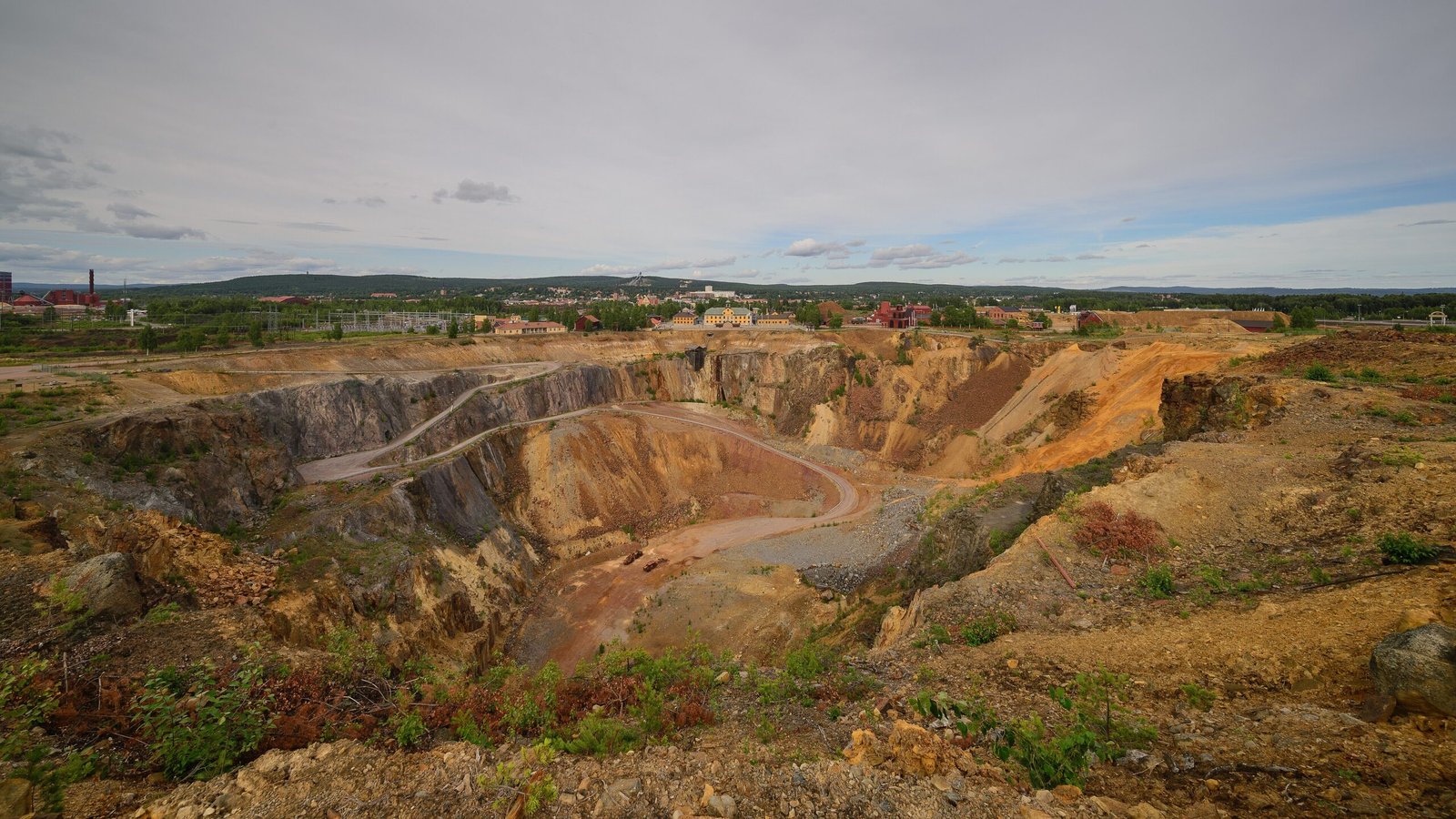
The historic copper mine that funded the Swedish Empire for three centuries: at peak production around 1650, Falun supplied approximately two-thirds of the world’s copper, and its red-ochre byproduct gave Swedish farmhouses their characteristic colour that endures to this day.
At a glance
Inscribed as a UNESCO World Heritage Site in 2001, the Mining Area of the Great Copper Mountain at Falun in Dalarna County, central Sweden, encompasses one of the world’s most historically significant mines. In continuous operation from approximately 1288 CE through 1992 CE — over 700 years — Falun Mine was the economic engine of Swedish imperial power. At its 17th-century peak it produced roughly two-thirds of the world’s copper supply, funding Sweden’s military campaigns in the Thirty Years War (1618–1648) and its dominance of the Baltic. The dramatic Great Pit (Stora Stöten), created by a catastrophic collapse on Midsummer Day 1687, remains the visual centrepiece of the site.
Key facts
- UNESCO inscription: 2001 (criteria ii, iii, v)
- Location: Falun, Dalarna County, central Sweden
- Active period: c. 1288–1992 CE — approximately 700 years of continuous mining
- Peak production: c. 1650 CE — approximately two-thirds of world copper supply
- Great Pit collapse: Midsummer Day, 1687 — crater 90 m deep, 350 m wide
- Byproduct: Falun Red (Faluröd) paint — made from iron sulfate byproduct; used on Swedish timber buildings since the 17th century
- Open: Falun Mine museum open year-round; underground tours daily in summer
History
Copper mining at Falun is first documented in 1288 CE, when Bishop Peter of Västerås accepted one-eighth of a share in the mine as a bequest — suggesting the mine was already a significant economic entity. Medieval copper production was small-scale, using hand tools and fire-setting (lighting fires against the rock face to crack it with thermal stress). The mine was worked cooperatively by the local burghers of Falun.
The great expansion came in the 16th and 17th centuries. The Swedish Crown needed copper for coinage, artillery, and international trade; Falun was its primary source. By the mid-17th century the mine employed approximately 1,200 workers and produced an estimated 3,000 tonnes of copper annually — the equivalent, in some years, of two-thirds of global copper production. This copper funded Sweden’s military power in the Thirty Years War (1618–1648), when Sweden emerged as the dominant power in northern Europe and occupied much of northern Germany. Falun was, in effect, the financial foundation of the Swedish Empire.
The disaster came on Midsummer Day, 24 June 1687, when most of the miners were absent for the holiday. The central section of the mine — where intensive extraction over decades had left the supporting rock pillars too thin — collapsed catastrophically, creating the vast open crater (Stora Stöten, “the Great Pit”) that still defines the site. No lives were lost because of the holiday; had it occurred on a working day, the death toll would have been catastrophic. The collapse actually clarified the site: it revealed the full extent of the ore body, allowing a more systematic approach to mining.
Production continued after the collapse and remained significant into the 18th century, though never at 17th-century levels. By the 19th century iron pyrite (for sulphuric acid production) had become more economically important than copper. Mining continued, increasingly mechanised, until the mine was finally closed in 1992.
The mine’s most pervasive legacy is invisible to most people who know it: Falun Red (Faluröd), the characteristic dark red-ochre paint on Swedish timber farmhouses. The paint is made from iron sulfate, iron oxide, rye flour, and linseed oil — waste products of the copper-smelting process. Cheap, abundant, and effective as a wood preservative, it has been applied to Swedish country buildings since the 17th century. Today roughly 80% of Swedish rural wooden buildings are painted in some variant of Falun Red.
What you see
The Great Pit (Stora Stöten) is the overwhelming first impression: a vast open-air crater 90 metres deep and 350 metres wide, its ochre-red walls of broken rock descending in terraces to water at the bottom. Walking around the rim path gives the scale of seven centuries of extraction made visible in a single catastrophic moment.
The mine museum buildings surrounding the pit preserve 17th- and 18th-century structures: ore-roasting hearths, the smelting house, the master miner’s house (still furnished), and rows of workers’ housing. The museum holds 700 years of mining artefacts — tools, ore samples, maps, and the preserved body of a miner (“Fet-Mats”) found in the mine in 1719, perfectly preserved by the copper-sulphate-saturated water and recognised by his elderly fiancée.
Underground tours descend into the actual working levels of the historic mine via original ladders and shafts, passing through copper-mineral stained rock passages where centuries of hands have smoothed the walls. The tours last approximately one hour and require warm clothing even in summer (10°C underground year-round).
Practical information
- Falun Mine Museum: Gruvplatsen 1, 791 60 Falun — guided underground tours (book ahead in summer); museum exhibitions open year-round
- Admission: Charged for underground tours and museum; check Falun Mine website (falugruva.se) for current prices and tour times
- Underground tour: Bring warm clothes (10°C underground); sturdy footwear required; some low passages
- Allow: Half day for tour and museum; full day if combining with Falun town
- Accessibility: Museum buildings accessible; underground tour involves uneven surfaces and narrow passages
Getting there
Falun is 225 km northwest of Stockholm. By rail: Direct trains from Stockholm Central to Falun (approx. 3 hours); Falun station is about 1.5 km from the mine museum (taxi or bus available). By car: E16 from Stockholm via Avesta; the mine is signposted from Falun centre. By bus: Regional bus services from Stockholm and surrounding Dalarna County.
Nearby
- Falun town centre — charming 17th-century mining town with the red-painted houses that the mine made famous; excellent local food and museums; 1.5 km from the mine
- Decorated Farmhouses of Hälsingland — another UNESCO WHS in Dalarna/Hälsingland; elaborately painted 18th-century farm interiors; 60–90 km north
- Dalarnas Museum — Falun; collection of Dalarna folk art, Dala horse tradition, regional history
- Sundborn — home of painter Carl Larsson (1853–1919), whose watercolours of Swedish domestic life are world-famous; 8 km from Falun
Sources
- UNESCO World Heritage List — Mining Area of the Great Copper Mountain, Falun (whc.unesco.org)
- Falun Mine — falugruva.se
- Åke Lindqvist, The Great Copper Mountain (Falun, 1996)
- Christopher Catling, Sweden (Insight Guides, 2019)
- Wikipedia — Falun Mine
Find it on the map
See this place and what’s around it →📷 Become a Cultural Heritage Online photographer
Share your photos of places: they stay published under your name as the author. The more they're seen, the more you get noticed — and soon a contest will reward the most appreciated photos.
Log in or sign up free to add a photo