
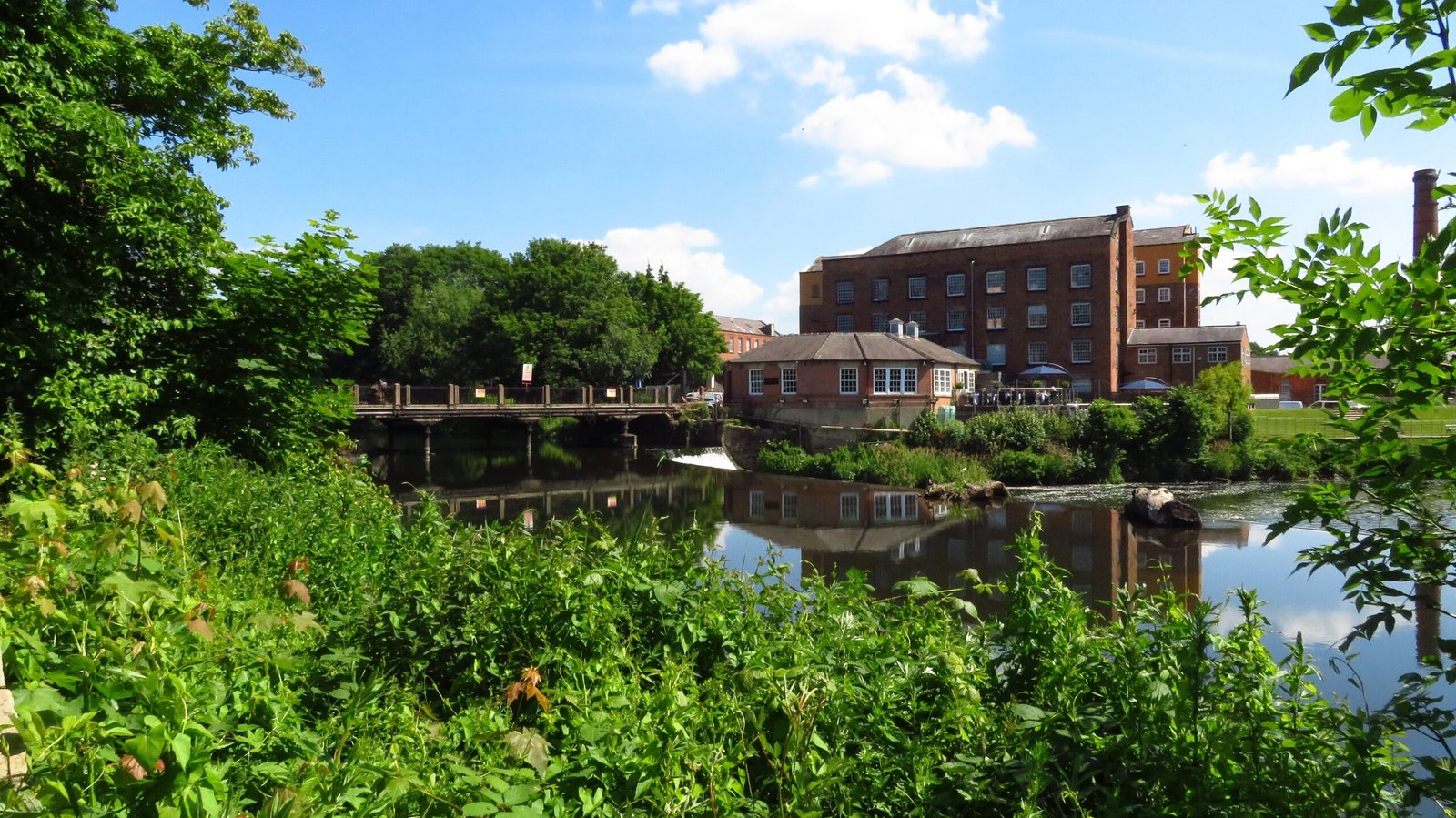
The birthplace of the modern factory system: a 24-kilometre stretch of the Derwent River valley where Richard Arkwright built the world’s first water-powered cotton spinning mill in 1771 and invented industrial capitalism.
At a glance
Inscribed as a UNESCO World Heritage Site in 2001, the Derwent Valley Mills landscape preserves the complete physical and social infrastructure of early industrial capitalism along approximately 24 km of the River Derwent in Derbyshire, England. In 1771 Richard Arkwright built Cromford Mill — the world’s first successful water-powered cotton spinning mill — harnessing the river’s reliable flow to drive his revolutionary water frame, the first powered spinning machine to produce cotton thread strong enough to use as warp. Within two decades the valley contained a series of large-scale mill complexes surrounded by purpose-built workers’ housing, canals, roads, and warehouses. The Derwent Valley model was copied worldwide, from New England to Alsace to Catalonia.
Key facts
- UNESCO inscription: 2001 (criteria ii, iv)
- Location: Derbyshire, England — approximately 24 km from Cromford to Derby
- First mill: Cromford Mill, 1771 CE (Richard Arkwright)
- Key invention: The water frame (1771) — first powered spinning machine producing cotton thread strong enough for warp
- Major sites: Cromford Mill, Masson Mill (1783), Belper North Mill (1804), Milford Mills
- River: River Derwent, Derbyshire; reliable flow essential for water-wheel power
- Open: Cromford Mill visitor centre open year-round; Masson Mills open most days
History
Before 1771, cotton spinning in England was a domestic cottage industry — women and children hand-spinning fibres at home, output limited by human endurance. Richard Arkwright (1732–1792), a barber-turned-industrialist from Preston, recognised that mechanical spinning could be powered by water if a mill were sited on a reliable river. In 1771 he opened Cromford Mill on the River Derwent, employing approximately 200 workers in disciplined shifts regulated by bells and written rules. The result was cotton thread produced at scale and cost that hand-spinning could never match.
Arkwright’s innovations went beyond his water frame machine. He invented the factory as a social institution: shift work, hierarchical supervision, production quotas, and the deliberate siting of mills away from established towns where guild customs might resist his methods. He built workers’ housing at Cromford village as labour-supply infrastructure, recruiting families from the surrounding countryside and keeping them tied to the valley.
By the 1780s Arkwright had added Masson Mill (1783) upstream. The Strutt family built Belper North Mill (1804) and Milford Mills downstream, each replicating the Cromford model. By 1800 the valley was the world’s most concentrated landscape of industrial production, attracting visitors from across Europe and America seeking to copy the new system. Steam power later freed mills from river locations, but the Derwent valley mills continued operating through the 19th century.
What you see
At Cromford Mill (1771), visitors see the original stone mill buildings, the Mill Pond fed from the Bonsall Brook, the workers’ terraces on North Street, and the canal wharf. Masson Mill (1783), Arkwright’s grandest mill, is a six-storey Venetian-windowed structure overlooking the Derwent gorge below Matlock Bath; it operated as a working textile mill until 1991.
At Belper, the Strutt family’s North Mill (1804) is one of the earliest iron-framed fireproof buildings in the world. The Horseshoe Weir — engineered to raise the river level and increase water-wheel power — remains visible. The whole valley is best understood as a system: river, weir, wheel-race, mill, canal, road, housing, church, and school, every element engineered to keep the machines running and the workforce in place.
Practical information
- Cromford Mill: Mill Lane, Cromford, DE4 3RQ — visitor centre, café, heritage tours
- Masson Mills: Derby Road, Matlock Bath, DE4 3PY — shopping village and textile museum
- Belper North Mill Museum: Matlock Road, Belper, DE56 1YD
- Admission: Cromford Mill grounds free; guided tours and Belper Museum charged
- Allow: Full day for the whole valley; half day for Cromford alone
- Accessibility: Cromford Mill mostly level; river towpath wheelchair-accessible for several km
Getting there
The valley runs along the A6 from Cromford to Derby. By rail: Cromford station (Matlock–Derby line, hourly) is a 10-minute walk from Cromford Mill; Belper station is central. By car: A6 through the valley; car parks at Cromford Mill, Matlock Bath, and Belper. On foot or cycle: the Derwent Valley Heritage Way and Cromford Canal towpath connect the sites; Sustrans National Cycle Route 67 follows the valley.
Nearby
- Matlock Bath — Victorian spa resort in the Derwent gorge, 2 km from Cromford
- Chatsworth House — great Baroque country house and gardens, 15 km north
- Haddon Hall — one of England’s most complete medieval manor houses, 8 km north
- Peak District National Park — surrounds the valley; hiking, cycling, show caves
Sources
- UNESCO World Heritage List — Derwent Valley Mills (whc.unesco.org)
- Derwent Valley Mills Partnership — derwentvalleymills.org
- Historic England — Arkwright’s Cromford Mills listing
- R.S. Fitton, The Arkwrights: Spinners of Fortune (Manchester University Press, 1989)
- Wikipedia — Derwent Valley Mills
Find it on the map
See this place and what’s around it →
📷 Become a Cultural Heritage Online photographer
Share your photos of places: they stay published under your name as the author. The more they're seen, the more you get noticed — and soon a contest will reward the most appreciated photos.
Log in or sign up free to add a photo