
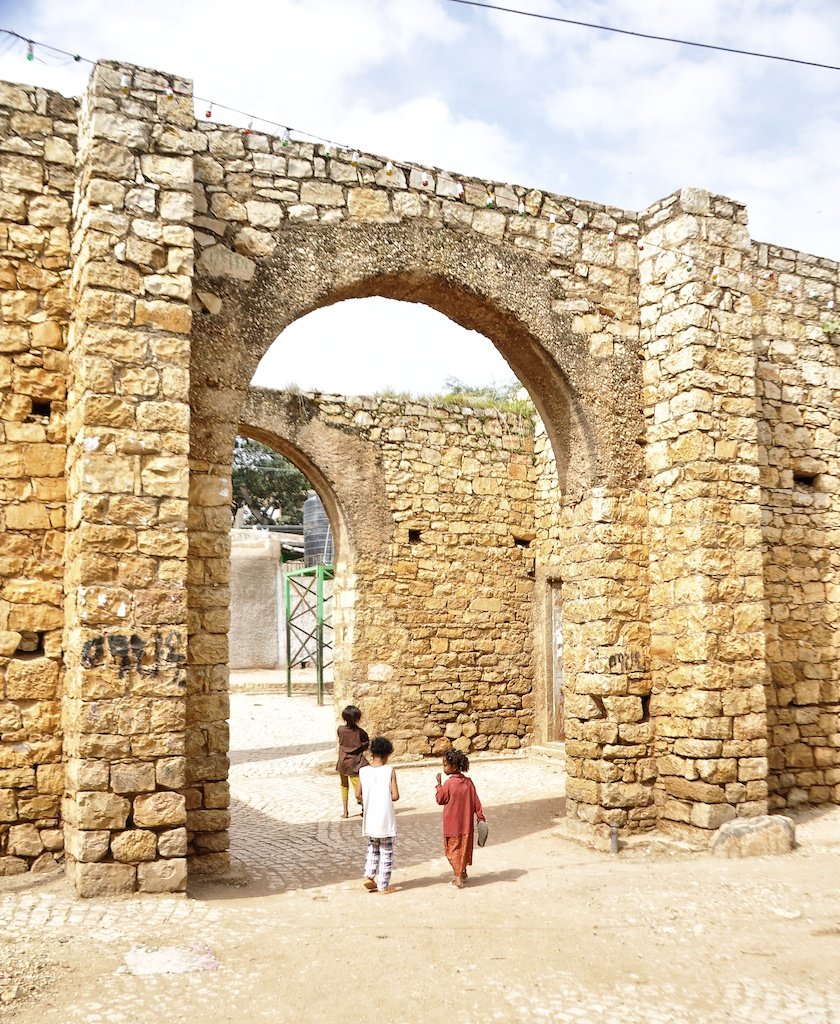
Harar is the fourth holiest city in Islam by some traditions, a labyrinth of 82 mosques and 102 shrines enclosed within a 16th-century wall, where spotted hyenas still enter the city each night and are fed by hand in a ritual four centuries old.
At a glance
Harar Jugol, the Fortified Historic Town, is a UNESCO World Heritage Site (2006) in the Harari Region of eastern Ethiopia. Founded around the 7th century CE as a trading post and centre of Islamic learning, the walled old city contains an extraordinary density of religious and cultural monuments: 82 mosques, three of which date to the 10th century CE, and 102 shrines. The Jugol — the defining city wall — was constructed between the 13th and 16th centuries CE.
Key facts
- UNESCO inscription: 2006
- Founded: c. 7th century CE
- City wall (Jugol): Constructed 13th–16th century CE
- Mosques: 82 within the old city; three date to the 10th century CE
- Shrines: 102 — extraordinary density for a city of ~30,000
- Significance: Considered the fourth holiest city in Islam by some Islamic traditions
- GPS: 9.3100° N, 42.1200° E
History
Harar grew from a small settlement into one of the most important Islamic cities in the Horn of Africa between the 7th and 16th centuries CE. It served as the capital of the Adal Sultanate and as a major caravan hub connecting the Ethiopian interior with the Red Sea ports. The Jugol was built progressively from the 13th century onwards, with the most substantial fortification phase occurring in the 16th century under Emir Nur ibn Mujahid.
Harar was effectively closed to non-Muslims for much of its history, under pain of death for outsiders who entered. The British explorer Richard Burton became the first known European to enter the city in 1855 CE, doing so disguised as an Arab merchant. The city was annexed by Emperor Menelik II of Ethiopia in 1887 CE, ending its status as an independent Islamic city-state.
During the Italian occupation (1936–41), the old city fabric was partially altered, but the historic core was largely preserved. Since the mid-20th century, the traditional compound houses and street pattern have been maintained as a living urban heritage.
What you see
The old city’s street pattern is a dense labyrinth of narrow alleys running between compound houses (harari gey) in a style unique in the world. The facades are tall and brightly painted in red, green, blue, and yellow. Inside, the houses follow a characteristic layout: raised sleeping platforms, elaborate basket-work wall decorations, and a central room serving as both reception and storage space.
The five historic city gates — Harar Gate, Argob Gate, Sanga Gate, Badro Gate, and Fallana Gate — punctuate the Jugol wall. The central market (Gidir Megala) remains the commercial hub, crowded with merchants from across eastern Ethiopia and the Somali region.
Each evening, the hyena-feeding ritual takes place at designated spots just outside the city walls: men known as “hyena men” call wild spotted hyenas by name and feed them strips of meat. The hyenas enter through drainage holes in the Jugol wall after dark and patrol the streets — a four-century-old arrangement.
Practical information
- Location: Harar city, Harari Region, eastern Ethiopia
- Old city entry: Free; no ticket required for the historic streets
- Hyena feeding: Nightly, outside the Fallana Gate; usually 19:00–21:00; small fee for local guides
- Dress code: Conservative dress respectful of Islamic tradition expected in the old city
- Photography: Generally welcome; ask permission before photographing individuals
Getting there
Harar is approximately 525 km east of Addis Ababa. By air: Ethiopian Airlines flies to Dire Dawa Airport (~1 hour); from Dire Dawa, minibuses cover the 55 km to Harar in ~1 hour. By road: 8–10 hours by bus from Addis Ababa via Nazret and Dire Dawa. The old city has a growing number of traditional guest houses.
Nearby
- Dire Dawa — commercial capital of eastern Ethiopia, 55 km west; historic Djibouti-Ethiopian Railway station
- Babille Elephant Sanctuary — home to a distinct population of African elephants, ~100 km east
- Kondudo Mountain — sacred highland above Harar with ancient trees and panoramic views
- Konso Cultural Landscape — UNESCO WHS (2011), ~650 km southwest in the Omo Valley region
Sources
- UNESCO World Heritage List: Harar Jugol, the Fortified Historic Town (2006)
- Burton, R. F. (1856). First Footsteps in East Africa. Longman, Brown, Green, and Longmans.
- Zekaria, A. (2008). Harar: A Cultural Guide. Ethiopian Heritage Trust.
- Wikipedia: Harar Jugol (consulted 2026)
Find it on the map
See this place and what’s around it →📷 Become a Cultural Heritage Online photographer
Share your photos of places: they stay published under your name as the author. The more they're seen, the more you get noticed — and soon a contest will reward the most appreciated photos.
Log in or sign up free to add a photo