
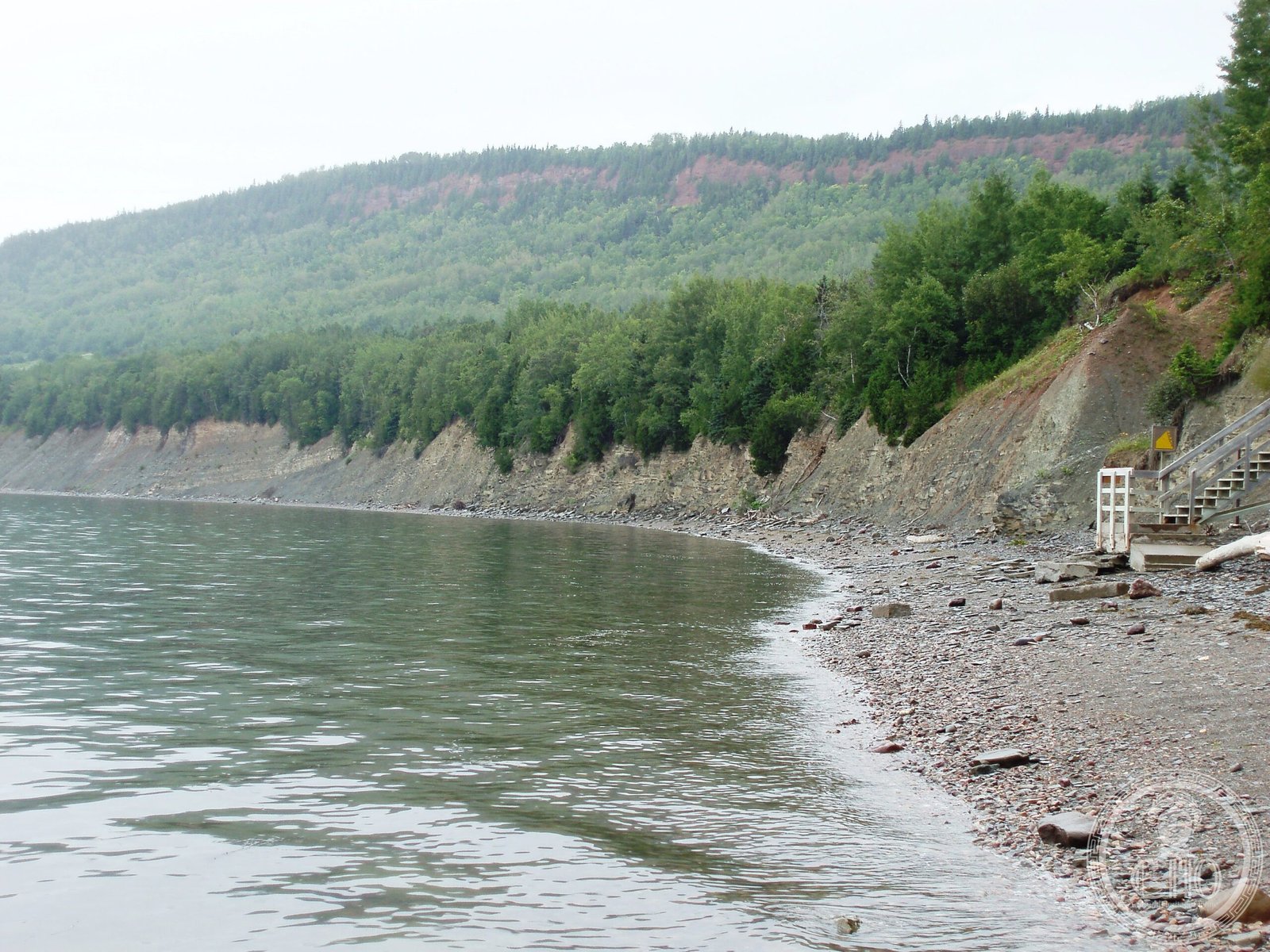
On the red-rock shores of Quebec’s Gaspé Peninsula, sea cliffs 380 million years old tell the story of the most consequential evolutionary step in vertebrate history: the moment when life first hauled itself out of the sea. Miguasha preserves the finest fossil record of that transition ever found anywhere on Earth.
At a glance
Miguasha National Park protects a series of sea-cliff exposures on the south shore of the Gaspé Peninsula, Quebec, Canada, where the Late Devonian Escuminac Formation yields extraordinary complete specimens of lobe-finned fish — the evolutionary ancestors of all land vertebrates, including humans. The UNESCO inscription (1999) describes Miguasha as “the most outstanding fossil site in the world for illustrating the vertebrate stage of the major biological event known as the Devonian fish-tetrapod transition.” The Mi’kmaq name “Miguasha” means “red earth” or “red rock,” a reference to the distinctive iron-rich hue of the Devonian sediments exposed in the cliffs.
Key facts
- UNESCO inscription: 1999 (Natural criterion viii)
- Age of fossils: c. 380 million years (Late Devonian Period)
- Location: South shore of the Gaspé Peninsula, Gaspésie, Quebec, Canada
- Nearest community: Miguasha (municipality of Nouvelle, Gaspésie)
- Key fossil species: Eusthenopteron foordi, Elpistostege watsoni, Miguashaia bureaui, Cheirolepis canadensis
- Formation: Escuminac Formation (Upper Devonian, c. 380 Ma)
- Museum on site: Miguasha National Park Interpretive Centre; over 5,000 fossil specimens catalogued
- Site area: Approximately 87 ha of protected cliff and shore
History of discovery
Fossils were first collected at Miguasha in 1842 by Abraham Gesner, a Canadian geologist. Systematic scientific study began in the 1870s and 1880s when specimens were sent to the British Museum and other European institutions. The site attracted international palaeontological attention throughout the 20th century as the significance of lobe-finned fish for understanding vertebrate evolution became clearer. The discovery of Elpistostege watsoni — found in a complete specimen at Miguasha in 2010 — confirmed it as one of the most fish-like creatures yet found with tetrapod-like features, refining the picture of the fish-to-land transition. UNESCO World Heritage status was inscribed in 1999.
The Devonian Period, 419–359 million years ago, was the age of fishes: the seas teemed with extraordinary diversity, but the land was largely empty of vertebrate life. Miguasha captures the moment — around 380 million years ago — when a lineage of lobe-finned fish with strong, muscular, bone-reinforced fins began colonising shallow-water and terrestrial environments. Every land vertebrate that has ever lived — every amphibian, reptile, dinosaur, bird, and mammal, including humans — descends from creatures like those preserved in the Miguasha cliffs.
What you see
The Escuminac Formation is exposed in a 5 km stretch of sea cliff up to 9 metres high. The rock is a grey-green fine-grained siltstone and shale deposited in a shallow, warm, brackish estuary. The fossils are found in discrete beds within this formation, often in nodules that split to reveal articulated skeletons of extraordinary completeness. The most famous single specimen, Eusthenopteron foordi — the “Prince of Miguasha” — is a metre-long predatory fish whose pectoral fin contains a humerus, ulna, and radius directly homologous to the bones of a human arm. The Interpretive Centre displays over 16 original fossil specimens in museum-quality mounts, alongside geological cross-sections of the cliff face and reconstructions of the Devonian estuarine environment. The cliff walk gives visitors direct visual access to the fossil-bearing layers.
Scientific significance
Miguasha is unique because it preserves multiple species at different stages of the fish-to-tetrapod transition within a single locality and geological moment. Most other transition-period sites yield isolated fragments; Miguasha yields complete, articulated animals. Eusthenopteron is the textbook example of the “intermediate form” — a fish with internal bone architecture identical to that of a four-limbed land animal. The 2010 specimen of Elpistostege, found with its pectoral fin fully articulated, revealed for the first time that this species had the same four-limbed digit-precursor bone arrangement as tetrapods, pushing back the origin of “fingers” by millions of years. The site also yields the oldest known terrestrial vascular plants in the region, providing context for the terrestrial environment the fish were beginning to explore.
Practical information
- Interpretive Centre: Open June to October; admission charged; guided cliff tours available
- Museum: On-site natural history museum with original fossil specimens and reconstructions
- Trail: 1.5 km cliff trail with interpretive panels; moderate difficulty; sturdy footwear recommended
- Fossil collecting: Strictly prohibited — all fossils are protected by provincial and federal law
- Photography: Permitted throughout; flash photography in the museum gallery restricted
- Languages: French primary; English interpretation available
Getting there
Miguasha National Park is located on Route 132, approximately 20 km west of Carleton-sur-Mer on the south coast of the Gaspé Peninsula. The nearest city with rail and air service is Rimouski (approx. 165 km west), from which the park is reached by car. There is no direct public transport to the park; a rental car is the practical option. The nearest airport with scheduled service is Mont-Joli Airport (YYY), approximately 130 km from the site. The park entrance is clearly signed from Route 132.
Nearby
- Carleton-sur-Mer — Attractive coastal town 20 km east, with beach, marina, and a small natural history museum complementing Miguasha’s collections
- Parc national de Miguasha (full park territory) — The protected zone extends inland; hiking trails access Devonian cliff exposures accessible only on foot
- Restigouche River estuary — Shared with New Brunswick across the water; excellent salmon fishing and Mi’kmaq cultural heritage
- Bonaventure Island and Percé Rock UNESCO site — A second Quebec UNESCO WHS, approximately 175 km east, protecting one of North America’s largest Northern Gannet colonies and Québec’s most dramatic sea-stack
Sources
- UNESCO World Heritage Centre — Miguasha National Park nomination file, 1999
- Cloutier, R. et al. (2020). “Elpistostege and the origin of the vertebrate hand.” Nature
- Long, J. A. (2011). The Rise of Fishes: 500 Million Years of Evolution. Johns Hopkins University Press
- Daeschler, E. B. et al. (2006). “A Devonian tetrapod-like fish and the evolution of the tetrapod body plan.” Nature
- Wikipedia — Miguasha National Park
Find it on the map
See this place and what’s around it →📷 Become a Cultural Heritage Online photographer
Share your photos of places: they stay published under your name as the author. The more they're seen, the more you get noticed — and soon a contest will reward the most appreciated photos.
Log in or sign up free to add a photo