
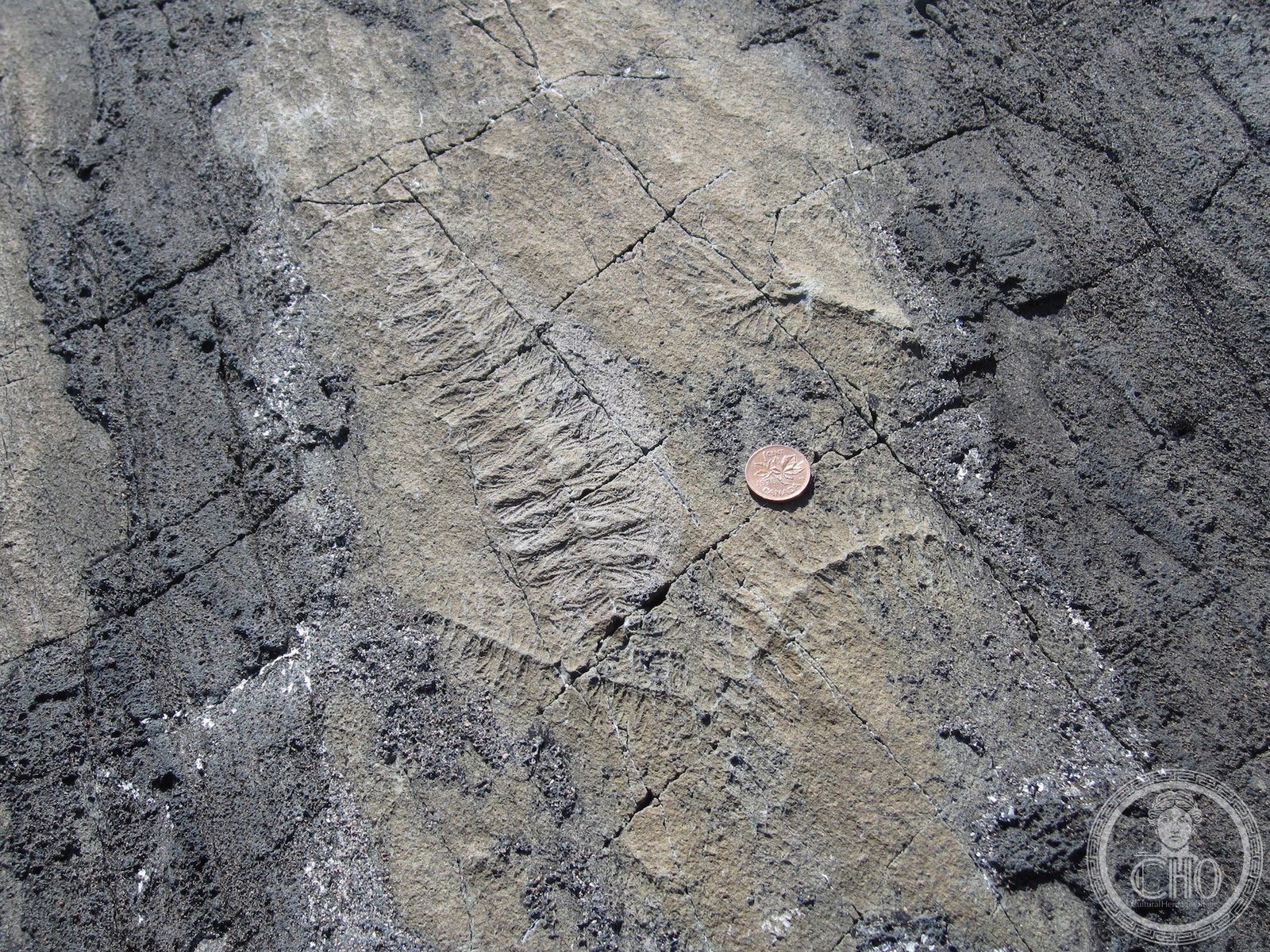
On the storm-battered sea cliffs of Newfoundland’s southeastern tip lies one of the most profound windows into deep time on Earth: fossils of the oldest complex multicellular life forms ever discovered, preserved exactly where they lived on the Ediacaran ocean floor more than 560 million years ago.
At a glance
Mistaken Point Ecological Reserve protects sea-cliff outcrops on the Avalon Peninsula of Newfoundland, Canada. The exposed rock surfaces display hundreds of fossilised organisms from the Ediacaran Period — fronds, discs, spindles and rangeomorphs up to two metres long — that lived on the deep-ocean floor approximately 565–580 million years ago. Designated a UNESCO World Heritage Site in 2016, the reserve holds a record of complex life that predates the Cambrian explosion by over 40 million years and the dinosaurs by more than 500 million years. The name comes from the navigational hazard the headland posed to sailing ships approaching St. John’s Harbour in poor visibility.
Key facts
- UNESCO inscription: 2016 (Natural criterion viii)
- Age of fossils: c. 565–580 million years (Ediacaran Period)
- Location: Southeastern tip of the Avalon Peninsula, Newfoundland, Canada
- Nearest community: St. Bride’s (approx. 15 km north)
- Access: Guided tours only; 45-minute hike over rough coastal terrain
- Key fossil species: Fractofusus, Charnia, Bradgatia, Charniodiscus, Thectardis
- Preservation mechanism: Volcanic ash falls buried organisms in place (analogous to Pompeii, 570 million years earlier)
- Site area: Approximately 146 km²
History of discovery
The fossils at Mistaken Point were first described scientifically in 1967 by palaeontologist S. B. Misra, though local people had long known of the unusual markings on the cliff rocks. The site became a provincial ecological reserve in 1987, and international recognition grew steadily as researchers realised the assemblage was the oldest known complex multicellular fossil community on Earth. UNESCO World Heritage status was conferred in 2016.
For the first three billion years of Earth’s existence, life consisted only of single-celled organisms. The Mistaken Point organisms, appearing around 580 million years ago, represent the first evolutionary experiment with complex multi-cellular body plans. Most had no hard parts, no mouths, and no clear living relatives; they may represent an entirely extinct branch of the tree of life. Their disappearance coinciding with the Cambrian explosion around 540 million years ago remains one of palaeontology’s enduring mysteries.
What you see
The fossils are exposed on horizontal rock platforms — wave-cut surfaces of Precambrian mudstone — that emerge from the base of the sea cliffs at low tide. The most spectacular surface, the D surface at Mistaken Point itself, displays over 4,500 fossil impressions in an area roughly equivalent to a tennis court. The organisms are preserved as casts and moulds in fine volcanic ash, showing their original orientation on the seafloor. The frond-like rangeomorphs are the most visually striking: elongated structures with fractal-like branching patterns, anchored to the seafloor by a holdfast disc, many reaching 50–100 cm in length. Disc-shaped forms (Aspidella) are scattered across the surfaces in hundreds.
Scientific significance
Mistaken Point occupies a unique position in the history of life science. The assemblage demonstrates that evolution had already produced large, architecturally complex organisms more than half a billion years ago — long before shells, bones, eyes, or legs appeared. The volcanic ash preservation is key: unlike most Ediacaran sites, Mistaken Point preserves entire ecological communities in their original spatial relationships, allowing researchers to study population dynamics and environmental gradients of organisms that lived over 560 million years ago. The site continues to yield new species; as recently as 2020, new rangeomorph taxa were described from surfaces that had been studied for decades.
Practical information
- Access: Guided tours only — fossils are strictly protected; no independent access to fossil surfaces
- Tours: Offered by The Rooms Provincial Museum (St. John’s) and local operators; advance booking essential in summer
- Season: June to October (weather and tidal conditions permitting)
- Difficulty: Moderate to challenging — 45-minute walk over rough coastal terrain; sturdy waterproof footwear essential
- Photography: Permitted; flash photography directly on fossil surfaces is discouraged
- No facilities on site; nearest services in St. Bride’s or Trepassey
Getting there
Mistaken Point lies at the end of Route 92 on the southern Avalon Peninsula, approximately 3.5 hours by road from St. John’s via the Trans-Canada Highway and Route 10 south through Trepassey. There is no public transport to the reserve; a private vehicle is essential. The trailhead is at Cape Race Road, from which a marked coastal path leads to the main fossil exposures. The nearest airport is St. John’s International Airport (YYT).
Nearby
- Cape Race Lighthouse — Historic lighthouse at the southeastern tip of Newfoundland; site of the first reception of the Titanic distress signal in North America (1912)
- Mistaken Point UNESCO Visitor Centre — Interpretive facility in St. Bride’s with fossil replicas and geological context
- Avalon Wilderness Reserve — Vast protected boreal landscape home to one of the world’s densest populations of woodland caribou
- St. Mary’s Ecological Reserve — One of North America’s largest gannet colonies on the northern Avalon Peninsula
Sources
- UNESCO World Heritage Centre — Mistaken Point nomination file, 2016
- Liu, A. G. et al. (2015). “Remarkable insights into the paleoecology of the Avalonian Ediacaran macrobiota.” Gondwana Research
- Narbonne, G. M. (2005). “The Ediacara biota: Neoproterozoic origin of animals and their ecosystems.” Annual Review of Earth and Planetary Sciences
- Wikipedia — Mistaken Point Ecological Reserve
Find it on the map
See this place and what’s around it →📷 Become a Cultural Heritage Online photographer
Share your photos of places: they stay published under your name as the author. The more they're seen, the more you get noticed — and soon a contest will reward the most appreciated photos.
Log in or sign up free to add a photo