
Decorated Farmhouses of Hälsingland
Deep in the forested province of Hälsingland, wealthy linen farmers built timber farmhouses that concealed extraordinary interiors: entire rooms painted floor-to-ceiling by itinerant artists in baroque and rococo-inspired murals — the most lavish folk art expression of rural prosperity in Scandinavia.
At a glance
Inscribed as a UNESCO World Heritage Site in 2012, the Decorated Farmhouses of Hälsingland are seven representative examples chosen from approximately 1,200 surviving painted timber farmhouses in the Hälsingland province of central Sweden. What sets these buildings apart is not their external form — large, well-crafted log structures typical of northern Sweden — but their interiors: elaborately decorated “high rooms” (storstugor) used only for weddings, funerals, and major celebrations. These rooms were showpieces of family wealth and aspiration, kept in immaculate preservation between uses.
Key facts
- UNESCO inscription: 2012
- Period: 18th–19th century CE
- Number listed: 7 farmhouses (from ~1,200 surviving examples)
- Province: Hälsingland, Gävleborg County, central Sweden
- Distinctive feature: Lavishly painted “high rooms” (storstugor) — guest rooms used only for weddings and major ceremonies
- Building type: Timber log construction, characteristic of northern Scandinavia
- Builders: Independent linen-farming families; interiors by professional itinerant artists
History
The Hälsingland linen industry flourished from the 17th to the mid-19th centuries, making the province’s farmers unusually wealthy for their social class. Unlike the Swedish nobility, who had long traditions of decorated interiors, the Hälsingland farmers occupied a middle position — prosperous enough to commission luxury, but not noble enough to build in stone. They solved this by investing in extraordinarily decorated rooms within their timber farmhouses.
The decorative tradition reached its peak in the late 18th and early 19th centuries. Itinerant painters — known by name in several cases, including Johan Axel Nylander and masters of the so-called Hälsingland decorative painting tradition — travelled the region, producing wall-to-wall and ceiling-to-ceiling mural programmes. Their imagery drew on baroque and rococo sources (via pattern books, printed illustrations, and church art), translated into a distinctive regional folk idiom. Biblical narratives, allegorical figures, elaborate floral borders, and narrative scenes of daily and ceremonial life appear across these interiors.
The high room was a charged social space. Entered only on the most significant occasions, it displayed the family’s finest possessions: hand-carved clock cases, ornately painted wedding chests, embroidered curtains, and ceramics — all arranged in the same configuration for generations. The paintings and furnishings were maintained with meticulous care, making these interiors time capsules of 19th-century rural culture.
As the linen economy collapsed in the face of industrialisation, many farmhouses were preserved through neglect rather than change — a paradoxical benefit. Today, the seven UNESCO sites are carefully maintained and open to visitors under supervised conditions.
What you see
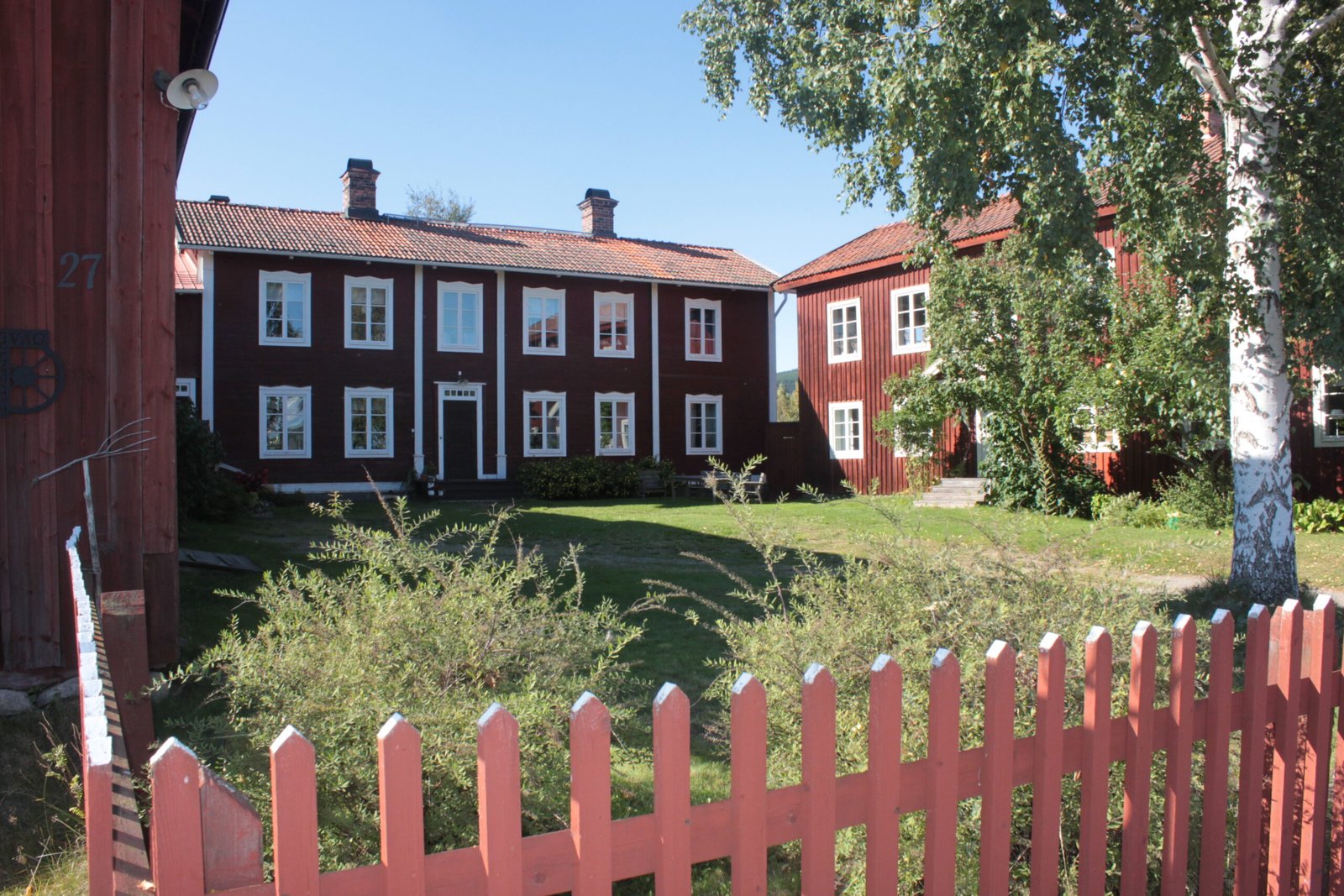
Externally the farmhouses are large, handsome log structures with painted or natural-wood facades, multiple outbuildings arranged in a courtyard, and the characteristic steep roofs of the Swedish timber vernacular. Size signals status: the wealthiest farms have two-storey main buildings with numerous auxiliary structures.
Internally the high rooms are the revelation. Walls, ceilings, and wooden pillars are covered continuously in painted decoration, with no surface left plain. The quality varies between farms — from extraordinarily accomplished figurative programmes to dense floral patterns — but all share an intensity of coverage and colour that is unlike almost any other rural interior in Europe. Furniture, textiles, and objects in the high rooms are original to the families who owned them.
The seven UNESCO farmhouses — Gästgivars, Bortom åa, Pallars, Kristoffer-Anders, Erik-Anders, Svedja, and Stenegård — are distributed across Hälsingland and each has its own distinctive decorative character. Most require advance booking or seasonal opening hours.
Practical information
- Location: Distributed across Hälsingland province, Gävleborg County, central Sweden
- Opening: Most farmhouses open mid-June to mid-August; advance booking required for several — check individual farm schedules at hälsingegårdar.se
- Guided tours: Typically guided only — unaccompanied visits not generally permitted to protect the interiors
- Admission: Modest entry fees per farmhouse; multi-site passes available
- Best time: Summer (June–August) when all seven are accessible and days are long
Getting there
The farmhouses are spread across Hälsingland, a province roughly 250–350 km north of Stockholm. The main hubs are the towns of Hudiksvall, Ljusdal, and Bollnäs, all served by trains from Stockholm (2.5–4 hours). A car is essential to visit multiple farmhouses, as they are distributed across the rural landscape. The E4 motorway passes through the province. The nearest airports are Sundsvall–Timrå (50 km south of the province’s southern boundary) and Arlanda (Stockholm), with onward train connections.
Nearby
- Hudiksvall — the main regional town, with a well-preserved 19th-century wooden-house district and the Hälsingland Museum
- Alfta open-air museum — regional ethnographic collection, Hälsingland tradition
- High Coast / Kvarken Archipelago — UNESCO WHS for post-glacial isostatic rebound, approximately 200 km north
- Falun Copper Mine — UNESCO WHS, approximately 200 km south-west (Dalarna)
Sources
- UNESCO World Heritage — Decorated Farmhouses of Hälsingland
- Wikipedia — Decorated farmhouses of Hälsingland
- Hälsingegårdar — halsingegardarna.se
Find it on the map
See this place and what’s around it →📷 Diventa un fotografo di Cultural Heritage Online
Condividi le tue foto dei luoghi: restano pubblicate con la tua firma come autore. Più vengono viste, più ti fai conoscere — e presto un concorso premierà le foto più apprezzate.
Accedi o registrati gratis per aggiungere una foto