
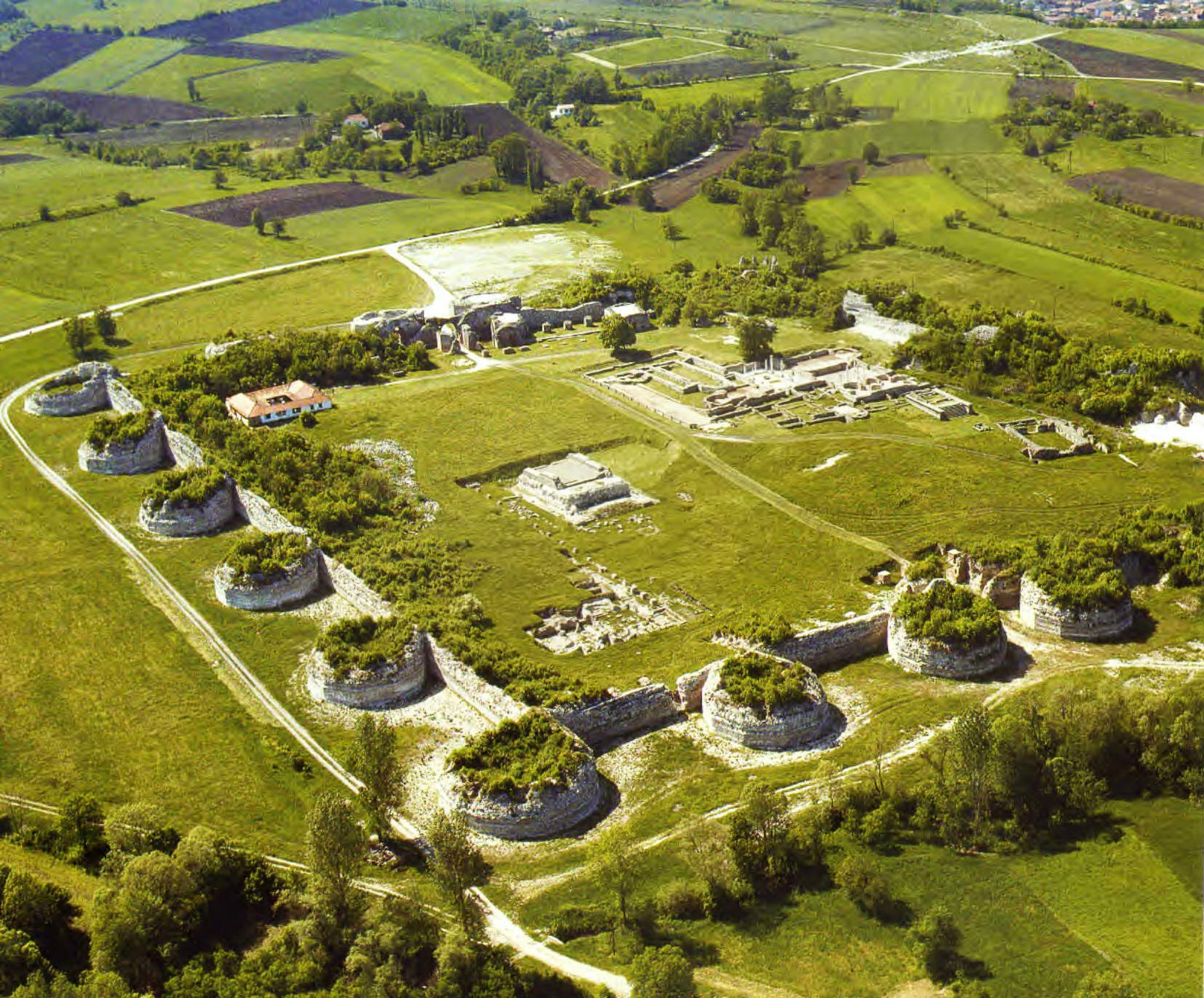
Rising from the plains of eastern Serbia, Felix Romuliana is one of the best-preserved late Roman imperial complexes in the Balkans — a walled palace, twin temples, ceremonial arch, and deification tumuli built by the emperor Galerius as both a seat of power and a dynastic cult centre.
At a glance
Gamzigrad-Romuliana was inscribed as a UNESCO World Heritage Site in 2007. Built between approximately 298 and 311 CE by co-emperor Galerius near the town of Zaječar in eastern Serbia, it was named after his mother Romula and served as his residence, religious centre, and — after his death — his apotheosis site. The palace fell into disuse after the collapse of the Tetrarchy and was never rebuilt, preserving its original late Roman plan remarkably intact beneath centuries of earth.
Key facts
- UNESCO inscription: 2007
- Period: Late Roman, c. 298–311 CE
- Builder: Emperor Galerius (c. 260–311 CE)
- Ancient name: Felix Romuliana (named after his mother Romula)
- Location: Near Zaječar, eastern Serbia
- Key structures: Double fortifications, palatial residence, temples of Jupiter and Hercules, tetrapylon, bathhouse, two burial tumuli
History
Galerius Valerius Maximianus was one of four co-emperors under the Tetrarchic system established by Diocletian. Born near this site in Moesia Superior (present-day eastern Serbia), he chose his birthplace for a grand imperial residence — a statement of dynastic identity as much as military function. Construction began around 298 CE and continued until his death in 311 CE.
Galerius is a contradictory figure in Roman history. He was the principal author of the Great Persecution of Christians (303 CE) — the last and most severe of the systematic state persecutions. Yet it was Galerius who, in the final months of his life, issued the Edict of Serdica (311 CE), the first imperial decree to formally grant Christians legal toleration within the Roman Empire, two years before Constantine’s Edict of Milan.
After Galerius died at Felix Romuliana in 311 CE, his body was placed in one of two large burial tumuli immediately north of the palace walls. His mother Romula, for whom he named the complex, is believed to occupy the other. Both received posthumous deification rites — a solemn statement of dynastic legitimacy in the late Roman tradition.
What you see
The site preserves two concentric fortified enclosures, each with towers. The inner enclosure contains the palatial residence — an irregular arrangement of reception halls, private apartments, and peristyle courts whose foundations remain clearly legible. Two tetrastyle temples, dedicated to Jupiter and Hercules (the divine patrons of the Tetrarchy), stand within the inner precinct.
A tetrapylon — a ceremonial four-gated arch — marked a principal approach. The bathhouse complex has been partially excavated near the eastern sector. The floor mosaics include geometric and figural compositions of high quality; sculptural fragments — portrait heads and architectural reliefs — are held at the National Museum in Zaječar. The burial tumuli north of the walls, each about 30 m in diameter, are visible as grassed earthworks whose burial chambers have been excavated and studied.
Practical information
- Address: Village of Gamzigrad, near Zaječar, eastern Serbia
- Opening: Open daily; visitor centre has seasonal hours — check locally
- Admission: Modest entry fee; combination tickets with the Zaječar National Museum available
- National Museum Zaječar: Houses the finest sculptural and mosaic finds — strongly recommended as companion visit
- Best time: Spring and early autumn; summers are hot on the open plains
Getting there
Zaječar is approximately 11 km from the site, reachable by bus from Belgrade (around 3.5 hours). From Zaječar, the site is best reached by taxi or rental car. The nearest international airport is Niš, approximately 120 km to the south.
Nearby
- National Museum Zaječar — the essential companion, holding sculptures and mosaics from the site (11 km)
- Gamzigrad Spa — thermal spa village immediately adjacent to the archaeological complex
- Lepenski Vir — major Mesolithic site on the Danube, about 85 km north-west
- Viminacium — Roman legionary fortress on the UNESCO Tentative List, about 120 km north-west
Sources
- UNESCO World Heritage — Gamzigrad-Romuliana, Palace of Galerius
- Wikipedia — Gamzigrad-Romuliana
- National Museum Zaječar — muzejzajecar.org
Find it on the map
See this place and what’s around it →📷 Become a Cultural Heritage Online photographer
Share your photos of places: they stay published under your name as the author. The more they're seen, the more you get noticed — and soon a contest will reward the most appreciated photos.
Log in or sign up free to add a photo