
Tehuacan-Cuicatlan Valley: Originary Habitat of Mesoamerica
A semi-arid valley straddling Puebla and Oaxaca that gave the world maize and still harbours the greatest diversity of columnar cacti on Earth. Twelve thousand years of human presence have left an unbroken record of food production from hunter-gatherer camp to Aztec aqueduct.
At a glance
Inscribed on the UNESCO World Heritage List in 2018 on both cultural and natural criteria, the Tehuacan-Cuicatlan Valley lies in a rain-shadow belt receiving under 500 mm of rain per year. It is simultaneously the birthplace of maize cultivation (c. 9,000 years ago) and a globally exceptional cactus hotspot with 45 endemic species including columnar giants up to 15 metres tall. Pre-Columbian peoples built stone-lined aqueducts and irrigation canals that turned this desert into one of the most intensively farmed landscapes in pre-contact Mesoamerica.
Key facts
- UNESCO inscription: 2018 (mixed natural and cultural criteria)
- Location: Puebla and Oaxaca states, southern Mexico
- Area: 145,255 ha (core zone)
- Earliest occupation: c. 12,000 years ago (hunter-gatherer)
- Maize domestication: c. 9,000 years ago from wild teosinte
- Endemic cactus species: 45, including Neobuxbaumia tetetzo (up to 15 m)
- Principal peoples: Tehuacan, Cuicatec, Mixtec, Aztec (post-1450 CE)
- Spanish conquest: 1521 CE
History
Around 12,000 years ago, hunter-gatherers camped in rockshelters along the valley. By c. 9,000 years ago, inhabitants were selecting wild grasses, gradually transforming teosinte into maize. This domestication event ranks among the most consequential in human history: maize now feeds more people globally than any other single crop.
Between 3,500 and 2,000 years ago, permanent villages appeared. The Tehuacan and Cuicatec peoples cut aqueducts from solid rock, channelling highland spring water to irrigate maize, chillies, avocados, and cotton. The Aztec Empire absorbed and extended these hydraulic systems after 1450 CE. Spanish conquest in 1521 dismantled the political framework but not the agricultural landscape; today Nahua, Mixtec, and Cuicatec communities maintain traditional practices recognised under the UNESCO inscription.
What you see
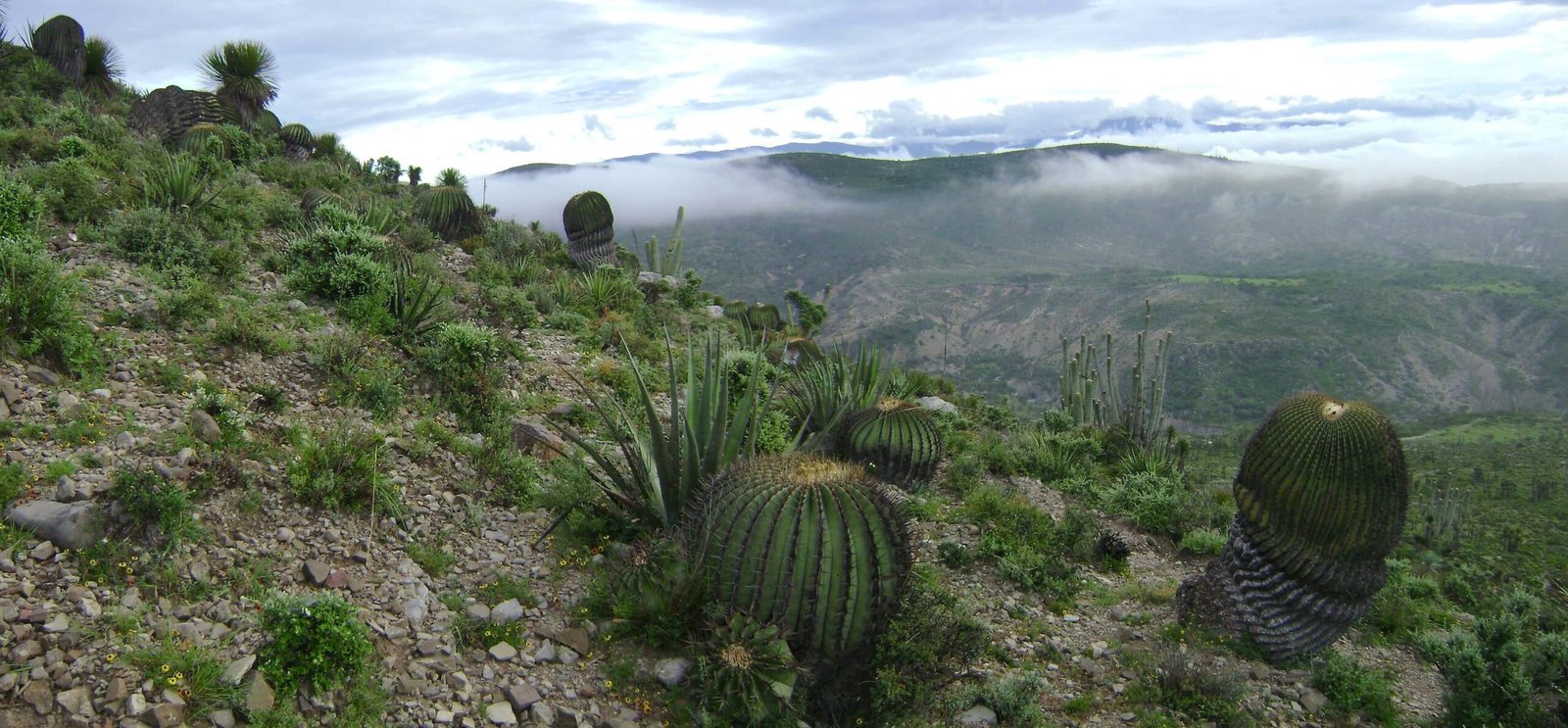
The valley opens into a vast garden of columnar cacti rising like green organ pipes. The endemic Neobuxbaumia tetetzo reaches 15 metres; Cephalocereus columna-trajani forms cathedral-like groves. Scattered through the cactus forest are remains of pre-Columbian aqueducts, stone irrigation channels, and agricultural terraces. Zapotitlan de las Salinas preserves natural salt pans used for millennia. Richard MacNeish excavated (1961-1965) maize cobs just 2-3 cm long here, the earliest domesticated specimens known, now in the Peabody Museum at Harvard.
Global significance
Only a handful of places qualify for UNESCO inscription on both cultural and natural criteria. Maize domestication here shaped the food security of two hemispheres: the plant now grows on every inhabited continent and accounts for roughly one-quarter of global caloric intake. The valley demonstrates 12,000 years of sustainable land management by indigenous communities who transformed an extreme environment without destroying it.
Practical information
- Gateway city: Tehuacan, Puebla (130 km SE of Puebla city)
- By bus: ADO from Mexico City TAPO terminal (4.5 hours) or from Puebla (2 hours)
- Key sites: Jardin Botanico El Riego (Tehuacan); Zapotitlan de las Salinas Botanical Garden
- Best season: November-April; cacti bloom March-May
- Accommodation: Hotels in Tehuacan; basic lodging in Zapotitlan de las Salinas
Getting there
From Mexico City, ADO buses depart TAPO terminal in approximately 4.5 hours. From Puebla, buses and shared taxis (combis) take about 2 hours. A rental car from Puebla gives maximum flexibility. For Zapotitlan de las Salinas, shared taxis run from Tehuacan central market.
Nearby
- Monte Alban, Oaxaca – 150 km south: Zapotec sacred capital (UNESCO 1987)
- Mitla, Oaxaca – 180 km south: finest Zapotec stone mosaic architecture
- Puebla historic centre – 130 km NW: UNESCO colonial Baroque city
- Cholula – 145 km NW: largest pyramid by volume in the world
Sources
- UNESCO WHC, Tehuacan-Cuicatlan Valley, whc.unesco.org/en/list/1534
- Piperno D.R. and Flannery K.V. (2001). The Earliest Archaeological Maize from Highland Mexico. PNAS 98(4):2101-2103.
- MacNeish R.S. (1964). Ancient Mesoamerican Civilization. Science 143(3606):531-537.
Find it on the map
See this place and what’s around it →📷 Diventa un fotografo di Cultural Heritage Online
Condividi le tue foto dei luoghi: restano pubblicate con la tua firma come autore. Più vengono viste, più ti fai conoscere — e presto un concorso premierà le foto più apprezzate.
Accedi o registrati gratis per aggiungere una foto