
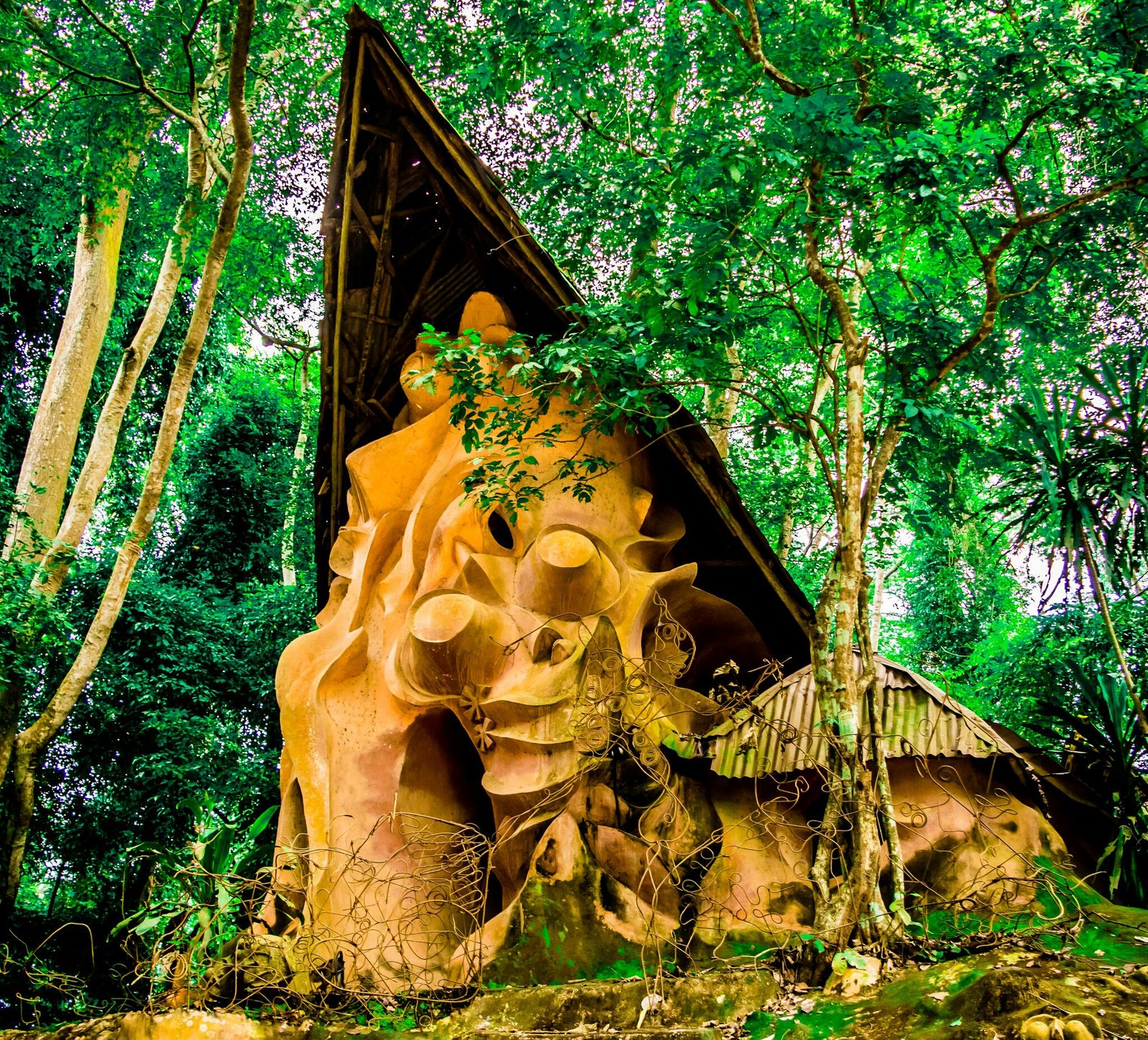
Osun-Osogbo Sacred Grove
Deep inside the city of Osogbo, a 75-hectare forest on the banks of the Osun River holds the last great sacred grove of the Yoruba people: a living shrine, a UNESCO World Heritage Site, and one of Africa’s most extraordinary fusions of nature, myth, and sacred art.
At a glance
The Osun-Osogbo Sacred Grove is a dense tropical forest preserved because it is considered the earthly home of Osun (Oshun), the Yoruba orisha of fertility, love, and sweet water. The grove shelters rivers, springs, shrines, and a remarkable collection of monumental sculptures created by the Austrian-born sacred artist Susanne Wenger (Adunni Olorisha) from the 1960s onward. Each August, hundreds of thousands of Yoruba devotees and Candomble practitioners from Brazil gather here for one of West Africa’s largest religious festivals. UNESCO inscribed the site in 2005 as outstanding living African heritage.
Key facts
- UNESCO inscription: 2005 (List No. 1118)
- Area: approximately 75 hectares — the largest surviving sacred grove in southern Nigeria
- Deity: Osun (Oshun), Yoruba orisha of fertility, sweet water, and love
- Location: banks of the Osun River, Osogbo, Osun State, southwestern Nigeria
- Key artist: Susanne Wenger (Adunni Olorisha, 1915-2009), Austrian painter turned Yoruba priestess
- Annual festival: Osun-Osogbo Festival, every August; a two-week ceremony culminating in a torchlit river procession
- Diaspora connections: sacred to Candomble (Brazil) and Lucomí/Santería (Cuba/USA) practitioners
History and significance
Yoruba oral tradition holds that the Osun River goddess appeared to the first settlers of Osogbo in this forest, warning them not to cut down her grove. The city grew around it, but the forest was preserved as a sacred boundary between human settlement and the spirit world. The grove has been maintained continuously by a succession of high priests (Aworo Osun) and priestesses (Iya Osun), with the current custodian the Ataoja of Osogbo holding spiritual responsibility for its upkeep.
The transformative moment in modern history came through Susanne Wenger, who arrived in Nigeria in 1950, converted to the Yoruba Orisha religion, and took the spiritual name Adunni Olorisha. Working with local Yoruba artists over five decades, she created scores of monumental cement and iron sculptures that blended European avant-garde sensibility with Yoruba cosmological iconography. Her work restored the grove’s spiritual art and drew international attention, helping to secure UNESCO status before her death in Osogbo at age 93.
The Osun-Osogbo Festival, documented continuously since the 17th century, brings the sacred geography alive each August. Its climax is the Arugba procession: a young virgin carries a sacred calabash from the palace to the river under torchlight, a ritual believed to sustain the wellbeing of the Yoruba people for the coming year.
What you see
The grove is entered through a narrow path that muffles the sounds of the city within steps. Enormous trees form a closed canopy over dense undergrowth; the Osun River runs dark and swift at the centre. Shrines of different ages line the route: simple clay structures with offerings of cowrie shells and palm oil alongside Wenger’s large-scale concrete sculptures, their surfaces alive with interlocking zoomorphic and anthropomorphic figures.
The most celebrated Wenger works include the gateway guardian figures at the entrance, a many-armed river-goddess Oshun at the main shrine, and iron sculptures at the riverside sanctuary. The sculptures are consecrated cult objects maintained with regular ritual offerings; visitors are expected to remove footwear at certain shrines. The grove also contains open-air sanctuaries where diviners (babalawo) practice, and sacred iroko trees (African teak) regarded as spirit dwellings. At the heart of the grove, the river widens into a pool where the annual Arugba procession ends.
The Osun-Osogbo Festival
The annual festival is one of the largest religious gatherings in West Africa. The two-week programme includes the lighting of a 500-year-old sixteen-point lamp (Ina Olojumerindinlogun), traditional drumming and ijala chanting by hunters’ guilds, and the installation of a new Arugba if the previous bearer has come of age. The climactic torchlit procession is one of the most visually powerful religious events in Africa. International Candomble delegations travel regularly from Brazil and Cuba to participate, reflecting the Yoruba diaspora’s unbroken spiritual ties to Osogbo.
Practical information
- Getting there: Osogbo is approximately 85 km northeast of Ibadan; daily buses and shared taxis from Lagos (4-5 hours) and Ibadan (1.5-2 hours)
- Entry: small admission fee at the main gate; guided tours available from local guides at the entrance
- Opening hours: generally daily, morning to late afternoon; may close earlier during ritual preparation periods
- Festival timing: August annually; exact dates follow the Yoruba lunar calendar — confirm with Osun State tourism board
- Dress code: modest dress; remove footwear when requested at shrines
- Photography: permitted in most areas; ask before photographing any ritual or consecrated object
Getting there
The nearest major airport is Murtala Muhammed International Airport (Lagos, LOS), approximately 200 km southwest. Domestic flights also serve Akure Airport (AKR, Ondo State, about 90 km south) from Abuja and Lagos. From Osogbo town, the grove is accessible by tricycle (keke napep) or motorcycle taxi from the central market area.
Nearby
- Nike Art Gallery, Osogbo — one of Nigeria’s largest private art galleries, owned by batik master Nike Davies-Okundaye
- Ile-Ife (65 km south) — spiritual heartland of the Yoruba, home to the Ife Museum and its celebrated bronze and terracotta heads
- Ibadan (85 km west) — historic Yoruba city with the University of Ibadan and the Bower Tower
Sources
- UNESCO World Heritage List — Osun-Osogbo Sacred Grove (No. 1118, 2005)
- Wikipedia — Osun-Osogbo
- Drewal, H.J. & Mason, J. (1998). Beads, Body, and Soul: Art and Light in the Yoruba Universe. UCLA Fowler Museum.
- Probst, P. (2011). Osogbo and the Art of Heritage. Indiana University Press.
Find it on the map
See this place and what’s around it →📷 Diventa un fotografo di Cultural Heritage Online
Condividi le tue foto dei luoghi: restano pubblicate con la tua firma come autore. Più vengono viste, più ti fai conoscere — e presto un concorso premierà le foto più apprezzate.
Accedi o registrati gratis per aggiungere una foto