
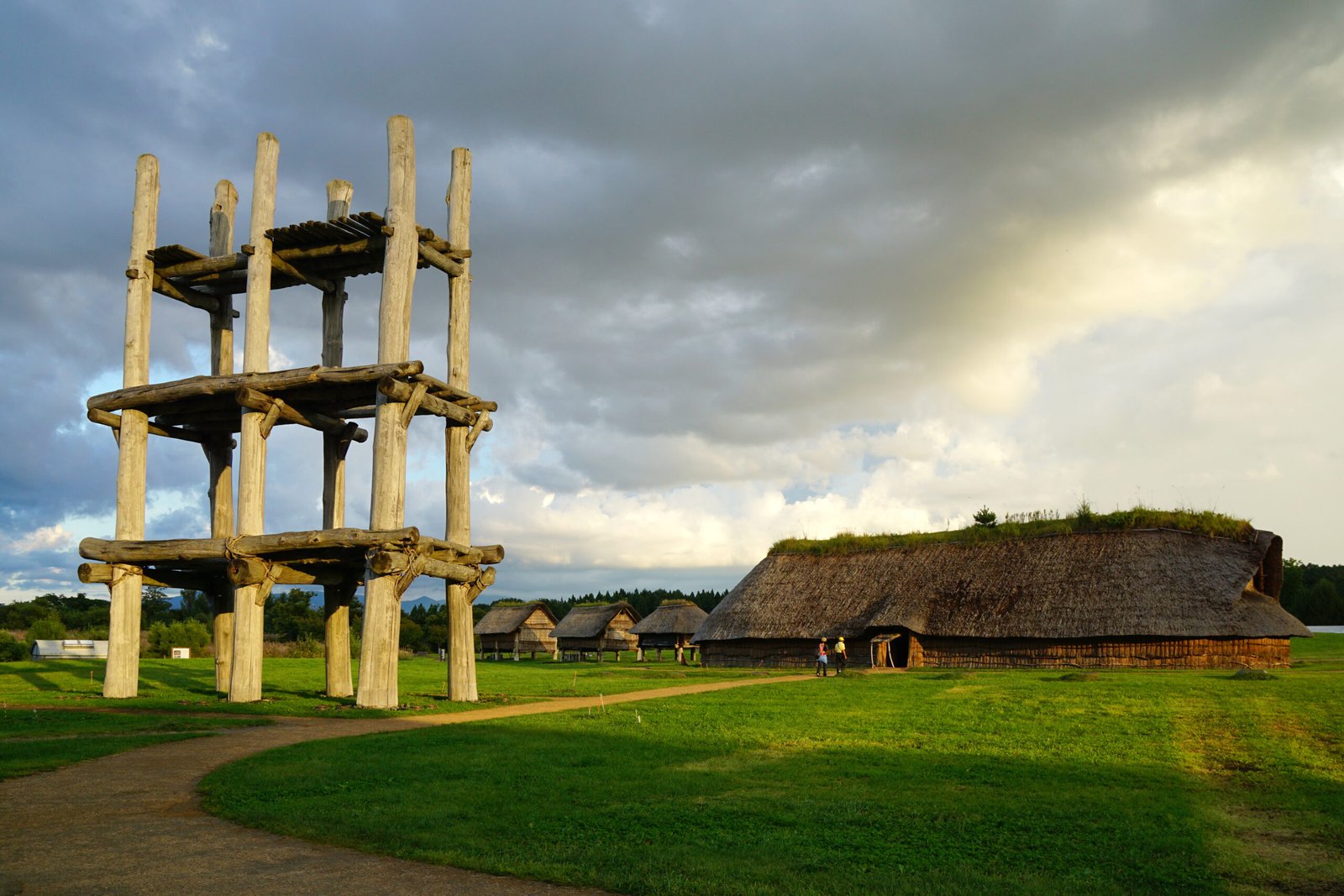
A serial UNESCO World Heritage Site of 17 archaeological locations across Hokkaido and northern Honshu, representing the Jomon culture — a sophisticated hunter-gatherer civilisation that produced the world’s oldest known pottery, built settled communities without agriculture, and endured for over 13,000 years.
At a glance
The Jomon people inhabited the Japanese archipelago from approximately 13,000 BCE to 400 BCE — one of the longest-lasting continuous cultures in human history. Despite being hunter-gatherers, they achieved levels of social complexity, artistic sophistication, and sedentism that challenge standard models of civilisation. They produced the world’s oldest known fired pottery (c. 16,000 BCE), built substantial wooden structures and ceremonial stone circles, and maintained extensive trade networks. The 17 inscribed sites, concentrated in Hokkaido and Tohoku, represent the full arc of Jomon civilisation from its earliest phases to its ceremonial peak. UNESCO recognised the serial site in 2021 — the first World Heritage inscription specifically honouring the achievements of a non-agricultural hunter-gatherer society.
Key facts
- UNESCO inscription: 2021 — Jomon Prehistoric Sites in Northern Japan
- Number of sites: 17 component sites across Hokkaido and Aomori, Iwate, and Akita Prefectures
- Cultural period: Jomon period, c. 13,000–400 BCE
- Oldest pottery: c. 16,000 BCE — the earliest known fired ceramic vessels in the world
- Key sites: Sannai Maruyama (Aomori), Oyu Stone Circles (Akita), Niida Stone Circle, Kakinoshima, Kitakogane shell midden
- Jomon descendants: the Jomon are direct ancestors of the Ainu people of Hokkaido and the Ryukyuan people of Okinawa
- Significance: first UNESCO WH recognition of a non-agricultural civilisation’s global importance
The Jomon civilisation
The Jomon culture takes its name from the characteristic rope-pattern (jomon) decoration pressed into the surface of their pottery. Beginning around 13,000 BCE, Jomon communities spread across the Japanese archipelago, developing regional traditions while maintaining long-distance exchange networks for obsidian, amber, jade, and other prestige materials. In northern Japan — Hokkaido and Tohoku — the cold climate supported an exceptionally rich hunter-gatherer economy based on salmon, deer, nuts, and marine resources.
Jomon society challenges the equation of sedentism with agriculture. By 5000 BCE, large Jomon villages of hundreds of people existed in northern Japan, with planned layouts, communal cemeteries, and evidence of sustained year-round occupation. Sannai Maruyama, occupied from c. 5900 to 4200 BCE, housed a community of several hundred people living in pit dwellings and raised-floor structures, trading over distances of hundreds of kilometres. The Oyu and Niida stone circles (c. 2000 BCE) are among the largest megalithic complexes in East Asia, their layout aligned to astronomical events.
Jomon artistic production includes the “dogu” clay figurines — abstract female forms with goggle-shaped eyes unique to this culture — and the elaborate “flame-pot” ceramics of the Middle Jomon period, whose flamboyant modelled rims have no parallel in world prehistoric art. Around 400 BCE, the migration of rice-farming Yayoi people from the continent began to transform the archipelago, gradually absorbing the Jomon population — though their genetic legacy persists strongly in the Ainu and Ryukyuan peoples today.
What you see at the sites
The 17 inscribed sites encompass a range of site types: large settlement complexes (Sannai Maruyama), shell middens (Kitakogane, Kakinoshima), stone circles (Oyu, Niida), and burial grounds. At Sannai Maruyama — the most visited and extensively excavated — reconstructed pit dwellings, raised-floor granary structures, and a distinctive six-post building provide a vivid picture of village life. The on-site museum contains outstanding collections of Jomon pottery and dogu figurines. The Oyu Stone Circles in Akita consist of two large concentric rings of standing stones, their radial alignment oriented toward the midsummer sunset.
Practical information
- Main visitor site: Sannai Maruyama, Aomori city — open Tuesday to Sunday, 9:00–17:00 (extended hours in summer); closed Mondays and New Year period; admission charged
- Oyu Stone Circles: near Kazuno city, Akita Prefecture; outdoor site accessible year-round; museum on site
- Getting there (Sannai Maruyama): bus from Aomori station, approximately 20 minutes
- Best season: May–October; many northern sites have limited winter access
- Combined pass: check Aomori Prefecture tourism for multi-site discount tickets
Getting there
Aomori city — gateway to Sannai Maruyama, the most accessible Jomon site — is reached by Shinkansen (Tohoku Shinkansen) from Tokyo in approximately 3 hours, or from Sapporo (Hokkaido) in about 4 hours. Regional trains and buses connect Aomori to the Oyu Stone Circles in Akita and other inscribed sites across the Tohoku region.
Nearby
- Sannai Maruyama Site Museum — outstanding collection of Jomon pottery, dogu figurines, and reconstructed structures; directly adjacent to the excavation site in Aomori city
- Aomori Museum of Art — modern art museum in Aomori city, housing important works by Yoshitomo Nara and Marc Chagall
- Towada-Hachimantai National Park — volcanic landscape, caldera lake, and beech forests across Aomori, Akita, and Iwate prefectures
- Oyu Stone Circles (Manzaki and Nonakado) — two large double concentric stone rings from c. 2000 BCE, Kazuno city, Akita; a separate inscribed component of the UNESCO serial site
Sources
- UNESCO World Heritage List — Jomon Prehistoric Sites in Northern Japan (2021): whc.unesco.org/en/list/1632
- Sannai Maruyama Site official: sannaimaruyama.pref.aomori.jp
- Wikipedia — Jomon Prehistoric Sites in Northern Japan: en.wikipedia.org
Find it on the map
See this place and what’s around it →📷 Become a Cultural Heritage Online photographer
Share your photos of places: they stay published under your name as the author. The more they're seen, the more you get noticed — and soon a contest will reward the most appreciated photos.
Log in or sign up free to add a photo