
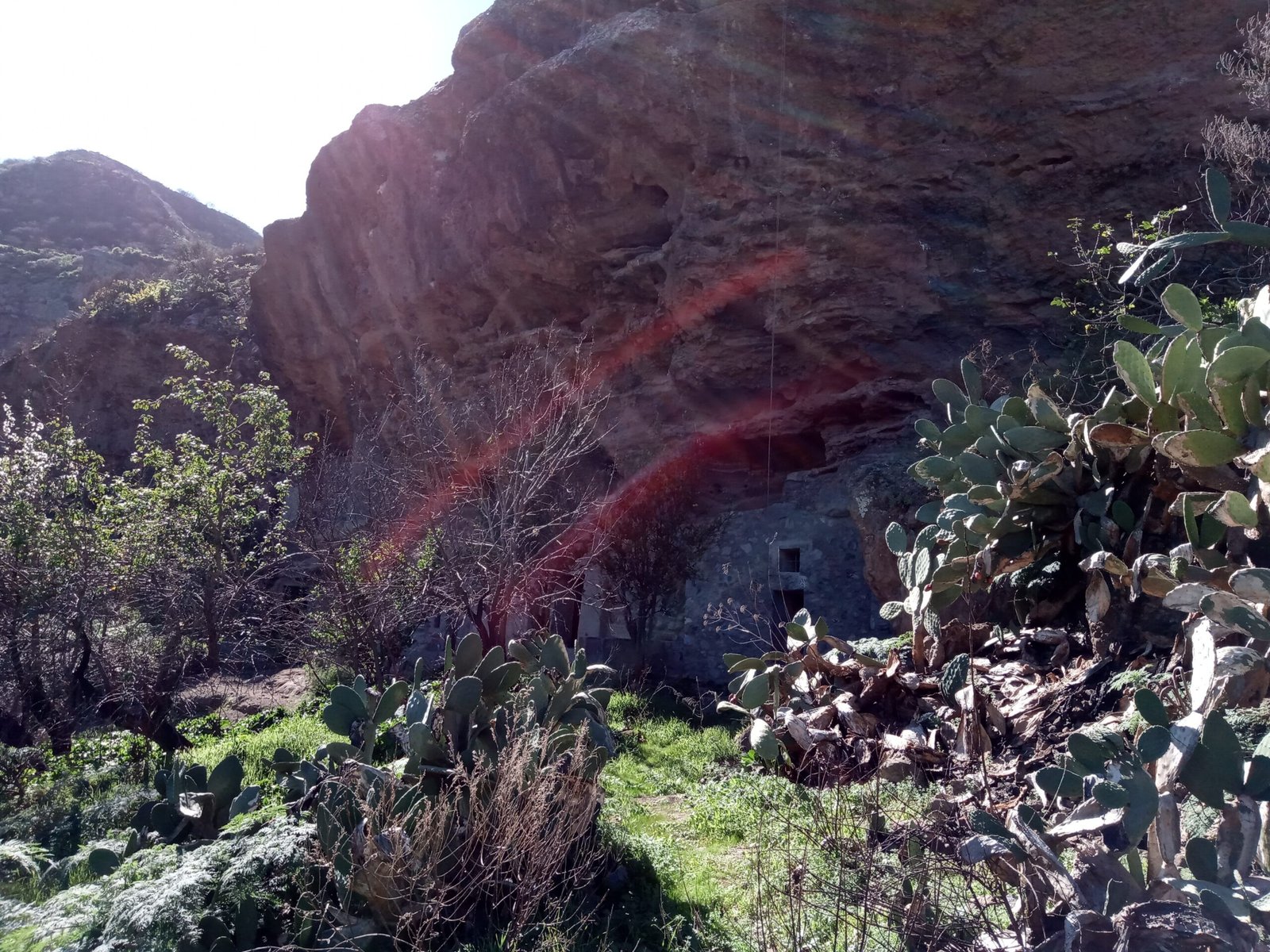
Carved into the vertical walls of a remote ravine in Gran Canaria’s highlands, the Risco Caído sanctuaries are the most remarkable surviving expression of Guanche civilisation — a pre-Hispanic people who built no boats, used no metal, and were cut off from the outside world for centuries until the Spanish conquest.
At a glance
Risco Caído (Fallen Rock in Spanish) is a UNESCO World Heritage Site (2019) in the central highlands of Gran Canaria, Canary Islands, Spain. The inscription encompasses two elements: a cluster of artificially excavated cave dwellings and ceremonial sanctuaries carved into soft volcanic tuff in the Barranco Hondo ravine, and the Sacred Mountains — primarily Roque Nublo and Pico de las Nieves — which served as natural cult centres for the ancient Canarian population. What sets Risco Caído apart from other prehistoric cave sites is its astronomical precision: certain sanctuary chambers contain carved trapezoidal niches through which sunlight enters only at the solstices and equinoxes, transforming the cave interiors into solar calendars. The complex represents the spiritual and communal centre of the Guanche people of Gran Canaria, who maintained a remarkably isolated civilisation for centuries before Spanish colonisation in 1478–1483.
Key facts
- UNESCO inscription: 2019 (Cultural landscape)
- Location: Barranco Hondo, municipality of Agaete, central Gran Canaria, Canary Islands, Spain
- Period: c. 10th–15th century CE (Guanche period, pre-Spanish conquest)
- Type: Cultural landscape combining cave sanctuaries, dwellings, and sacred natural landmarks
- Culture: Guanche (ancient Canarians), of probable North African Berber origin
- Key feature: Astronomical niches — sunlight enters only at solstices and equinoxes
- Coordinates: 27.9764° N, 15.5989° W
History
The ancestors of the Guanche people are believed to have arrived in the Canary Islands from North Africa, most likely related to ancient Berber populations, sometime between the first millennium BCE and the early centuries CE. Once established on Gran Canaria, they developed an entirely self-sufficient society with no sea-going capability — they had no boats capable of inter-island travel, meaning each island’s population evolved in effective isolation from the others and from the mainland.
The cave dwellings and sanctuaries at Risco Caído were excavated from the volcanic tuff (ignimbrite) of the Barranco Hondo ravine, a steep-sided gorge in the island’s interior. The site functioned as both a residential settlement and, more importantly, a ceremonial centre. The astronomical alignment of the sanctuary niches — precise enough to mark the solstices and equinoxes — demonstrates a sophisticated understanding of the solar calendar and suggests that Risco Caído played a central role in the ritual calendar of Gran Canaria’s Guanche communities.
The Guanche civilisation of Gran Canaria had no metal tools, no wheel, and no writing system. They herded goats, grew cereals, and worked volcanic stone with exceptional skill. The cave complexes served multiple functions: habitation for elites or priests, storage of grain in sealed silos, and ceremony. The carved idols and geometric symbols found in the sanctuary walls — trapezoidal reliefs, oval forms, abstract markings — have no fully agreed interpretation; they may represent deities, fertility symbols, or calendrical markers.
The Spanish conquest of Gran Canaria was completed in 1483. The Guanche population was decimated by warfare, enslavement, and European disease. The cave sanctuaries at Risco Caído fell out of use and were effectively forgotten by the colonial population, which helped preserve them. Systematic archaeological investigation began in the 20th century, and UNESCO inscription in 2019 confirmed the site’s outstanding universal value.
What you see
The Risco Caído complex consists of cave chambers cut directly into the walls of the ravine at various heights. The excavation technique is highly skilled: the walls are smoothed, the floors levelled, and the chambers shaped with evident intention. The most celebrated feature is a group of sanctuary chambers containing carved niches — trapezoidal or oval in shape — positioned so that a beam of sunlight falls precisely onto specific carved symbols only on the winter and summer solstices and at the equinoxes. This is one of the clearest examples of intentional astronomical alignment in prehistoric Atlantic Europe or the Canary Islands.
The caves also contain storage silos (sealed with clay stoppers), domestic areas with hearths and animal pens, and carved petroglyphs whose meaning remains debated. Some chambers have been interpreted as initiation or fertility sanctuaries, based on the nature of the carvings and their spatial relationship to the astronomical niches.
The Sacred Mountains component of the WHS — Roque Nublo (a dramatic 80-metre volcanic monolith rising from a 1,803 m plateau) and Pico de las Nieves (the island’s highest point at 1,949 m) — served as visual and spiritual anchors for Guanche communities across Gran Canaria. Both peaks are visible from much of the island and were clearly of profound cosmological significance. Roque Nublo is today one of the most recognisable symbols of Gran Canaria.
Why it matters
Risco Caído is exceptional for several reasons. First, it preserves the most complete surviving evidence of a pre-Hispanic Canarian ceremonial landscape, combining habitation, ritual, and astronomical observation within a single landscape unit. Second, the astronomical precision of the sanctuary niches places it within a broader Atlantic tradition of solar calendar-marking that includes Stonehenge and Newgrange — remarkable for an island culture with no documented contact with Atlantic Europe. Third, it documents a civilisation that evolved in near-total isolation for centuries, making it an irreplaceable laboratory for understanding human social and spiritual development under conditions of geographic isolation. UNESCO’s 2019 inscription was among the most recent additions to the World Heritage List, recognising values that had been underappreciated for decades.
Practical information
- Access: The site is in a protected natural area. Guided visits are mandatory and must be booked in advance through the Cabildo de Gran Canaria (island government). Independent access is not permitted to protect the fragile tuff carvings.
- Visitor centre: The Centro de Interpretación de Risco Caído is located in the nearby village of Artenara, the highest municipality on Gran Canaria.
- Best time to visit: Year-round, though the astronomical alignments are most dramatic at the winter solstice (21 December) and summer solstice (21 June). Book well in advance for solstice visits.
- From Las Palmas de Gran Canaria: Approximately 50 km by road (about 1 hour), via the GC-15 into the interior highlands. Roque Nublo is accessible from the car park near Cruz de Tejeda.
- Admission: Guided tours have a fee; check the Cabildo website for current pricing and availability.
Getting there
Gran Canaria is served by Gran Canaria Airport (LPA), with frequent direct flights from mainland Spain and major European cities. From Las Palmas de Gran Canaria, the site is reached by car via the central mountain roads (GC-15 / GC-21). Public transport into the interior highlands is limited; a rental car is strongly recommended. The nearest villages are Artenara (for the interpretation centre) and Tejeda. Roque Nublo is accessible by a 30-minute walk from the Cruz de Tejeda car park area.
Nearby
- Roque Nublo: The 80-metre volcanic monolith, symbol of Gran Canaria and a Guanche sacred mountain — a 30-minute walk from the Cruz de Tejeda area.
- Pico de las Nieves: Highest point of Gran Canaria (1,949 m); panoramic views across the island.
- Artenara: The highest village in Gran Canaria, with cave houses still inhabited and the Risco Caído interpretation centre.
- Tejeda: Picturesque village in the volcanic caldera, gateway to the central highlands; known for almond blossom in February.
- Cenobio de Valerón: Another major Guanche cave complex on the northern coast of Gran Canaria — grain silos and meeting chambers carved into a cliff face.
Sources
- UNESCO World Heritage Centre — Risco Caído and the Sacred Mountains of Gran Canaria Cultural Landscape (List no. 1577, inscribed 2019)
- Wikipedia — Risco Caído
- Cabildo de Gran Canaria — official site management authority
Find it on the map
See this place and what’s around it →📷 Become a Cultural Heritage Online photographer
Share your photos of places: they stay published under your name as the author. The more they're seen, the more you get noticed — and soon a contest will reward the most appreciated photos.
Log in or sign up free to add a photo