
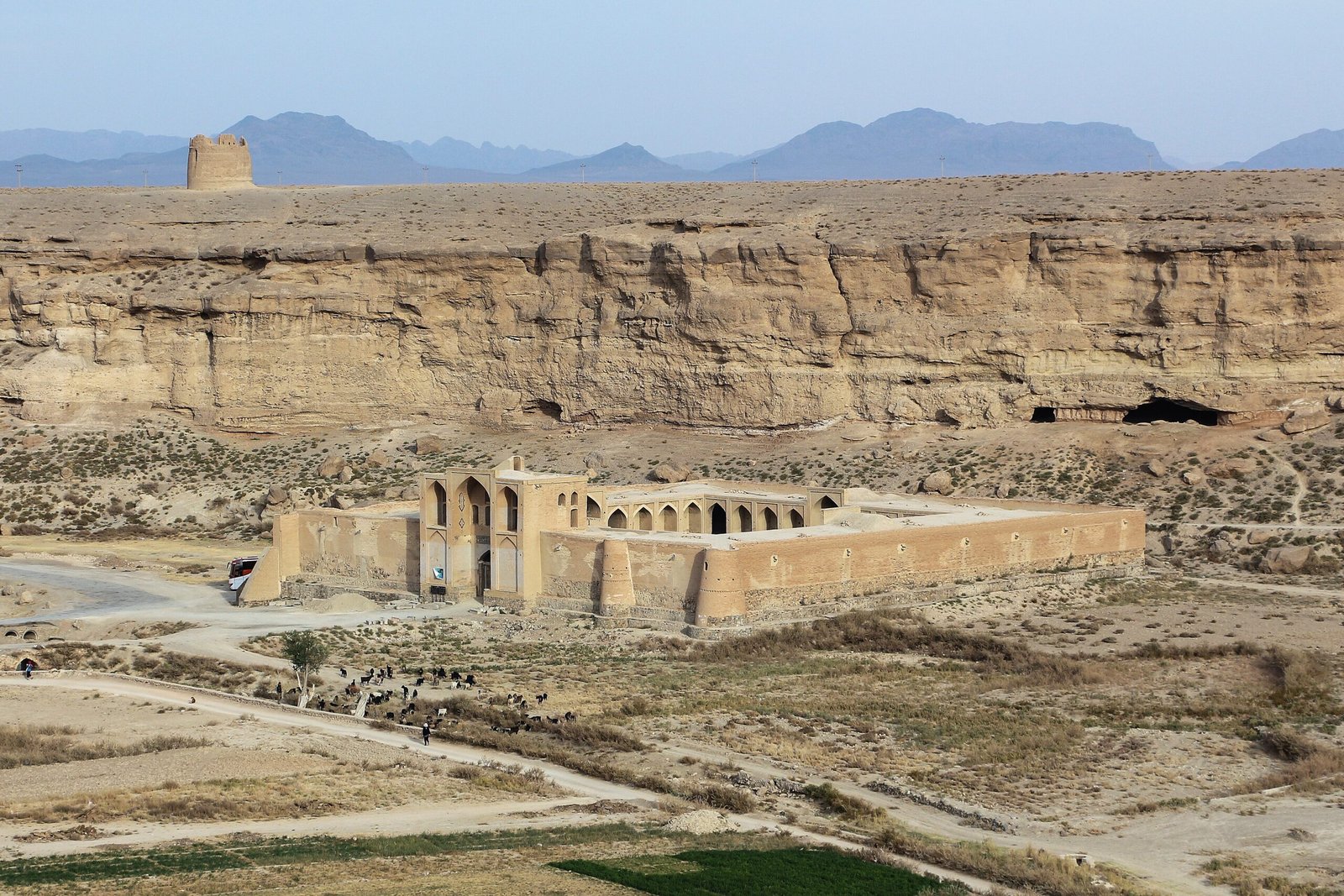
For a thousand years, the vast Iranian plateau was crossed by a web of roadside inns — caravanserais — spaced one day’s journey apart, providing food, shelter, water, and safety to merchants, pilgrims, and armies. The 54 surviving examples inscribed by UNESCO in 2023 are among the most refined architectural achievements of the Islamic world.
At a glance
The Persian Caravanserai is a UNESCO World Heritage Site (2023) — a serial nomination of 54 caravanserais distributed across the major historical trade routes of the Iranian plateau. Together they represent one of the most substantial surviving networks of pre-modern roadside inns in the world, and the most coherent architectural tradition of Islamic hospitality infrastructure. Caravanserais were built at intervals of roughly 25–35 km — approximately one day’s travel by caravan — to provide overnight accommodation, stabling for animals, water, food, and security along the great trade routes connecting Central Asia, Mesopotamia, Anatolia, and the Persian Gulf. The inscribed examples in Iran span primarily the Safavid (16th–18th centuries) and Qajar (18th–19th centuries) periods, though the tradition is older. Their distinctive plan — a central courtyard with a deep iwan (vaulted portal) on each of the four sides and rows of cells arranged around the perimeter — represents one of the most consistent and geometrically elegant architectural types in the Islamic world. The 2023 UNESCO inscription was among the most recent additions to the World Heritage List.
Key facts
- UNESCO inscription: 2023 (Serial cultural property — 54 components)
- Location: Distributed across Iran; major clusters in Isfahan, Kerman, Fars, and Khorasan provinces
- Period: 16th–19th century CE (Safavid through Qajar dynasties); tradition dates to at least the Sassanid era
- Type: Serial nomination of roadside inns / hospitality architecture
- Number of components: 54 caravanserais selected from hundreds of surviving examples
- Key feature: Central courtyard plan with four iwans; cells arranged around perimeter; spacing of one day’s caravan journey (~25–35 km)
- Reference coordinates: 32.4279° N, 53.6880° E (centroid of Iranian plateau)
History
The concept of the caravanserai — a protected overnight stopping place for merchant caravans — is ancient in Iran and the broader Islamic world. Precursors existed in the Sassanid Persian period (3rd–7th century CE), and the tradition continued under the Umayyad and Abbasid caliphates. But it was under the Safavid dynasty (1501–1736) that caravanserai construction in Iran reached its apogee. Shah Abbas I (r. 1588–1629), who transformed Isfahan into one of the great cities of the early modern world, is credited with a massive programme of caravanserai construction along Iran’s major roads — reportedly building or rebuilding hundreds of caravanserais as part of a deliberate policy of stimulating commerce and securing long-distance trade.
The economic logic was straightforward: caravans carrying silk, spices, textiles, and metals needed secure stopping points. A caravanserai offered a walled enclosure (protection against banditry), stabling for horses, camels, and mules, accommodation cells for merchants, a water supply (often from a qanat or cistern), and sometimes a bazaar, bath (hammam), and mosque. In return, the state collected tolls and encouraged trade that generated tax revenue.
The Qajar dynasty (1789–1925) continued the tradition, though with fewer royal-patronage projects and more commercially funded buildings. By the late 19th century, the advent of motorised transport and the decline of caravan trade rendered the caravanserai network obsolete. Many fell into ruin; others were converted to other uses (bazaars, hotels, warehouses). The surviving examples preserved enough architectural integrity to support a UNESCO serial nomination, which was finally approved in 2023 after years of preparation by the Iranian Cultural Heritage, Handicrafts and Tourism Organization (ICHTO).
What you see
The canonical Persian caravanserai plan is one of the most recognisable in Islamic architecture: a large rectangular or square enclosure with a single fortified entrance, a central open courtyard (often with a central pool or fountain), and a deep vaulted iwan on each of the four sides of the courtyard. The iwan — a three-sided vaulted hall open at the front — was the defining Iranian architectural element, inherited from Sassanid palatial architecture and adapted for the caravanserai. Around the courtyard perimeter run rows of accommodation cells (hujras), each typically consisting of a small room with a raised sleeping platform and a stable below or adjacent for the merchant’s animals.
The 54 inscribed examples span a wide range in scale, material, and decoration. The great royal caravanserais of the Safavid period — such as Shah Abbasi Caravanserai in Kashan or the caravanserais along the Isfahan-Shiraz road — are large, formally planned structures with elaborate tile decoration on the portals and iwans. Simpler desert caravanserais in remote areas of Kerman or Khorasan are built of mud brick with minimal ornament, their grandeur deriving entirely from proportion and function. Some are circular in plan (a distinctive Iranian variation); others are octagonal or irregular, adapting to the terrain.
Water management was critical. Many caravanserais are associated with a qanat (underground irrigation channel) that provided a reliable water supply in the arid Iranian plateau. Cisterns, ice houses (yakhchal), and gardens formed part of the larger caravanserai complex at major stopping points.
Why it matters
The Persian caravanserai network was the internet of the pre-modern Silk Road world: infrastructure that made long-distance connectivity possible at scale. The 54 inscribed examples collectively document the full architectural typology of the caravanserai form — from desert mud-brick posts to royal-patronage showpieces — and represent an irreplaceable record of pre-modern hospitality, commerce, and landscape organisation across the Iranian plateau. Iran’s caravanserais also had profound architectural influence: the caravanserai plan was adopted and adapted across the Islamic world from Morocco to Central Asia, making the Iranian examples the closest thing to a canonical type. UNESCO’s 2023 serial inscription, one of the most recent on the World Heritage List, recognised this outstanding universal value after decades of advocacy by Iranian heritage authorities.
Practical information
- Visiting individual caravanserais: The 54 inscribed components are spread across Iran. Many are accessible as day trips from major cities: Isfahan, Shiraz, Kerman, and Yazd are convenient bases.
- Best known examples: Shah Abbasi Caravanserai (Kashan); Zein-o-din Caravanserai (near Yazd, now a boutique hotel); Ganjali Khan Caravanserai (Kerman bazaar complex); Izadkhvast Caravanserai (Fars Province, the UNESCO hero image).
- Some caravanserais are now hotels: Zein-o-din and a handful of others have been sensitively converted into accommodation — an extraordinary way to experience the architecture.
- Entry requirements for Iran: Most Western nationals require a visa; check current requirements before travel. Iran is generally safe for cultural tourism; guided tours are available from specialist operators.
- Best time to visit: Spring (March–May) and autumn (September–November) avoid summer heat on the plateau.
Getting there
Iran is served by international airports in Tehran (IKA — Imam Khomeini International), Isfahan (IFN), and Shiraz (SYZ). Most visitors base themselves in Tehran, Isfahan, Shiraz, or Yazd to access different clusters of caravanserais. Domestic flights connect major cities efficiently. Many caravanserais sit directly on main highways and are accessible by car or organised tour. The Isfahan–Shiraz road (historic Safavid royal route) passes several inscribed examples and can be driven in a day with stops. Zein-o-din Caravanserai near Yazd is one of the most accessible and best-preserved, approximately 60 km south of Yazd city on the old Yazd–Kerman road.
Nearby highlights
- Isfahan (Naqsh-e Jahan Square): UNESCO WHS and one of the world’s great public spaces — the epicentre of Safavid architecture, 3 km from multiple caravanserai examples.
- Yazd: UNESCO-listed historic city of wind towers and qanats — base for Zein-o-din Caravanserai.
- Persepolis (near Shiraz): The ceremonial capital of the Achaemenid Empire — accessible from the Shiraz caravanserai cluster.
- Kerman: Gateway to the Lut Desert (UNESCO WHS) and the Ganjali Khan caravanserai complex within the historic bazaar.
- Kashan: Home to the Shah Abbasi Caravanserai and the Fin Garden (another UNESCO site).
Sources
- UNESCO World Heritage Centre — The Persian Caravanserai (List no. 1678, inscribed 2023)
- Wikipedia — Persian caravanserai
- Iranian Cultural Heritage, Handicrafts and Tourism Organization (ICHTO)
Find it on the map
See this place and what’s around it →📷 Become a Cultural Heritage Online photographer
Share your photos of places: they stay published under your name as the author. The more they're seen, the more you get noticed — and soon a contest will reward the most appreciated photos.
Log in or sign up free to add a photo