
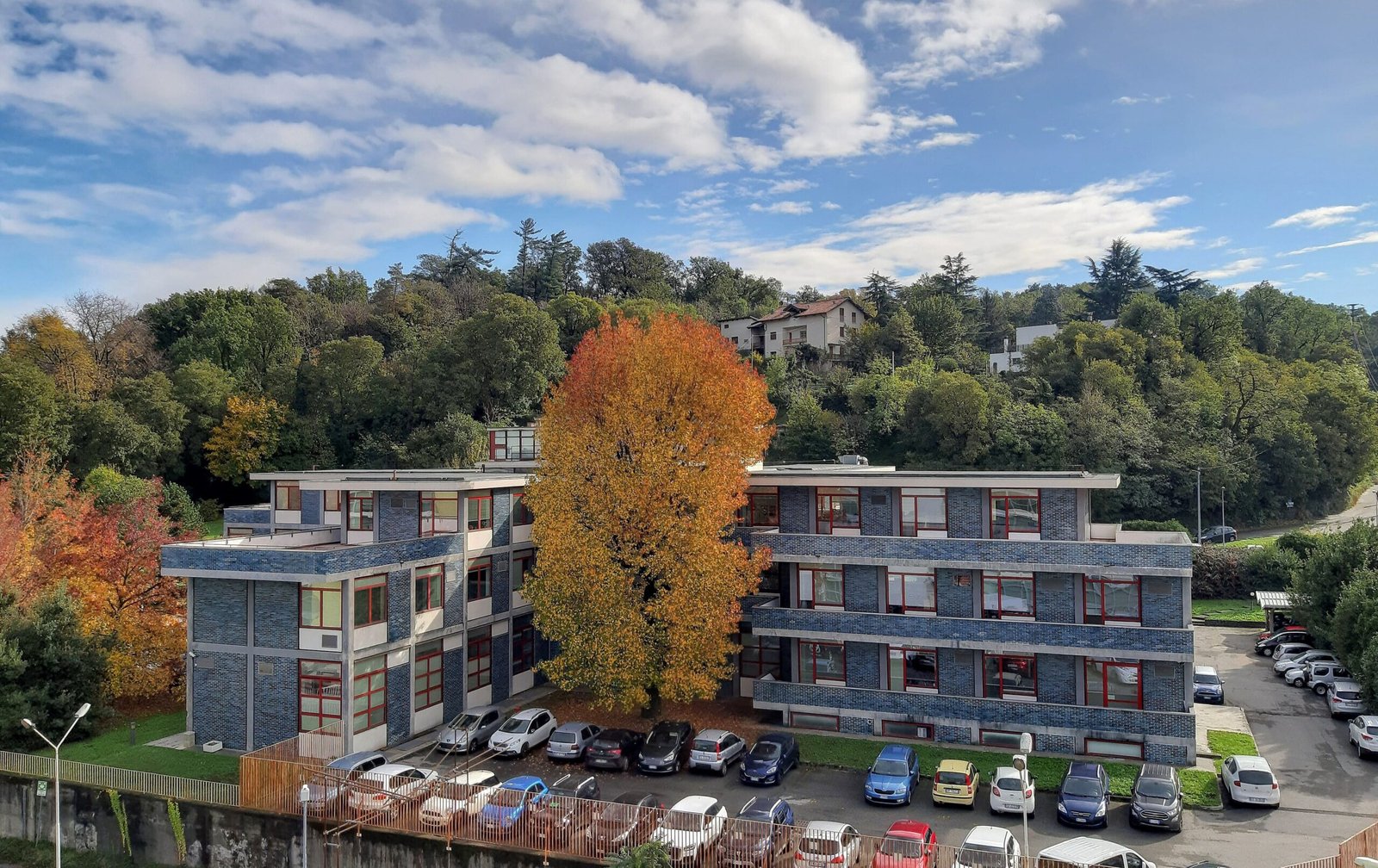
A small Piedmontese town where the Olivetti company, under Adriano Olivetti, employed Italy greatest modernist architects to build not just factories but a complete model city for workers, producing a cohesive urban landscape unique in Italy and a philosophy of industrial design still influential worldwide. UNESCO World Heritage Site since 2018.
At a glance
Ivrea is a town of approximately 22,000 inhabitants in the Aosta Valley foothills of northwest Piedmont, about 50 km north of Turin. The Olivetti typewriter and computing company, founded by Camillo Olivetti in 1908 and developed into a global enterprise by his son Adriano from the 1930s, systematically built the town around the needs of its workers, commissioning Italy leading architects to design factories, housing, nurseries, a library, canteens, social clubs, and arts facilities. The result is the most complete example of modernist social urbanism in Italy, with over 30 protected buildings. UNESCO inscribed Ivrea in 2018 as the most complete and best-preserved example of urban planning inspired by the modern movement in Italy.
Key facts
- Founded: Olivetti factory opened 1896; Adriano Olivetti era of social urbanism mainly 1930s to 1960s
- Key architects: Giovanni Michelucci, Ignazio Gardella, Luigi Figini, Gino Pollini, Marco Zanuso, Eduardo Vittoria
- Protected buildings: Over 30 listed structures including factories, housing blocks, nurseries, social facilities
- UNESCO: Inscribed 2018 as Outstanding Universal Value category i and iv
- Landmark product: Programma 101, 1965, considered by many historians the first personal computer, years before Apple I or Altair
- Company fate: Olivetti declined after Adriano death in 1960; sold computing division 1964; typewriter production ended 2000s
- Population: Approx. 22,000 today in Ivrea; peak workforce at Olivetti was approx. 15,000 in the 1960s
History
Camillo Olivetti founded Olivetti in 1908 as Italy first typewriter manufacturer in a converted former cotton mill in Ivrea. His son Adriano, who took control of the company in 1938, had studied at Fiat and in the United States and had become convinced that industrial capitalism could serve human flourishing rather than merely profit. He began commissioning Italy finest architects to rebuild the entire company environment.
Between the 1930s and 1960s Adriano Olivetti hired Giovanni Michelucci, Ignazio Gardella, Luigi Figini, Gino Pollini, Marco Zanuso, and others to design factory buildings that were in themselves expressions of beauty and dignity, not just production sheds. Around the factories he built workers housing, nurseries open to all employees children, a community library, canteens designed as social spaces, theatres, sports facilities, and a research centre. The architectural quality of each commission was extraordinarily high; the factory buildings from Figini and Pollini in particular are among the finest examples of Italian modernism.
Adriano Olivetti also ran the company as an experiment in social democracy: workers participated in governance, profit-sharing was introduced, and the seven-hour working day was pioneered here before becoming Italian law. He died suddenly in 1960 at age 58, and without his guiding vision the company lost coherence and market position in the transition to computing, eventually selling its computing division to General Electric in 1964. Production of typewriters continued until the early 2000s before the final closure.
The Programma 101, launched at the New York World Fair in 1965, is regarded by historians as a landmark in computing: a desk-sized programmable calculating machine with magnetic card memory, it predated the Altair and Apple by more than a decade and sold approximately 44,000 units. HP licensed its technology for its own early desktop calculators.
What you see
The Olivetti industrial district is concentrated in the lower part of Ivrea, along the left bank of the Dora Baltea river. The landmark building is the large factory ICO, Ing. C. Olivetti and Co, designed by Figini and Pollini from 1934, with its celebrated glass curtain wall facades, one of the first examples of this construction technique in Italy. Alongside it are the red brick workers housing blocks of the Residential Quarter designed by the same architects and notable for their large windows, generous ceiling heights, and communal gardens.
Among the social buildings, the nursery designed by Nizzoli associates stands out for its low, light-filled interiors designed around the needs of small children. The mensa aziendale, or company canteen, by Ignazio Gardella is a masterpiece of postwar Italian rationalist architecture. The research centre La Serra by Eduardo Vittoria from the 1950s-60s introduced glass curtain walls in a hill setting. Together these buildings form a coherent urban fabric where modernist architecture meets social purpose across an entire district of the town.
A museum, Museo Tecnologico Olivetti, is located in Ivrea and contains historic typewriters, the Programma 101, and documentation of the company history. Several buildings are used for cultural events and temporary exhibitions.
World Heritage significance
UNESCO recognised Ivrea as demonstrating outstanding universal value under criteria i and iv: as an outstanding example of human creative genius in the integrated design of an industrial town, and as an outstanding example of a type of architectural or technological ensemble illustrating a significant stage in human history specifically, the 20th-century belief that industrial capitalism could be humanised through design, architecture, and social policy.
Ivrea is unique in that the ambition was total: Adriano Olivetti did not merely commission good factory architecture but set out to redesign work, community, and urban life simultaneously. The result is the only Italian city where modernist social urbanism was realised at this scale and quality. The inscription recognises Ivrea alongside similar experiments in model industrial towns including Crespi d Adda in Lombardy, which is also on the World Heritage List.
Practical information
- Address: Ivrea, Province of Turin, Piedmont, Italy
- Free access: The town and most of the Olivetti district can be visited freely; the factory buildings are partially accessible on guided tours
- Museum: Museo Tecnologico Olivetti, Piazza Camillo Olivetti 2; check current opening hours locally
- Guided tours: Offered by Ivrea tourism office and various cultural associations; some in English
- Annual festival: Ivrea hosts a famous carnival each February featuring the Battle of the Oranges, one of Italy oldest carnival traditions
Getting there
Ivrea is served by direct rail from Turin Porta Nuova station, journey approximately 45 to 55 minutes, with frequent departures throughout the day. By car from Turin take the A5 motorway towards Aosta, exit at Ivrea, approximately 50 km and under one hour. From Milan by train, change at Turin or take a direct service via Chivasso, total journey approximately 1.5 to 2 hours. Parking is available in the town centre and near the industrial district.
Nearby
- Crespi d Adda – UNESCO listed model workers village built by cotton industrialist Cristoforo Crespi, Lombardy, approx. 80 km southwest
- Aosta – Roman provincial capital with exceptional amphitheatre and triumphal arch, 60 km north up the Aosta Valley
- Turin – Piedmontese royal capital, Baroque palaces, Fiat Lingotto, Museo Egizio, 50 km south
Sources
- UNESCO World Heritage Centre – Ivrea, industrial city of the 20th century, whc.unesco.org/en/list/1538
- Wikipedia – Ivrea industrial city of the 20th century, en.wikipedia.org/wiki/Ivrea,_industrial_city_of_the_20th_century
- Valerio Ochetto – Adriano Olivetti, Mondadori, 1985
- Fondazione Adriano Olivetti – fondazioneadrianolivetti.it
Find it on the map
See this place and what’s around it →📷 Become a Cultural Heritage Online photographer
Share your photos of places: they stay published under your name as the author. The more they're seen, the more you get noticed — and soon a contest will reward the most appreciated photos.
Log in or sign up free to add a photo