
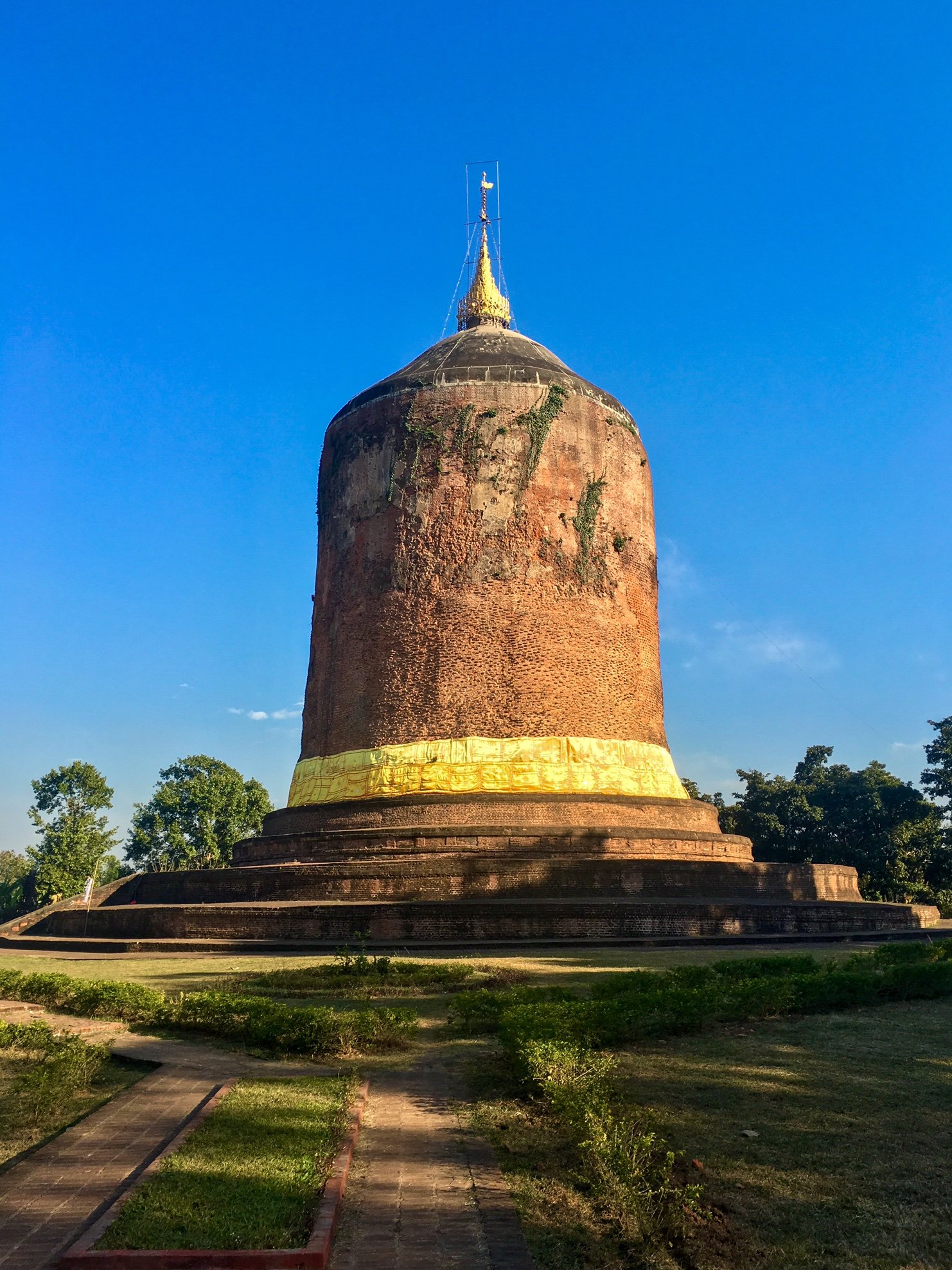
The Pyu city-states were the first urbanised civilisation in Myanmar and a critical conduit for Theravada Buddhism moving from South Asia into Southeast Asia — centuries before Bagan, centuries before Angkor. UNESCO inscribed three of their walled capitals in 2014.
At a glance
Between roughly 200 BCE and 900 CE, the Pyu people built a series of walled urban centres across central Myanmar that represent the earliest cities, the earliest Buddhist monuments, and the earliest surviving inscriptions in the region. Three cities form the UNESCO World Heritage property: Beikthano (the earliest, c. 200–600 CE, containing the oldest known Buddhist monastery enclosure in Southeast Asia), Halin (the most northerly, in the dry zone), and Sri Ksetra (the largest and best-studied, c. 7th–9th centuries CE, with a 7 km city wall circuit and remarkable brick stupas). Together they document a Buddhist urban civilisation that predates both Bagan and Angkor by several centuries.
Key facts
- UNESCO inscription: 2014 (World Heritage Site)
- Period: c. 200 BCE–900 CE (Pyu civilisation)
- Three cities: Beikthano (earliest), Halin (northernmost), Sri Ksetra (largest)
- Sri Ksetra city wall: Approximately 7 km circuit; oval plan
- Oldest Buddhist monastery: Beikthano contains the oldest known monastery enclosure in Southeast Asia
- Pyu inscriptions: Nearly 3,000 texts on gold, silver, and tin tablets from Sri Ksetra — the oldest surviving written records in Myanmar
- Location: Sri Ksetra near Pyay (Prome), Bago Region; Beikthano in central Myanmar; Halin in the northern dry zone
History
The Pyu people established themselves in the Irrawaddy valley of central Myanmar around the beginning of the Common Era, probably moving southward from the eastern Tibetan plateau. Their cities were not single-period settlements but long-lived urban centres that evolved over centuries, absorbing and transmitting cultural influences from India along the maritime and overland trade routes connecting South Asia to mainland Southeast Asia.
Beikthano, the oldest of the three UNESCO cities, was occupied from approximately 200 BCE to 600 CE. Its most significant discovery is an early Buddhist monastery enclosure — the oldest identified in all of Southeast Asia — demonstrating that Theravada Buddhism had taken root in this part of the world long before the more famous later kingdoms of Bagan or Angkor. Ceramics found at Beikthano show direct links to northern Indian Buddhist centres.
Sri Ksetra, situated near modern Pyay (Prome) in Bago Region, was the largest and most powerful of the Pyu cities, reaching its peak in the 7th to 9th centuries CE. Its impressive oval city wall, approximately 7 km in circuit, enclosed a palace complex, Buddhist monasteries, and a series of large brick stupas. Among these, the Bawbawgyi Stupa and the Payama Stupa are the best preserved. Nearly 3,000 Pyu texts on metal tablets discovered here represent the oldest surviving inscriptions in Myanmar and provide direct evidence of Sanskrit Buddhist learning at the site.
The Pyu civilisation declined and was ultimately absorbed into emerging Burman kingdoms by the 9th–10th centuries CE. The Bagan kingdom, which would become Myanmar known heritage landmark, emerged partly from the political vacuum left by the Pyu city-states.
What you see
At Sri Ksetra, the most accessible of the three cities, the oval earthen city wall survives as a substantial earthwork and can be traced for much of its 7 km circuit. Within the enclosure, the most striking monuments are the large brick stupas. The Bawbawgyi Stupa is a cylindrical tower stupa of considerable height; its form, with a straight cylindrical body and a simple dome, is quite different from the bell-shaped Burmese stupas familiar from Bagan, and reflects an earlier architectural tradition with strong South Asian connections. The Payama Stupa and the Lemyethna Temple are also largely intact. Royal palace mounds, tank embankments, and scattered brick foundations complete the site. An on-site museum displays Pyu artefacts including the extraordinary gold and silver tablet inscriptions.
Beikthano and Halin are more remote and less developed for visitors, but both contain visible earthwork city walls, Buddhist remains, and excavation areas.
Practical information
- Sri Ksetra: Open daily; an entry fee applies for the site area and the on-site museum; guide services available locally
- Base town: Pyay (Prome), approximately 3 km from Sri Ksetra, with hotels, restaurants, and bus/rail connections to Yangon (c. 5–6 hours by bus)
- Beikthano and Halin: More remote; require private transport and additional travel time; conditions vary by season
- Best time: November–February (cool dry season); the central Myanmar plain is very hot March–May and subject to heavy rain June–October
Getting there
The principal gateway to the Pyu World Heritage sites is Pyay (Prome), served by express buses from Yangon (c. 5–6 hours) and by train. From Pyay, Sri Ksetra is approximately 3 km by road and accessible by motorcycle taxi or private car. Halin is reached from Shwebo in the Sagaing Region (north Myanmar); Beikthano is near Taungdwingyi in the Magway Region. Domestic flights to Yangon connect to international routes.
Nearby
- Pyay town — the modern town on the Irrawaddy river, with the prominent Shwesandaw Pagoda rising above the riverbank
- Bagan — c. 200 km north; Myanmar most celebrated heritage site, with thousands of 9th–13th century Buddhist temples across a vast plain (UNESCO WHS 2019)
- Magwe and the oil fields region — historic Irrawaddy valley towns with colonial-era architecture
Sources
Find it on the map
See this place and what’s around it →📷 Become a Cultural Heritage Online photographer
Share your photos of places: they stay published under your name as the author. The more they're seen, the more you get noticed — and soon a contest will reward the most appreciated photos.
Log in or sign up free to add a photo