
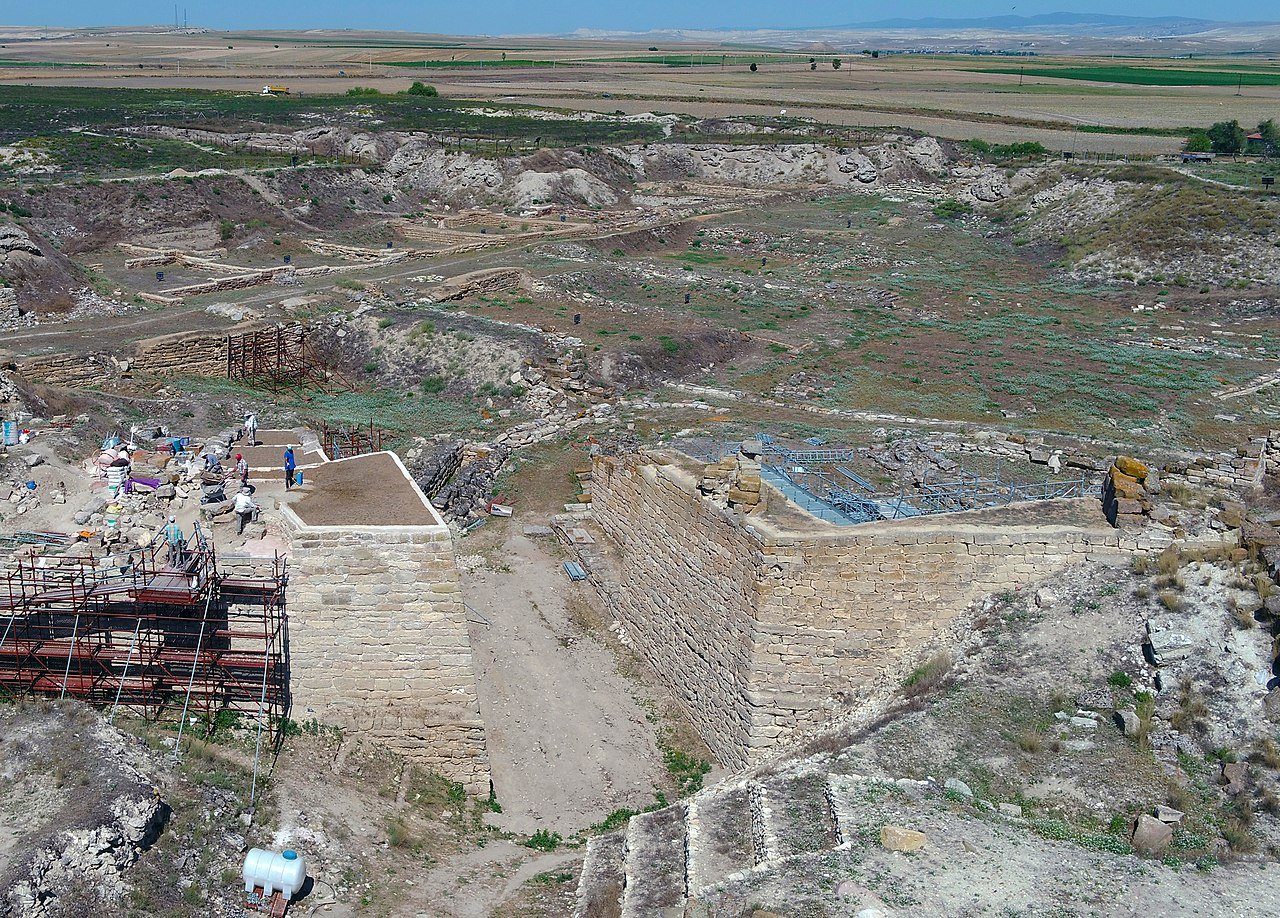
The ancient capital of Phrygia — site of the Gordian Knot legend, tomb of the legendary King Midas, and home to the world’s earliest known geometric mosaic floors — inscribed UNESCO World Heritage in 2023.
At a glance
Gordion, the capital of the ancient kingdom of Phrygia, lies near modern Polatlı, about 100 km southwest of Ankara in central Turkey. It was inscribed on the UNESCO World Heritage List in 2023. Occupied from the Early Bronze Age (c. 2300 BCE) through the Byzantine period, the site reached its peak as a wealthy regional power controlling trade routes between Aegean Greece and the Near East in the 9th and 8th centuries BCE.
Gordion is famous for two legends: the Gordian Knot (cut by Alexander the Great in 333 BCE) and its association with the semi-mythological King Midas of the golden touch. Excavations since the 1950s have produced extraordinary findings that fully justify both the legends and the UNESCO inscription.
Archaeological discoveries
The excavated citadel contains a set of Early Phrygian (c. 950–800 BCE) mudbrick buildings whose floors are covered in elaborate geometric patterns made from small pebbles — the earliest known geometric mosaic floors in the world, predating Greek mosaics by several centuries. The patterns include meanders, swastikas (an ancient solar symbol), and star motifs, rendered with a precision that implies a sophisticated design tradition already in full development.
The most celebrated discovery is Tumulus MM (the “Midas Mound”), a burial mound excavated in 1957 by Rodney Young of the University of Pennsylvania. It contained the largest intact wooden structure from the ancient world: a chambered pine log tomb with extraordinary wooden furniture — inlaid tables, stands, and vessels — and the skeletal remains of an elderly male, interpreted as a Phrygian king, possibly Midas or his father Gordios. The tomb is now the Gordion Museum.
The Gordian Knot
Ancient tradition held that an oracle had promised the kingdom of all Asia to whoever could untie a fabulously complex knot tied to a cart in the city’s temple of Zeus. When Alexander the Great arrived at Gordion in 333 BCE during his campaign against Persia, he cut the knot with his sword (or, in some versions, pulled out the pole securing it). Whether historical or legendary, the episode made Gordion one of the most storied places in antiquity, and “cutting the Gordian knot” entered world language as a phrase for resolving intractable problems by unconventional means.
History
Gordion’s Bronze Age settlement dates to around 2300 BCE. The Phrygians — who may have migrated from the Balkans after the collapse of the Hittite Empire c. 1200 BCE — established their capital here and built the citadel that dominates the site. At its height in the 9th–8th centuries BCE, Gordion controlled lucrative trade routes and accumulated wealth reflected in the rich burials of its elite.
The Cimmerian invasion from the north devastated the city around 695 BCE. It was subsequently absorbed into the Lydian and then Persian empires. Alexander’s passage in 333 BCE is the site’s most famous historical episode. The city continued under Seleucid, Galatian, and later Roman rule before declining in late antiquity.
Modern excavation began in 1900 with German archaeologists. The definitive campaigns were conducted by the University of Pennsylvania Museum from 1950 to 1973 under Rodney Young, and resumed in 1988 by a team that continues today.
Key facts
- Country: Turkey (Ankara Province)
- Location: near Polatlı, ~100 km southwest of Ankara
- GPS: 39.654°N, 31.996°E
- UNESCO inscription: 2023 (listing #1667)
- Occupation: c. 2300 BCE – 14th century CE
- Peak period: 9th–8th century BCE (Phrygian Empire)
- Key finds: earliest geometric mosaic floors; Tumulus MM tomb (largest intact ancient wooden structure)
Practical information
- The Gordion Museum (in the converted tomb site) is open Tuesday–Sunday; check current hours with the Turkish Ministry of Culture and Tourism before visiting.
- Entry covers both the museum and the outdoor site including the tumuli field.
- The site is best visited on a day trip from Ankara; guided tours available from Ankara.
- The terrain is semi-arid plateau; take water and sun protection in summer.
Getting there
Gordion is approximately 100 km southwest of Ankara. From Ankara, drive west on the E90/D200 highway toward Polatlı; the site is signposted from the main road. There is no direct public bus to the site; the nearest town with bus connections from Ankara is Polatlı (reachable by TCDD commuter rail). From Polatlı, a taxi or dolmuş (shared minibus) covers the remaining ~16 km to the site.
Nearby
- Ankara — Museum of Anatolian Civilizations (housing Gordion and Phrygian artefacts)
- Polatlı (16 km) — nearest town with accommodation
- Midas City (Yazılıkaya, Eskişehir Province) — another major Phrygian rock-cut site
Sources
Find it on the map
See this place and what’s around it →📷 Become a Cultural Heritage Online photographer
Share your photos of places: they stay published under your name as the author. The more they're seen, the more you get noticed — and soon a contest will reward the most appreciated photos.
Log in or sign up free to add a photo