
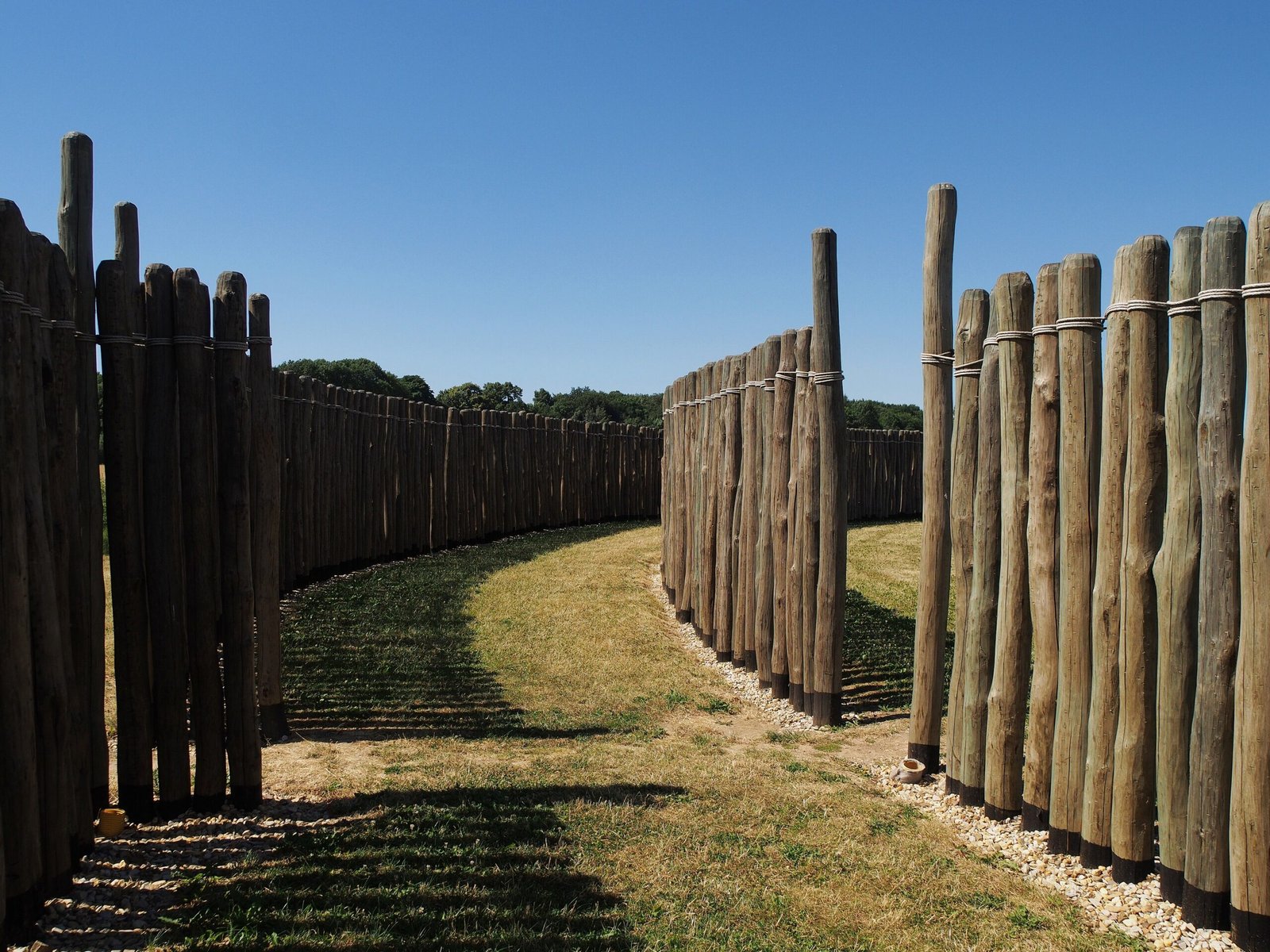
One of the oldest known solar observatories on Earth, Goseck Circle is a Neolithic circular enclosure built around 4900 BCE in Saxony-Anhalt, Germany — its gate openings aligned with precision to the winter solstice sunrise and sunset.
At a glance
Built approximately 6,900 years ago by the Stroke-Ornamented Ware culture, Goseck Circle consists of a ditch, an earthen bank, and two wooden palisade rings with three gate openings. Two southern gates align precisely to the winter solstice sunrise and sunset; a third faces north. Discovered via aerial photography in 1991 and excavated 2002–2004, the monument was reconstructed with new timber posts in 2005. Located just 25 km from the find spot of the Nebra Sky Disc, Goseck anchors a deep regional tradition of astronomical knowledge that predates Stonehenge by more than two millennia.
Key facts
- Type: Neolithic circular enclosure and solar observatory
- Built: c. 4900 BCE (Stroke-Ornamented Ware culture)
- Outer diameter: approximately 75 metres
- Structure: ditch, earthen bank, two concentric wooden palisade rings
- Gate openings: three — north, winter solstice sunrise (SE), winter solstice sunset (SW)
- Discovery: 1991 aerial survey by Franciszek Rożnowski; excavated 2002–2004
- Reconstruction: 2005 — palisades rebuilt on original post holes
- UNESCO connection: part of the Nebra Sky Disc cultural landscape (under consideration)
History and discovery
Buried beneath centuries of ploughing, the Goseck earthwork was invisible at ground level until aerial photographs in 1991 revealed a ghostly ring of crop marks. Archaeologist Franciszek Rożnowski recognised its significance, leading to excavations from 2002 to 2004 that uncovered the monument in remarkable detail.
The decisive finding was the solar alignment: observers at the centre on the winter solstice see the sun rise and set through separate gate openings in the southern palisade arc. Animal bones and possible human remains near the gates suggest the site also served ceremonial purposes. The Stroke-Ornamented Ware culture built Goseck during a period when Neolithic farming communities were spreading across central Europe — roughly 5400 to 4400 BCE.
The Nebra Sky Disc — the world’s oldest known depiction of the night sky, found 25 km to the north-west — post-dates Goseck by over 3,000 years but reflects the same regional fascination with the heavens. Together they make a compelling case that communities in Saxony-Anhalt possessed sophisticated astronomical knowledge far earlier than the historical record once assumed.
What you see today
The reconstructed monument presents a ring of tall wooden posts approximating the original palisades, rebuilt in 2005 on the excavated post holes. Walking through one of the three gate openings makes the solar geometry immediately tangible. An outdoor interpretation area explains the excavation, the cultural landscape, and the Nebra Sky Disc connection. The open farmland surrounding the site preserves the clear horizon essential to its astronomical function.
On the winter solstice (around 21 December), visitors gather to watch the sun rise and set through the aligned gates — connecting the present to an act of observation performed here nearly 7,000 years ago.
Practical information
- Address: Goseck, Burgenlandkreis, 06667 Saxony-Anhalt, Germany
- Access: Open-air site, accessible year-round
- Admission: Free
- Best time: Winter solstice (c. 21 December) for the solar alignment experience
- Nearest city: Weißenfels (~18 km NW); Naumburg (~20 km S)
- Combine with: State Museum of Prehistory, Halle — home of the Nebra Sky Disc (~30 min)
Getting there
Goseck lies in Burgenlandkreis, approximately 18 km south-east of Weißenfels. By car from Halle (Saale), take the B91 south then follow local signage to Goseck village; the monument is signposted. By public transport, regional trains from Halle reach Weißenfels; local buses or a taxi cover the final stretch. Roughly 2.5 hours by road from Berlin or Frankfurt.
Nearby
- State Museum of Prehistory, Halle (Saale) — permanent home of the Nebra Sky Disc (~30 km N)
- Naumburg Cathedral — UNESCO World Heritage Site, medieval cathedral with the famous Uta statue (~20 km S)
- Merseburg Cathedral — Romanesque cathedral complex on the Saale (~40 km N)
- Memleben Monastery ruins — Carolingian imperial monastery (~15 km E)
Sources
- Bertemes, F. & Northe, A. (2007). Der Kreisgraben von Goseck. Landesamt für Denkmalpflege und Archäologie Sachsen-Anhalt.
- Schlosser, W. (2002). “Astronomische Orientierung des Kreisgrabenanlage von Goseck.” Archaeologie in Sachsen-Anhalt.
- Wikipedia contributors. “Goseck circle.” Wikipedia, The Free Encyclopedia. Accessed 2026-06.
- Landesamt für Denkmalpflege und Archäologie Sachsen-Anhalt — lda.sachsen-anhalt.de
Find it on the map
See this place and what’s around it →📷 Become a Cultural Heritage Online photographer
Share your photos of places: they stay published under your name as the author. The more they're seen, the more you get noticed — and soon a contest will reward the most appreciated photos.
Log in or sign up free to add a photo