
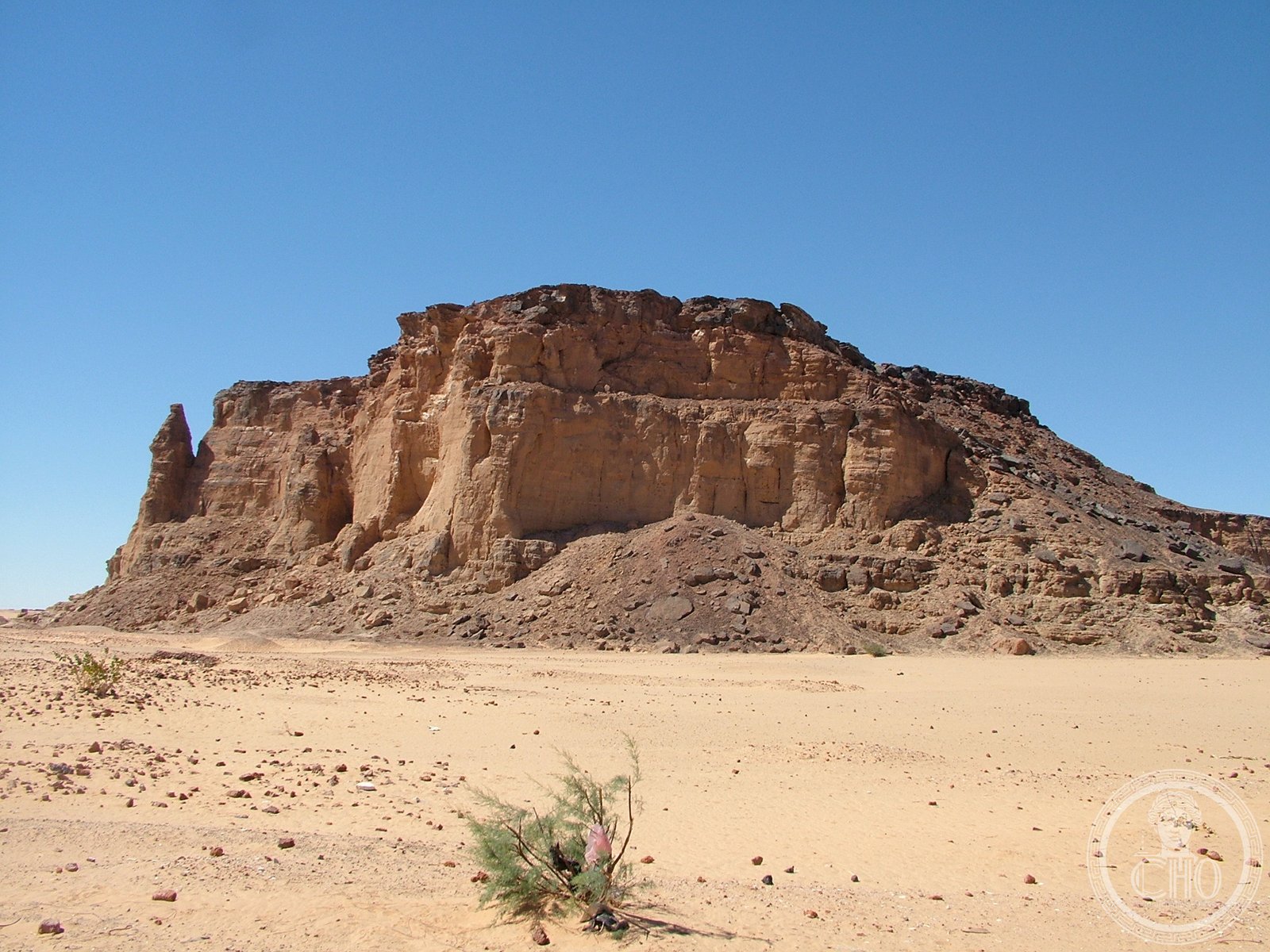
A sacred sandstone mesa rising 98 metres above the Nile — one of the most sacred sites of the ancient world — whose temples, pyramids, and royal cemeteries anchored Kushite civilisation for over fifteen centuries. The seat of an African empire that once ruled all of Egypt. UNESCO World Heritage Site since 2003.
At a glance
Gebel Barkal is an isolated flat-topped sandstone mesa on the east bank of the Nile at the ancient town of Napata, 400 km north of Khartoum. To the Egyptians who conquered Nubia in the 18th Dynasty (c. 1550–1292 BCE), the mountain’s vertical cliff-face — with a solitary pinnacle resembling a rearing cobra — proclaimed it the dwelling place of Amun, the supreme deity of Egyptian cosmology. To the Kushite rulers who inherited Egypt’s culture after Egypt’s withdrawal, the mountain remained the spiritual centre of their kingdom for over a thousand years. At its base and in the surrounding desert are the remains of the largest temple complex outside Egypt proper, multiple pyramid fields, and the royal cemeteries of the Napatan and early Meroitic kings — including the tomb of Taharqa, the mightiest ruler of the 25th Dynasty, the Kushite Pharaohs who conquered and governed all of Egypt from 747 to 656 BCE.
Key facts
- UNESCO designation: World Heritage Site, 2003 — “Gebel Barkal and the Sites of the Napatan Region”
- Location: Karima (ancient Napata), Northern State, Sudan (18.5296°N, 31.8287°E)
- Period of main occupation: c. 1450 BCE (first Egyptian temple) – 350 CE (end of the Meroitic kingdom)
- The mesa: 98 metres high, flat-topped, with near-vertical cliff walls; the pinnacle at the south end was interpreted as Amun in the form of a uraeus cobra
- Principal sites in the Napatan Region: Gebel Barkal (temple complex + pyramid field), Nuri (royal cemetery of 19 kings + 52 queens/princes), El Kurru (earliest Kushite royal cemetery), Zuma, Sanam
- Temple of Amun at Gebel Barkal: Begun by Thutmose III c. 1450 BCE; the largest temple complex outside Egypt — its sanctuary is cut directly into the cliff face of the mesa
- Taharqa (690–664 BCE): Greatest pharaoh of the 25th Dynasty; his pyramid at Nuri, 15 km northeast of Gebel Barkal, is the largest in the Napatan necropolis
- 25th Dynasty: Kushite pharaohs who ruled all of Egypt 747–656 BCE — the most extensive empire ever to control the entire Nile Valley from Khartoum to the Mediterranean
History
The Egyptians first conquered Nubia as far south as Napata under Thutmose I (c. 1503 BCE) and built a temple at the foot of Gebel Barkal under Thutmose III (c. 1450 BCE). They identified the mesa as the “pure mountain” at the southern edge of the known world — the place where Amun manifested on earth. The temple was enlarged by Seti I and Ramesses II, and inscriptions proclaiming the mountain’s sanctity were carved directly into the cliff face.
After Egypt’s withdrawal from Nubia around 1070 BCE, a local dynasty at Napata inherited Egypt’s culture, religion, and hieroglyphic writing, but developed them in distinctly Kushite directions. Around 747 BCE, the Kushite king Piye (also read as Piankhy) launched a military campaign that conquered all of Egypt, establishing the 25th Dynasty — the “Black Pharaohs” who ruled from Napata and Memphis simultaneously. Piye’s successors Shabaka, Shebitku, Taharqa, and Tantamani maintained the dynasty until 656 BCE, when the Assyrian empire under Assurbanipal drove the Kushites back to Nubia.
The Napatan kingdom continued at Gebel Barkal for another three centuries, with kings buried at Nuri in steeply pitched, characteristically Kushite pyramids — narrower and taller than Egyptian pyramids. Around 300 BCE, the capital shifted south to Meroe (near modern Shendi), initiating the Meroitic period, but Gebel Barkal retained its religious prestige as the sacred centre of Amun worship in Africa until the kingdom’s final collapse around 350 CE.
What you see
At Gebel Barkal itself, the most impressive surviving structure is the Temple of Amun (B500), whose innermost sanctuary is a rock-cut chamber inside the cliff face of the mesa. In front of it, a sequence of pylons, hypostyle halls, and processional avenues — now largely reduced to foundations — once extended hundreds of metres into the desert. Scattered ram-headed sphinxes and column drums give a sense of the complex’s original scale. A smaller pyramid field sits directly against the mesa’s south face.
At Nuri, 15 km northeast, the royal cemetery of the Napatan kingdom contains the pyramids of 19 kings and 52 queens — including the largest, Taharqa’s pyramid (Nu. 1), built around 664 BCE. Unlike Egyptian pyramids, the Napatan pyramids are steeply pitched (at approximately 65–70°) and relatively slender; they rise from small bases and are entered through a rock-cut chapel cut into the east face. Many are in varying states of decay, but the field as a whole — dozens of pyramids in the Sudanese desert — is one of the most extraordinary and least-visited heritage landscapes on earth.
At El Kurru, 13 km southeast of Gebel Barkal, the earliest royal Kushite cemetery includes the tombs of Piye, Shabaka, and their predecessors, cut into the rock below small pyramids. The burial chambers of some Napatan queens contain painted wall decorations that are among the finest surviving examples of Kushite art.
Practical information
- Access: Karima is 340 km north of Khartoum; the journey by road takes 4–5 hours or is accessible by train (the overnight Khartoum–Dongola service passes through Karima). Domestic flights from Khartoum may also serve Merowe, 40 km east.
- Gebel Barkal site: The mesa and temple ruins are openly accessible. A small site museum near the base provides context. Local guides are available in Karima.
- Nuri and El Kurru: Both are accessible from Karima by car; Nuri is 15 km northeast, El Kurru 13 km southeast. A single day allows visits to all three main Napatan sites.
- Travel advisory: Sudan has experienced severe political instability and armed conflict since 2019 (military coup) and 2023 (outbreak of civil war). Check your government’s current travel advisory before planning any visit. As of 2025, independent travel to the Napatan Region is not recommended.
- Best season (when safe): November–February — Sudan’s mild winter. Summer temperatures in the Nubian desert regularly exceed 45°C.
Getting there
When travel is safe, the standard route from Khartoum is north along the Nile on the road through Ed Damer and Shendi. Karima is located at the point where the Nile makes its great northward bend (the Fourth Cataract region). From Karima, Gebel Barkal is visible and walkable; a bicycle or motorcycle is sufficient to reach Nuri and El Kurru. Organised archaeology-focused tours (when operating) typically include a desert camp at Karima with day trips to all five Napatan sites.
Nearby
- Meroe Pyramids (300 km southeast, also UNESCO): the later Kushite capital, with the most famous and photogenic pyramid fields in Sudan — over 200 pyramids at three necropolis sites.
- Kerma (250 km northwest): the capital of the Kingdom of Kerma (c. 2500–1450 BCE), the earliest indigenous urban civilisation in sub-Saharan Africa; the two massive mud-brick Deffufa temples are among the oldest structures in Africa.
- Soleb Temple (150 km northwest): an 18th Dynasty Egyptian temple of Amenhotep III in remarkable condition, one of the finest surviving New Kingdom temples outside Egypt proper.
Sources
- UNESCO World Heritage List: Gebel Barkal and the Sites of the Napatan Region, 2003 — whc.unesco.org/en/list/1073
- Wikipedia: “Gebel Barkal” — en.wikipedia.org/wiki/Gebel_Barkal
- Wikipedia: “Nuri (archaeological site)” — en.wikipedia.org/wiki/Nuri_(archaeological_site)
- Wikipedia: “Twenty-fifth Dynasty of Egypt” — en.wikipedia.org/wiki/Twenty-fifth_dynasty_of_Egypt
- Museum of Fine Arts Boston: Sudan expedition records (Reisner excavations, Nuri/El Kurru) — mfa.org/collections/ancient-world
Find it on the map
See this place and what’s around it →📷 Become a Cultural Heritage Online photographer
Share your photos of places: they stay published under your name as the author. The more they're seen, the more you get noticed — and soon a contest will reward the most appreciated photos.
Log in or sign up free to add a photo