
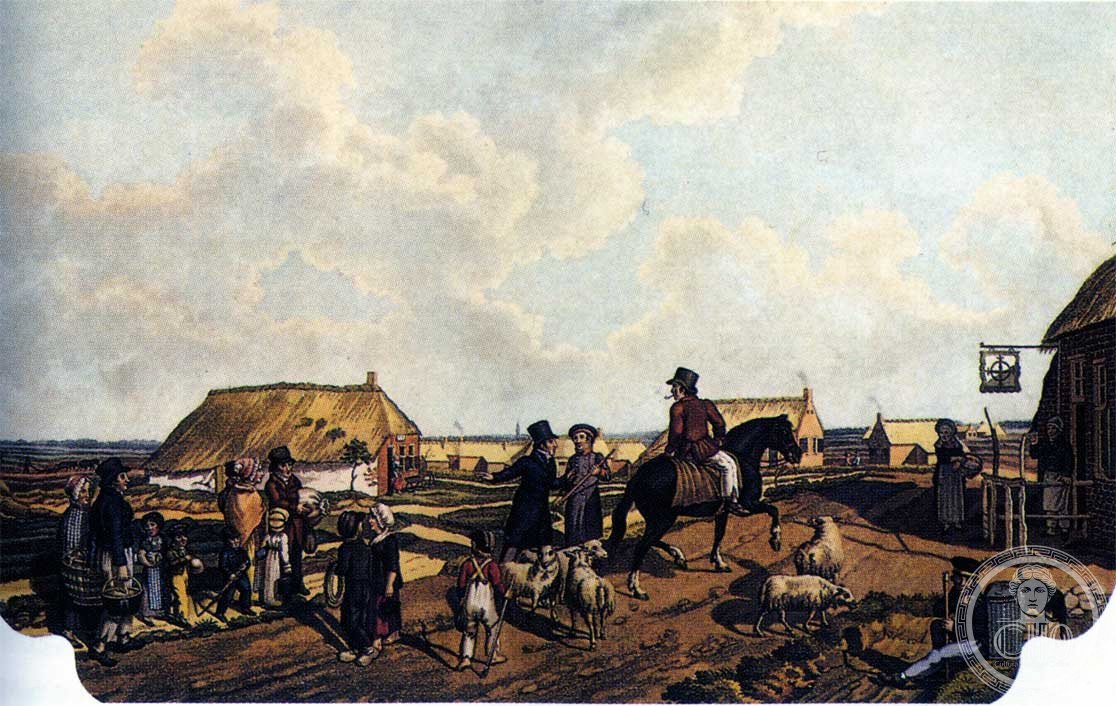
Nine planned rural settlements built on moorland from 1818 to rescue Europe’s urban poor — the boldest social experiment of the 19th century, and a UNESCO World Heritage Site shared between the Netherlands and Belgium.
At a glance
The Colonies of Benevolence are a group of nine agricultural villages established by the Society of Benevolence (Maatschappij van Weldadigheid) from 1818 onward. Founded by General Johannes van den Bosch, the Society proposed a radical answer to post-Napoleonic urban poverty: move the destitute to uncultivated heathlands, give them land and tools, and transform them into self-sufficient farmers. The nine colonies in the Netherlands (Frederiksoord, Willemsoord, Wilhelminaoord, Veenhuizen) and Belgium (Wortel, Merksplas) were inscribed as a UNESCO World Heritage Site in 2021, recognized as an extraordinary experiment in early modern social engineering. Their grid-pattern landscapes, institutional buildings, and farmstead rows survive largely intact.
Key facts
- UNESCO inscription: 2021 (World Heritage List)
- Founded: 1818 CE by General Johannes van den Bosch
- Countries: Netherlands and Belgium
- Dutch colonies: Frederiksoord, Willemsoord, Wilhelminaoord, Veenhuizen
- Belgian colonies: Wortel, Merksplas
- Largest site: Veenhuizen (Netherlands) — 5,000 hectares, three separate establishments
- System type: Free colonies (voluntary poor) and forced colonies (beggars, the disorderly poor)
- Coordinates (Frederiksoord): 52.8417°N, 6.1833°E
History
After the Napoleonic Wars, the cities of the Netherlands and Belgium were overwhelmed by beggars and destitute families — veterans, displaced workers, orphans. The newly restored Kingdom of the Netherlands faced a crisis it could not solve by traditional poor relief. General Johannes van den Bosch had a different idea: instead of feeding the poor in cities, remove them entirely from the urban environment and place them in purpose-built agricultural colonies on uncultivated moorland in Drenthe and the Kempen region.
In 1818, van den Bosch founded the Society of Benevolence as a private philanthropic initiative. Subscriptions from wealthy Dutch and Belgian citizens funded the construction of the first colony at Frederiksoord in Drenthe, which received its first settlers in 1818. Additional free colonies followed: Willemsoord (1820), Wilhelminaoord (1820). These were for voluntary settlers — families who surrendered their freedom of movement in exchange for housing, land, tools, seed, and a modest salary, with the expectation of eventually becoming independent.
Veenhuizen (1823) was a different matter: a complex of forced colony establishments for beggars committed by municipal authorities — essentially a network of labour institutions. The Belgian colonies at Wortel (1822) and Merksplas (1823) combined free and forced settlement on the flat Kempen heath.
The experiment reflected the optimism and paternalism of early 19th-century liberalism: poverty as a problem of environment and habit, solvable through rational organization, education, labour discipline, and moral instruction. In practice, the free colonies attracted genuine working-class families; the forced colonies were closer to penal servitude. The Society struggled financially throughout the 1820s–1840s. By the 1850s, the Dutch state had taken over management of Veenhuizen, which became a state penitentiary colony. Wortel and Merksplas passed to Belgian state control and continued as reform institutions into the 20th century.
UNESCO’s 2021 inscription recognized the colonies not as monuments but as complete planned landscapes — the only surviving example at this scale of 19th-century social colonization within Europe’s borders.
What you see
The colonies are landscapes, not single buildings. What makes them extraordinary is the survival of their original planned character across two centuries. At Frederiksoord — the symbolic heart of the inscription and the location of the Society’s headquarters — you walk a grid of roads laid out in 1818, lined with identical double farmhouses for two settler families each. The fields behind each house were the family’s allotted land. The colony director’s house, the school, the church, and the workers’ hall all stand in the village centre, exactly where van den Bosch placed them.
Veenhuizen is the most complete survival: three former colony establishments (the Eerste, Tweede, and Derde Gesticht — First, Second, Third Establishment) with their institutional main buildings, worker rows, fields, and canal network on a flat peat landscape. The Eerste Gesticht now houses the Penitentiaire Inrichting Veenhuizen (a still-functioning prison), the Tweede Gesticht is a museum complex (the Dutch Prison Museum), and the Derde Gesticht has been converted to housing.
The Belgian colonies at Wortel and Merksplas retain their characteristic heathland setting, institutional perimeter walls, and grid farmhouses. Merksplas Colony is a protected landscape with its original chapel, guesthouse, and worker barracks.
Practical information
- Main visitor centre: Maatschappij van Weldadigheid Museum, Frederiksoord (the Society’s former director’s house)
- Dutch Prison Museum: Veenhuizen — covers the forced colony and penitentiary history; highly recommended
- Belgian colonies: Wortel Colony and Merksplas Colony both have guided tours and visitor facilities
- Cycling: The colonies are ideal for cycling; the Drenthe and Kempen regions have well-marked cycle routes connecting the sites
- Best season: May–September; heathland in bloom in August
Getting there
Frederiksoord is in the province of Drenthe, the Netherlands, accessible by car from Zwolle (approx. 40 min) or Groningen (approx. 50 min). The nearest train station is Steenwijk; bus connections to Frederiksoord run irregularly. Veenhuizen is 25 km northeast of Frederiksoord. The Belgian colonies are near the town of Turnhout in Antwerp Province; Merksplas is 20 km north of Turnhout. A car is strongly recommended for visiting multiple sites.
Nearby
Drenthe province offers the prehistoric Hunebedden (megalithic tombs), the oldest surviving megaliths in the Netherlands, along the Hondsrug ridge. The open-air museum at Orvelte reconstructs a Saxon farming village. In Belgium, the Kempen heathland landscape around Wortel and Merksplas connects to the broader Nationaal Park Kalmthoutse Heide.
Sources
- UNESCO World Heritage Committee, Colonies of Benevolence, inscription 2021, Decision 44 COM 8B.12
- Egge Knol et al., De Koloniën van Weldadigheid, Drents Museum, 2018
- Lotte Jensen, Maatschappij van Weldadigheid 1818–1859, academic research overview
- Wikipedia, Colonies of Benevolence (accessed 2026)
Find it on the map
See this place and what’s around it →📷 Become a Cultural Heritage Online photographer
Share your photos of places: they stay published under your name as the author. The more they're seen, the more you get noticed — and soon a contest will reward the most appreciated photos.
Log in or sign up free to add a photo