
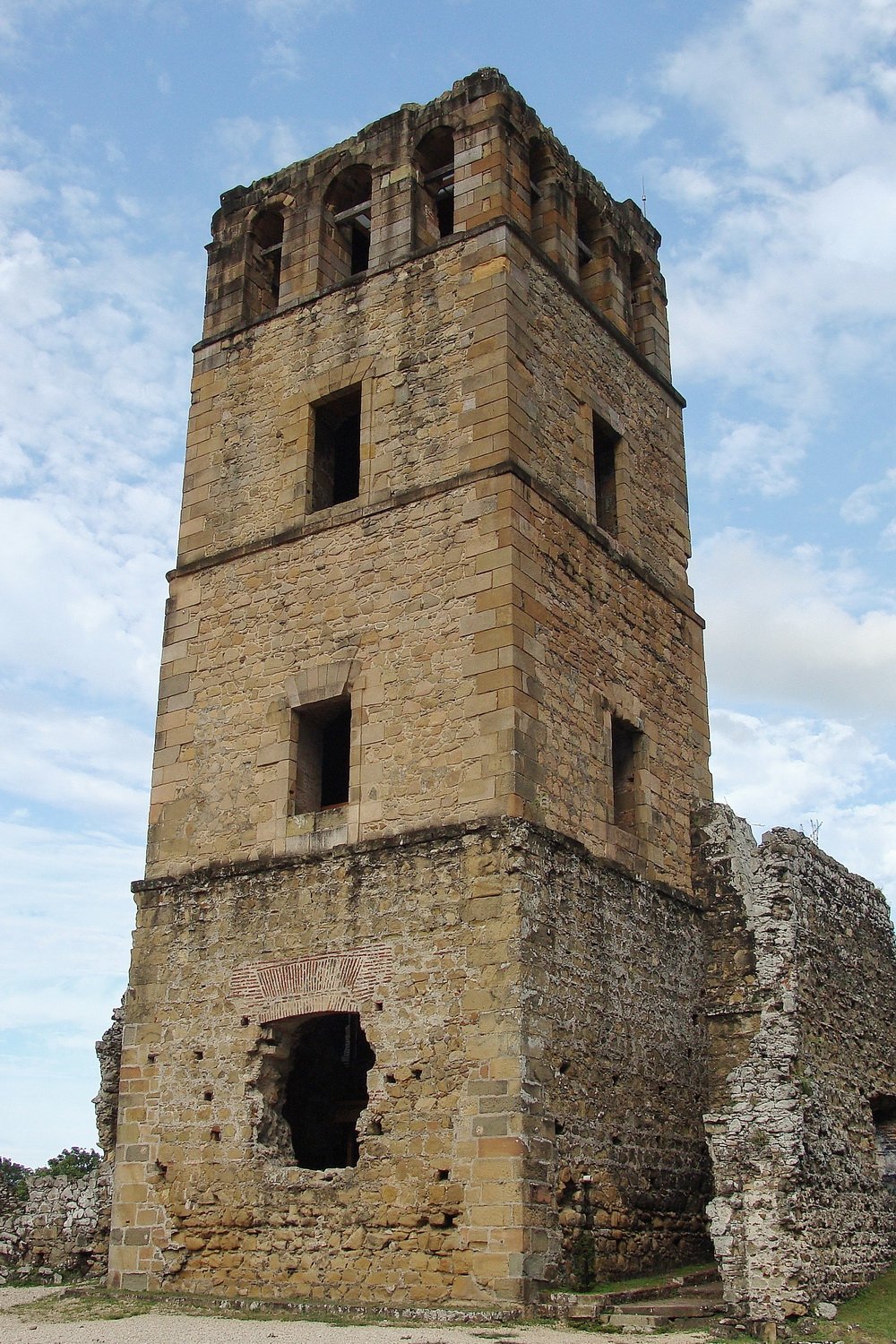
Two urban layers of a single city — the 1519 ruins of the first permanent European settlement on the Pacific coast of the Americas, and the well-preserved colonial quarter of the rebuilt city of 1673. Together they tell the complete story of Spanish empire in the Pacific. UNESCO World Heritage Site since 1997.
At a glance
Panamá Viejo (Old Panama) was founded by the conquistador Pedrarias Dávila on 15 August 1519 CE — making it the oldest continuously inhabited European settlement on the Pacific coast of the Americas and the southern terminus of the Camino Real route that connected the Pacific to the Caribbean. From here, Francisco Pizarro launched the conquest of the Inca Empire in 1532 CE. The city was burned by the buccaneer Henry Morgan in 1671 CE after his force crossed the isthmus from Portobelo; the ruins remain preserved in situ. The rebuilt city, founded on a more defensible peninsula 8 km west and known as the Casco Antiguo or San Felipe district, preserves an intact grid of Spanish colonial churches, French Second Empire mansions, and Art Nouveau townhouses from the French Canal era of the 1880s.
Key facts
- UNESCO designation: World Heritage Site — Panamá Viejo inscribed 1997; extended to include the Historic District (Casco Antiguo) in 2003
- Founded: Panamá Viejo: 15 August 1519 CE by Pedrarias Dávila; Casco Antiguo: 1673 CE, 8 km southwest of the original site
- Location: Panama City, Panama Province, Panama. Panamá Viejo: 8.9499°N, 79.5317°W; Casco Antiguo: 8.9505°N, 79.5364°W
- Historical role: Southern terminus of the Camino Real transoceanic silver route; staging base for the conquest of Peru (1532 CE)
- Destruction of Panamá Viejo: January 1671 CE, by Henry Morgan’s buccaneer force, after Morgan crossed the isthmus from Portobelo
- Key surviving ruins at Panamá Viejo: Cathedral tower, Bridge of the King, Church of La Merced, Governor’s Palace ruins, King’s Bridge (the Camino Real’s Pacific terminus)
- Casco Antiguo character: Spanish colonial churches alongside French Second Empire mansions (1880s Canal era) and early 20th-century Republican buildings — a uniquely layered colonial streetscape
- First in the Americas: Panama City was the first city in the Americas to have its entire colonial district protected as a UNESCO World Heritage Site
History
Pedrarias Dávila, the Spanish governor of Castilla del Oro, founded Panamá — “place of many fish” in the indigenous Cueva language — on 15 August 1519 CE on the Pacific coast of the isthmus. The choice of location was strategic: it commanded the mouth of the Camino Real overland route that connected the Pacific coast to the Caribbean port of Nombre de Dios (later Portobelo), making it the natural depot and staging post for the entire Pacific enterprise of the Spanish empire.
The city’s importance exploded in 1532 CE when Francisco Pizarro, using Panama as his base, launched his conquest of the Inca Empire. The silver of Potosí and the gold of the Andes flowed through Panama; by the mid-16th century it was the wealthiest city on the Pacific coast of the Americas, with a cathedral, convents, hospitals, a courthouse, and the palaces of merchants and governors. Its population at its peak has been estimated at 10,000–15,000 people — extraordinary for a colonial city of that era.
On 9 January 1671 CE, Henry Morgan — the Welsh buccaneer operating under a commission from the English governor of Jamaica — reached Panama after crossing the isthmus with 1,400 men from Portobelo. After a battle at the outskirts, the Spanish garrison set fire to the city rather than surrender it intact. The ruins were abandoned; a new, more easily defended city was founded 8 km to the southwest on a narrow peninsula in 1673 CE, with the sea protecting three sides.
The rebuilt city — today’s Casco Antiguo or San Felipe — grew steadily through the colonial period. A second wave of construction came in the 1880s during the French attempt to build the Panama Canal; French engineers, merchants, and administrators built elegant Second Empire townhouses that still line the streets alongside 17th-century Spanish churches. The canal project ultimately failed; the American-built Canal opened in 1914 CE, making Panama City one of the world’s great crossroads once again.
What you see
At Panamá Viejo, the most visible monument is the tower of the Cathedral of Nuestra Señora de la Asunción — a solitary medieval-looking stone campanile rising above the Pacific shoreline, one of the most recognisable images in Panamanian heritage. Around it, excavated foundations reveal the extent of the original city: the Governor’s Palace, the convent of La Concepción, the Church of La Merced (whose carved stone facade was dismantled and rebuilt stone by stone in Casco Antiguo after 1671), and the King’s Bridge at the western end — where the Camino Real officially reached the Pacific. The on-site Panamá Viejo museum provides context and displays artefacts including ceramics, armour, and indigenous objects.
In the Casco Antiguo, the Plaza de la Independencia (Plaza Mayor) is the historic centre, flanked by the Metropolitan Cathedral, the National Institute of Culture (the former Grand Hotel), and the Municipal Palace. The nearby Palacio de las Garzas (Presidential Palace) looks over the bay. The narrow streets are lined with buildings in remarkable stylistic variety: severe 17th-century Spanish masonry, ornate 19th-century French townhouses with cast-iron balconies, and crumbling but picturesque Caribbean-influenced wooden structures from the early 20th century. Much of the district has been gentrified since UNESCO inscription; the Casco is now also Panama City’s primary restaurant, boutique hotel, and cultural venue district.
Practical information
- Panamá Viejo: Open daily. The archaeological site and museum are managed by the Patronato Panamá Viejo; there is an entrance fee. The ruined cathedral tower can be climbed for panoramic views over the Pacific.
- Casco Antiguo: A freely walkable neighbourhood; most church interiors can be visited at no charge. The Presidential Palace exterior can be viewed; the interior requires advance appointment.
- Combined visit: Allow at least half a day for Panamá Viejo and another half day for a thorough walk of the Casco Antiguo. The two sites are 8 km apart.
- Getting between the two: The Metrobus coastal route connects Casco Antiguo to Panamá Viejo along the waterfront Cinta Costera; the journey takes 15–20 minutes and provides views of the canal skyline.
- Best time: Early morning or late afternoon to avoid equatorial midday heat. The dry season (January–April) offers clearer skies but the rainy season (May–November) keeps the ruins lush and green.
Getting there
Panamá Viejo is in the eastern suburbs of Panama City, approximately 8 km from the city centre along the coastal Cinta Costera road — an easy taxi or Uber ride. The Casco Antiguo (San Felipe) is at the western tip of the old city peninsula, easily reached from any Panama City hotel; taxis, Uber, and the Metrobus all serve the area. The nearest Metro station to the Casco is 5 de Mayo (Line 1), a 15-minute walk. Panama City’s Tocumen International Airport is 25 km east.
Nearby
- Miraflores Locks, Panama Canal (10 km northwest): the Pacific-side locks of the Canal, with a visitor centre, museum, and viewing deck where you can watch ships transiting between ocean levels.
- Portobelo and San Lorenzo (98 km northeast): the UNESCO-listed Caribbean-side fortresses at the other end of the Camino Real that connected to Panamá Viejo. A logical two-site heritage day trip or overnight.
- Amador Causeway (3 km from Casco Antiguo): a former U.S. military road connecting three Pacific islands, now a waterfront promenade with views of the canal entrance and the city skyline.
- Biomuseo (1 km from Casco Antiguo): a museum designed by Frank Gehry dedicated to Panama’s extraordinary biodiversity and its role in the Great American Biotic Interchange — when the rising isthmus connected North and South America.
Sources
- UNESCO World Heritage List: Archaeological Site of Panamá Viejo and Historic District of Panamá, 1997/2003 — whc.unesco.org/en/list/790
- Patronato Panamá Viejo — patronato.panamaviejo.org
- Wikipedia: “Panama Viejo” — en.wikipedia.org/wiki/Panama_Viejo
- Wikipedia: “Casco Antiguo, Panama” — en.wikipedia.org/wiki/Casco_Antiguo,_Panama
Find it on the map
See this place and what’s around it →📷 Become a Cultural Heritage Online photographer
Share your photos of places: they stay published under your name as the author. The more they're seen, the more you get noticed — and soon a contest will reward the most appreciated photos.
Log in or sign up free to add a photo