
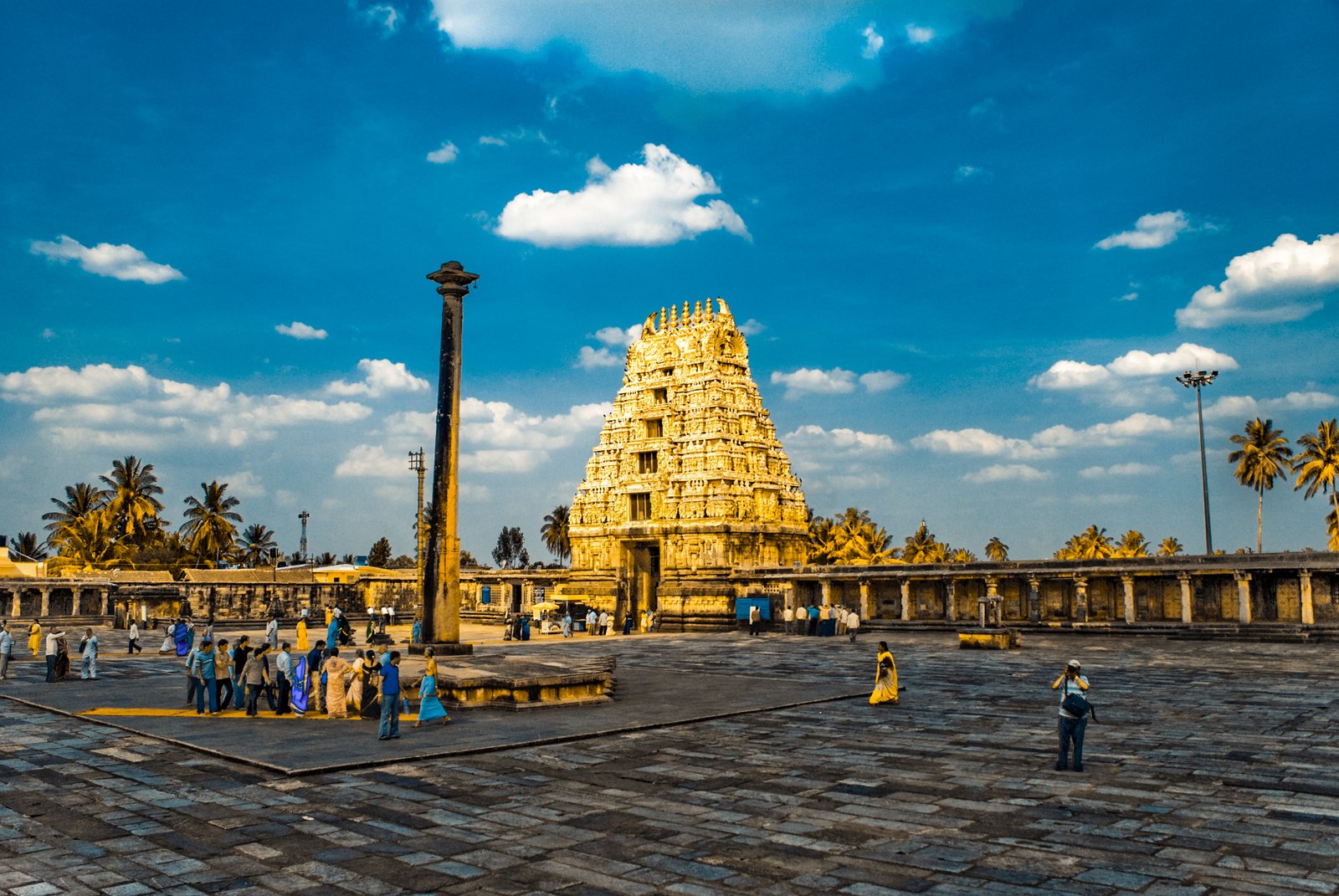
Commissioned in 1117 AD by Hoysala king Vishnuvardhana to celebrate his victory over the Cholas, the Chennakeshava Temple at Belur is the supreme achievement of Hoysala stone sculpture — a building whose every external surface is carved to a standard of detail that has no parallel in medieval stone craft anywhere in the world.
At a glance
The Chennakeshava Temple at Belur in the Hassan district of Karnataka was commissioned by the Hoysala king Vishnuvardhana in 1117 AD and took approximately 103 years to complete, construction continuing into the 13th century. The temple stands on a star-shaped platform (jagati) that creates the distinctive Hoysala stellate plan, sheathed in chloritic schist — a stone that carves like wax when fresh from the ground and hardens to near-granite on exposure to air. Its exterior carries approximately 650 large carved panels, thousands of decorative friezes, and hundreds of bracket figures (salabhanjika or madanika) of a quality unmatched in medieval stone sculpture. The temple was part of the Hoysala group inscribed on the UNESCO World Heritage List in September 2023 under the title “Sacred Ensembles of the Hoysalas.”
Key facts
- Commissioned: 1117 AD by Hoysala king Vishnuvardhana; construction completed c. 1220 AD
- Location: Belur, Hassan district, Karnataka, India
- UNESCO status: World Heritage Site (September 2023) — “Sacred Ensembles of the Hoysalas”
- Sculptural figures: approximately 650 major carved panels; hundreds of madanika bracket figures c. 70 cm tall
- Stone type: chloritic schist — soft when quarried, hardening on exposure to air
- Temple plan: star-shaped (stellate) platform with 32 projections and recesses
- Missing element: shikhara (tower) was never built; temple top remains flat
History
In 1116 AD the Hoysala king Vishnuvardhana defeated the Chola army at the Battle of Talakadu and converted from Jainism to Vaishnava Hinduism under the influence of the philosopher Ramanuja, who visited his court. The following year, Vishnuvardhana commissioned the Chennakeshava Temple at Belur — Chennakeshava meaning “beautiful Keshava,” an epithet of Vishnu — as both a victory monument and an act of religious devotion. The construction project lasted approximately 103 years, with successive Hoysala kings continuing and extending the work; the outermost enclosure wall and the gopurams (gateway towers) were added by later rulers, and some subsidiary shrines were still being added into the 14th century.
The temple remained an active centre of Vaishnava worship throughout the medieval period. It survived the Vijayanagara and Sultanate periods and continued to receive royal patronage. Today it is administered by the Hindu Religious and Charitable Endowments Department of the Karnataka government and remains an active temple — one of the unusual features of the Belur complex among Hoysala sites. The UNESCO inscription of 2023 was granted collectively to Belur, Halebidu, and Somnathpur as the Sacred Ensembles of the Hoysalas, recognising the group as the outstanding manifestation of Hoysala art and architecture.
What you see
The outer enclosure contains subsidiary shrines, a large stepped tank, and the main Chennakeshava shrine at its centre. The main temple stands on a star-shaped jagati (platform) whose 32 projections and 32 recesses generate the rhythmic play of light and shadow across the exterior that is the fundamental aesthetic device of Hoysala design. The exterior walls are divided into horizontal decorative bands: at the base, a frieze of elephants (representing stability); above that, horses (speed and power); then scrolling foliage; then a continuous narrative frieze depicting scenes from the Puranas, Ramayana, and Mahabharata; then makaras (sea monsters); then hamsa (geese); and at the top, the register of madanika (bracket figures) — the temple’s most celebrated element.
The madanika figures, approximately 70 cm tall, stand under ornamental foliage canopies at the projecting corners of the building. Each is carved as an individual: one holds a mirror; another a parrot; another a flower. The jewellery on each figure is rendered with filigree precision — individual links in chains are perforated so they appear to hang freely; earrings swing; bangles show knurled surfaces. The stone technology that enabled this — chloritic schist, carved while still soft from the quarry and left to harden in situ — was developed by the Hoysala craftsmen specifically for this project and used across all their major temples.
Practical information
- Entry: UNESCO World Heritage Site; ticketed access for foreigners via Archaeological Survey of India
- Temple hours: 8:00 AM to 8:00 PM daily (active temple — worship hours may affect tourist access to inner sanctum)
- Photography: permitted in outer enclosure; restrictions may apply inside inner sanctum
- Dress code: active temple — remove footwear; modest dress required
- On-site facilities: shoe storage, small shops around enclosure wall, guides available at entrance
- Best visit timing: early morning or late afternoon for best light on the sculpture; avoid festival days if seeking quiet contemplation
Getting there
Belur is approximately 220 km from Bengaluru and 40 km from Hassan, the nearest railway junction. From Hassan, frequent buses and auto-rickshaws connect to Belur (about 45 minutes). From Bengaluru, direct buses run to Hassan and Belur; the journey takes 4 to 5 hours by bus. The nearest airport is Kempegowda International Airport, Bengaluru (IATA: BLR). Belur is most efficiently visited in combination with Halebidu (Hoysaleshwara Temple), located 16 km away — both are UNESCO sites and most visitors see them on the same day.
Nearby
- Halebidu (Hoysaleshwara Temple) — UNESCO Hoysala ensemble, 16 km east; the twin-shrine Hoysaleshwara and Shanthaleshwara temples
- Somnathpur (Keshava Temple) — third UNESCO Hoysala site, approximately 140 km southeast near Mysuru
- Chikkamagaluru — coffee country and hill station, approximately 50 km west
- Hassan — nearest city with hotels, rail connections, and services, 40 km east
Sources
- UNESCO World Heritage Centre, “Sacred Ensembles of the Hoysalas” (WHS 2023)
- Foekema, Gerard, Complete Guide to Hoysala Temples, Abhinav Publications, 1996
- Wikipedia, “Chennakeshava Temple, Belur” — consulted June 2026
- Kamath, Suryanath U., A Concise History of Karnataka, MCC Publications, 2001
Find it on the map
See this place and what’s around it →📷 Become a Cultural Heritage Online photographer
Share your photos of places: they stay published under your name as the author. The more they're seen, the more you get noticed — and soon a contest will reward the most appreciated photos.
Log in or sign up free to add a photoIs this page about you?
This page is read by travellers and heritage enthusiasts who find it on Google. Tell us how you are connected to this place and we will take it from there.