
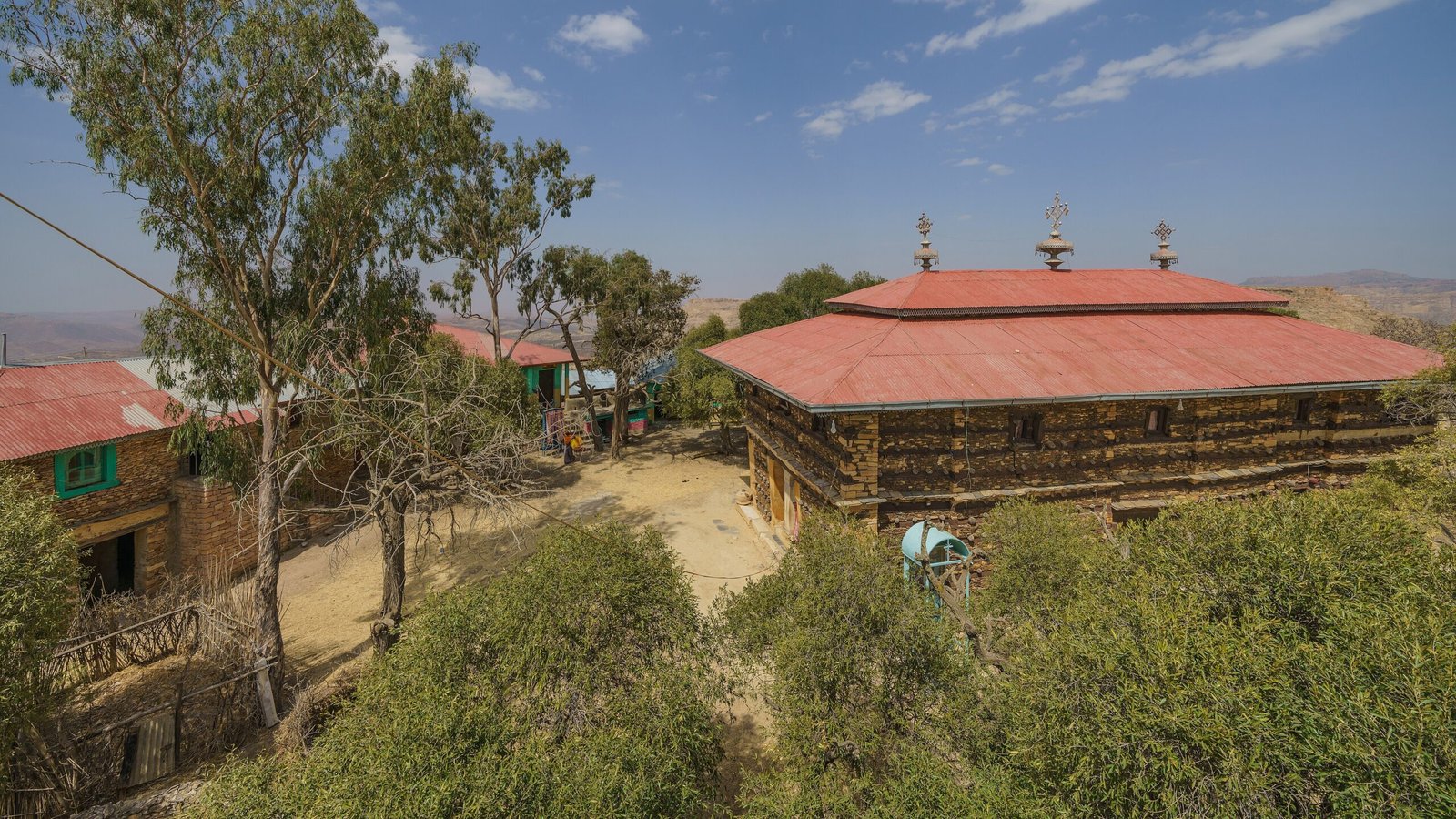
On a sheer-sided amba in the Tigray highlands, one of Christianity’s oldest monasteries has been reached by leather rope for fifteen centuries — women have never set foot on the plateau.
At a glance
Debre Damo occupies the entire summit of a flat-topped cliff approximately 1,000 metres long and 300 metres wide, rising vertically from the surrounding plain approximately 70 km north of Axum. Access to the plateau has always been by a leather rope lowered from the top — the same method used since the monastery was founded in the 6th century AD. The compound contains the oldest complete standing church in Ethiopia: the Church of Abba Aregawi, built in the Aksumite style with alternating stone courses and projecting wooden tie-beams. Debre Damo is one of the oldest continuously operating Christian institutions in the world. Women have been permanently prohibited from the plateau for approximately 1,500 years.
Key facts
- Founded: c. 520–540 AD, during the reign of the Aksumite king Gabra Masqal
- Founder: Abba Aregawi, one of the Nine Saints — Syrian or Roman monks credited with Christianising the Tigray highlands
- Plateau dimensions: approximately 1,000 m long × 300 m wide, entirely surrounded by vertical cliff faces
- Main church: Church of Abba Aregawi — approximately 14.5 m × 9 m, multi-storey, Aksumite architectural style
- Interior: painted ceiling panels from the 6th–10th centuries; wooden panels with geometric and animal designs; carved stone frieze above the entrance
- Access rule: women permanently prohibited — one of the longest-standing continuous exclusions in religious history
- UNESCO status: part of the Aksum World Heritage Site (inscribed 1980)
History
Debre Damo was founded by Abba Aregawi, one of the Nine Saints — a group of Syrian or Roman monks who arrived in the Ethiopian highlands in the 5th and 6th centuries and are credited with the systematic Christianisation of the Tigray region, the translation of the Bible into Ge’ez, and the founding of the first monasteries. According to Ethiopian tradition, Aregawi was lifted to the summit of the amba by a divine serpent sent by God; the serpent is still revered at the monastery and depicted in its iconography. The monastery was established during the reign of the Aksumite king Gabra Masqal, who is said to have provided building materials and royal patronage. The church that survives today on the plateau is considered by architectural historians to be datable to the 6th century on the basis of its construction technique and stylistic parallels with other Aksumite monuments at Axum itself.
Through the medieval period, Debre Damo accumulated a library of Ge’ez manuscripts — including some of the oldest illuminated Christian manuscripts in Africa — and became one of the major centres of Ethiopian monastic scholarship. The monastery was raided by the forces of Ahmad ibn Ibrahim al-Ghazi (Ahmad Gran) in the 1530s during his devastating campaign through the Ethiopian highlands, but its inaccessibility on the cliff top partially protected its treasures. In 1943, a cache of Aksumite coins and manuscripts was reportedly found in the walls of the church during restoration work. Today the monastery remains an active community of Ethiopian Orthodox monks, entirely self-sufficient on the plateau, with crops, animals, and a water supply maintained above the cliff.
What you see
The Church of Abba Aregawi is the centrepiece of the plateau compound and one of the most important monuments of early Christian architecture anywhere in the world. It is a multi-storey rectangular structure built entirely in the Aksumite style: large dressed stone blocks alternate with courses of projecting wooden tie-beams — the so-called “monkey head” beams, named for the rounded ends that protrude from the facade and give Aksumite buildings their characteristic banded texture. This structural technique, in which timber ties bond the masonry courses together against seismic movement, was common throughout the Aksumite civilisation and can be seen in the famous stelae fields at Axum. The church interior preserves painted ceiling panels dating from the 6th to 10th centuries, wooden carved panels with interlaced geometric patterns and animal motifs, and a carved stone frieze above the entrance portal — a survival of extraordinary rarity for sub-Saharan Africa.
Beyond the main church, the plateau compound includes a second smaller church dedicated to the archangel Mikael, monks cells arranged around open courtyards, a refectory, a library housing manuscripts in wooden chests, a threshing floor, and terraced garden plots. The entire community functions as a self-contained village above the cliff. The rope access point — a thick braided leather rope anchored at the top — is located at the only approach to the summit; monks and male visitors haul themselves up hand over hand, with a second rope available for the less agile. The surrounding views across the Tigray plains, with the Adwa massif in the middle distance, are spectacular.
Practical information
- Access: male visitors only; the ascent requires climbing a leather rope — fit adults typically take 5–10 minutes; local monks assist
- Dress code: modest clothing required; remove shoes before entering the church
- Opening hours: generally accessible during daylight hours; arrive before midday to ensure entry
- Entry fee: modest donation expected; camera fees may apply inside the church
- Photography: permitted outside; restricted inside the main church — ask monks before photographing
- Guides: local guides available at the base; strongly recommended for context and language assistance
Getting there
Debre Damo is approximately 70 km north of Axum along the road towards Adwa and the Eritrean border. From Axum, hire a vehicle or take a shared minibus towards Adwa, then continue north on the Adigrat road; the monastery access point is signed from the main road. The drive from Axum takes approximately 1.5–2 hours on paved and unpaved sections. Adwa (approximately 30 km south) is the nearest town with accommodation. Most visitors base themselves in Axum and make a day trip. The security situation in the Tigray region should be checked carefully before travel — the region experienced severe conflict in 2020–2022 and access conditions may vary.
Nearby
- Axum (Aksum): ~70 km south — the ancient Aksumite capital with its famous stelae, tombs of the kings, and the Church of Our Lady Mary of Zion (UNESCO World Heritage Site)
- Yeha: ~50 km southwest — the oldest standing stone temple in sub-Saharan Africa, pre-Axumite D’mt Kingdom, c. 700–500 BC
- Adwa: ~30 km south — site of the 1896 Battle of Adwa, the decisive Ethiopian victory over Italian colonial forces
- Abba Pantaleon monastery: near Axum — another monastery of the Nine Saints, accessible on foot from Axum
Sources
- David W. Phillipson, Ancient Ethiopia: Aksum — Its Antecedents and Successors, British Museum Press, 1998
- UNESCO World Heritage Centre — Aksum (inscribed 1980): whc.unesco.org/en/list/15
- Wikipedia — Debre Damo: en.wikipedia.org/wiki/Debre_Damo
- Ethiopian Orthodox Tewahedo Church historical records; UNESCO Aksum nomination file, 1980
Find it on the map
See this place and what’s around it →📷 Become a Cultural Heritage Online photographer
Share your photos of places: they stay published under your name as the author. The more they're seen, the more you get noticed — and soon a contest will reward the most appreciated photos.
Log in or sign up free to add a photoIs this page about you?
This page is read by travellers and heritage enthusiasts who find it on Google. Tell us how you are connected to this place and we will take it from there.