
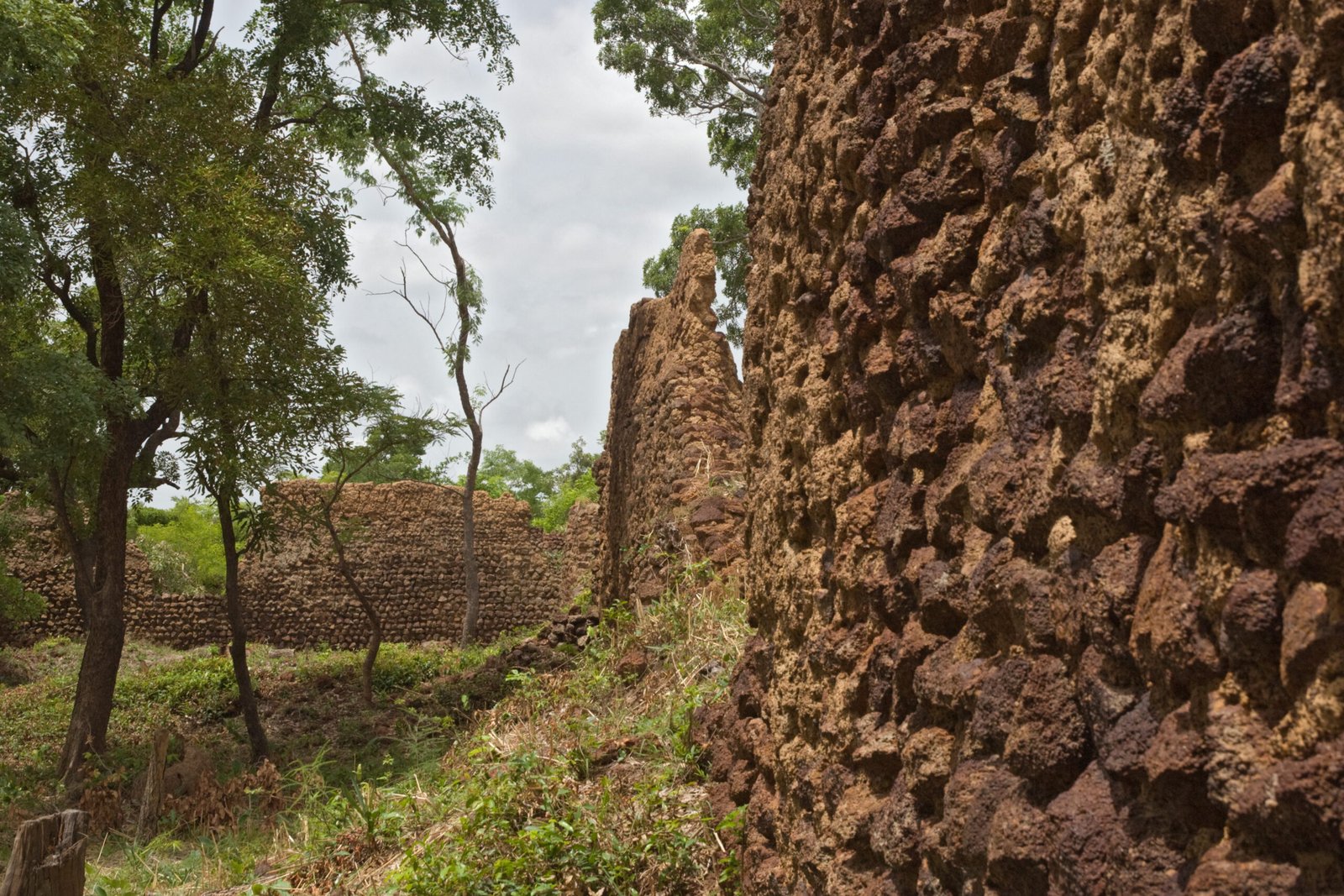
A walled stone enclosure six metres high in the savanna of southwest Burkina Faso — the best-preserved of a forgotten tradition of West African stone architecture, a UNESCO World Heritage Site and exceptional testimony to the trans-Saharan gold trade.
At a glance
In the extreme southwest of Burkina Faso, near the borders with Ghana and Côte d’Ivoire, the Ruins of Lorpéni — a roughly rectangular enclosure of approximately 100 × 57 metres, enclosed within dry-stone granite walls reaching 6 metres in height and up to 1.4 metres in thickness — are the best-preserved example of a stone enclosure tradition that once extended across a large area of West Africa’s savanna zone. UNESCO designated the site a World Heritage Site in 2009, the first in Burkina Faso, describing it as “exceptional testimony to the trans-Saharan gold trade.” The function and builders remain debated; oral tradition associates the site with a powerful lineage that controlled the gold trade before the 18th century, when the site appears to have been abandoned.
Key facts
- Location: Extreme southwest Burkina Faso, near borders with Ghana and Côte d’Ivoire
- Dimensions: Enclosure approx. 100 × 57 m; walls up to 6 m high and 1.4 m thick
- Construction: Dry-stone granite, no mortar, fitted blocks in sloping courses
- Period: c. 1000–1900 AD (iron tools and pottery evidence); abandoned c. 18th century
- UNESCO: World Heritage Site 2009 — first in Burkina Faso
- Attribution: Debated; Lobi, Koulango, and unnamed earlier groups all proposed by scholars
- Excavation: Joint Burkinabè-German mission ongoing since 2006
History
The Ruins of Lorpéni represent the largest and best-preserved of a broader tradition of stone enclosures in West Africa’s savanna belt, a tradition that includes structures in Mali, Senegal, and the wider Sahel. The construction technique — fitted granite blocks laid without mortar in courses that slightly slope inward for structural stability — is strikingly similar to the techniques used at Great Zimbabwe (built c. 1100–1450 AD) and other southern African stone enclosures, raising questions about whether this reflects a shared architectural tradition, independent parallel development, or long-distance cultural contacts within sub-Saharan Africa that are poorly understood.
Oral tradition in the region consistently associates Lorpéni with a powerful lineage that controlled gold trade routes through this part of West Africa before the 18th century. The site is in the Lobi cultural area, and the Lobi people, the Koulango, and earlier unidentified groups have all been proposed as builders by different scholars. The gold deposits of the region (the Lobi goldfields, still exploited by artisanal miners today) made control of this territory valuable in the context of the trans-Saharan trade that connected sub-Saharan Africa to North Africa and the Mediterranean world.
Systematic archaeological investigation began only in 2006 with a joint Burkinabè-German mission. Excavations have found iron tools, terracotta figurines, and pottery consistent with an occupation period from approximately 1000 to 1900 AD, but much of the site’s interior remains unexcavated. The site was awarded UNESCO World Heritage status in 2009 — the 878th site on the list and the first in Burkina Faso.
What you see
The enclosure walls are the dominant visual element: courses of fitted granite blocks, varying in size from small rubble fill to large facing stones, rise to 6 metres in the best-preserved sections. The slight inward slope of the courses gives the walls a massive, slightly tapering profile. There is no mortar; the stability of the structure depends entirely on the weight and fitting of the stones. The walls have rounded corners and several openings that may be original entrances or post-abandonment breaches. Inside the enclosure, the ground surface shows traces of internal structures (walls of smaller enclosures, post-holes) that suggest a complex internal organisation, but these lower remains are less visually dramatic than the outer walls.
The surrounding landscape is savanna: sparse trees, laterite soil, the characteristic red-brown of the dry season. The site is relatively isolated; the nearest town is Lorpéni (population a few thousand), about 3 km away. A small visitor centre and site museum opened after the UNESCO inscription.
Practical information
- Access: Open daily; entrance fee; small visitor centre on site
- Getting there: Lorpéni is approximately 350 km southwest of Ouagadougou; accessible by road via Gaoua (50 km to the northeast)
- Base: Gaoua (50 km) has the nearest reliable hotels and a notable regional museum (Musée de Poni)
- Best time: November–February (cool dry season); avoid May–September rainy season when roads can be impassable
- Security: Check current travel advisories for Burkina Faso before visiting; the southwest is generally more stable than the north but conditions change
Getting there
Ouagadougou has international flights. From the capital, the journey to Lorpéni is approximately 350 km by road southwest, passing through Gaoua. The roads are mostly paved to Gaoua; the final stretch to Lorpéni is on laterite road, passable by ordinary car in the dry season. Organised tours from Ouagadougou that include Lorpéni and the Gaoua museum are available through local operators.
Nearby
- Musée de Poni, Gaoua — regional museum with Lobi cultural objects and context for the stone enclosure tradition
- Lobi goldfields — artisanal gold mining still active in the surrounding area, the same goldfields that made Lorpéni strategically important
- Cascades de Karfiguela, Banfora — scenic waterfalls in the Cascades region, approximately 150 km north
Sources
- UNESCO World Heritage List: Ruins of Lorpéni (1376)
- Kienon-Kaboré, I.B. & Doamba, J. (2008). “Lorpéni: les ruines d’une cité de l’or.” Cahiers d’études africaines.
- Wikipedia: Ruins of Lorpéni
Find it on the map
See this place and what’s around it →📷 Become a Cultural Heritage Online photographer
Share your photos of places: they stay published under your name as the author. The more they're seen, the more you get noticed — and soon a contest will reward the most appreciated photos.
Log in or sign up free to add a photo