
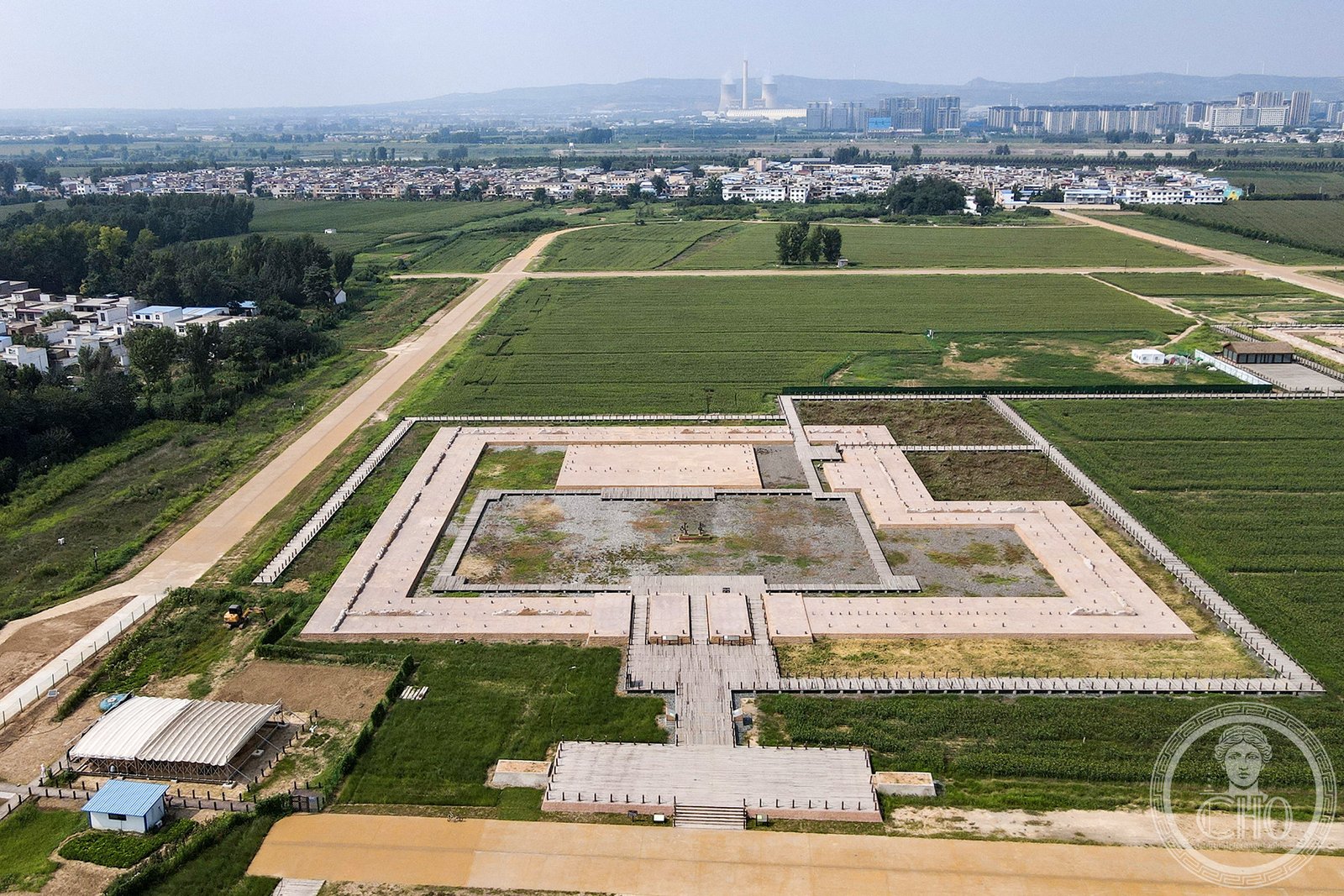
In a bend of the Yi River east of Luoyang, archaeologists have excavated since 1959 a Bronze Age city so advanced for its period that it has ignited one of the most politically charged debates in world archaeology: was Erlitou the capital of the Xia Dynasty, China's legendary first dynasty?
At a glance
Erlitou is the largest and most complex Bronze Age settlement found in China for its period (c. 1900–1500 BC), covering at least 3 km² in Yanshi County, Henan Province, 15 km east of Luoyang. The site contains the earliest known palace compounds in East Asia, the earliest known ritual bronze vessels from China, a paved cruciform road network, bronze- and jade-casting workshops, and elite burials with extraordinary objects. Chinese archaeologists overwhelmingly identify it as the capital of the Xia Dynasty; Western scholarship remains divided, making Erlitou one of the most contested archaeological sites on earth.
Key facts
- Location: Yanshi County, Henan Province — 15 km east of Luoyang
- Period: c. 1900–1500 BC (Erlitou culture, Bronze Age, possible Xia Dynasty capital)
- Area: At least 3 km² of settlement remains
- Key structures: Two palace compounds (each c. 150 × 100 m), cruciform paved road network, bronze and jade workshops
- Earliest bronzes: Ritual ding tripods and jue wine cups — oldest known cast bronze ritual vessels in China
- Star object: Turquoise-inlaid bronze plaque with dragon-face pattern — over 2,000 turquoise tesserae, no contemporary parallel worldwide
- Museum: Erlitou Museum of the Xia Capital, opened 2019, adjacent to the site; free admission
History and the Xia question
The Xia Dynasty appears in ancient Chinese texts — the Shiji (Records of the Grand Historian) and the Shangshu (Book of Documents) — as the first Chinese dynasty, ruling before the Shang (c. 1600–1046 BC). Western historians long treated the Xia as mythology. The discovery and systematic excavation of Erlitou from 1959 transformed this debate: here is an urban Bronze Age settlement of the right period (pre-Shang), the right location (Henan's Central Plains identified in texts as Xia territory), and the right complexity for a dynastic capital. China's National Archaeological Priority Programme has listed Xia identification as a primary goal since the 1990s. Chinese scholarship now widely accepts Erlitou as the Xia capital; Western scholars, noting the absence of written records and the difficulty of linking archaeological cultures to textual dynasties, remain more cautious.
What is not disputed is the site's extraordinary significance. Around 1900 BC, Erlitou shows an unprecedented leap in social complexity: the abandonment of the preceding Longshan culture village pattern and the emergence of a hierarchically organised urban centre with specialised craft production, elite zones, and a road network. The bronze technology here — lost-wax casting in piece moulds — was independently invented and qualitatively distinct from Mesopotamian contemporaries, proving China's Bronze Age was entirely self-generated. The site was occupied for approximately 400 years before being superseded, possibly as the Shang Dynasty rose to dominance.
The political stakes are high: China's national narrative of five thousand years of continuous civilisation depends partly on the Xia's historicity. The Erlitou Museum opened in 2019 as the 'Museum of the Xia Capital' — a curatorial and political statement as much as an archaeological one.
What you see
The most substantial visible remains are the two palace compounds, both enclosed by rammed-earth perimeter walls partially surviving above ground. Palace 1 (approximately 150 × 100 m) and adjacent Palace 2 are interpreted as ceremonial and administrative centres. The cruciform paved road network — connecting the palace zone to the bronze workshop, jade workshop, and settlement — is the earliest known paved road system in China. Elite burials around the palace zone yielded dozens of jade objects and bronze vessels.
The finest objects are at the adjacent Erlitou Museum: the turquoise-inlaid bronze plaque (a pectoral or mask ornament with over 2,000 turquoise tesserae in a dragon-face pattern, one of the most beautiful objects in early Chinese art), ding tripods, jue and jia wine cups, jade zhang blades, and a large bronze bell. The museum presents the Xia interpretation throughout and is essential viewing alongside the site.
Practical information
- Address: Erlitou Village, Yanshi District, Luoyang, Henan Province, China
- Museum hours: Tuesday–Sunday 09:00–17:00 (last entry 16:30); closed Mondays
- Admission: Free for museum; site visit may require booking — confirm via the museum
- Language: Primarily Chinese; some English interpretation in the museum
- Allow: 2–3 hours for museum and site walk combined
Getting there
Erlitou is 15 km east of Luoyang city centre in Yanshi District. From Luoyang take Bus 57 or 58 to Yanshi, then a local taxi (about 10 minutes). By high-speed rail: Luoyang Longmen station connects to Zhengzhou (30 min), Xi'an (1h 40 min), and Beijing (2h 10 min); the museum is 45 minutes by taxi from the station. By car: 25–30 minutes from Luoyang via G310 or the Yanshi expressway.
Nearby
- Luoyang: Ancient capital with Longmen Grottoes (UNESCO), Luoyang Museum, and Shaolin Monastery (1 hour east)
- Yanshi Shangcheng: The Shang Dynasty walled city in Yanshi District, providing direct post-Erlitou Bronze Age context
- Henan Museum, Zhengzhou: Finest collection of Central Plains Bronze Age material; 1.5 hours east by high-speed rail
Sources
- Liu Li & Chen Xingcan, The Archaeology of China, Cambridge University Press, 2012
- Bagley, Robert, “Shang Archaeology” in The Cambridge History of Ancient China, 1999
- Xu Hong, 'The Erlitou Culture and the Xia-Shang Problem', Journal of East Asian Archaeology
- Wikipedia: Erlitou culture
- Wikipedia: Erlitou
Find it on the map
See this place and what’s around it →📷 Become a Cultural Heritage Online photographer
Share your photos of places: they stay published under your name as the author. The more they're seen, the more you get noticed — and soon a contest will reward the most appreciated photos.
Log in or sign up free to add a photo