
On the edge of a volcanic cone in the Wetterau region of Hesse, a Celtic chieftain’s burial mound excavated between 1994 and 2000 yielded the most complete and artistically significant Celtic figurative sculpture surviving from the early La Tène period: the Glauberg Warrior, a sandstone standing figure whose equipment exactly matches the burial goods found in the mound — making this the earliest confirmed portrait-statue tradition in Celtic Europe.
At a glance
Glauberg is an early La Tène Celtic burial and ritual site of approximately 500 BC on a pronounced volcanic cone near the town of Glauburg in the Wetterau plain north of Frankfurt. The burial mound excavated from 1994 to 2000 contained the undisturbed inhumation of a Celtic chieftain with exceptional grave goods — and, most significantly, four life-size sandstone standing figures that originally flanked the processional avenue leading to the mound. One of these figures, the Glauberg Warrior, survives nearly complete: it depicts a man in full battle equipment (helmet, torque, armour, shield, sword) that precisely matches the actual objects found in the burial below, establishing that the statue was a ritual representation of the buried individual himself — the earliest documented portrait tradition in Celtic art.
Key facts
- Period: early La Tène, approximately 500–450 BC
- The Glauberg Warrior statue: 1.86 m tall, sandstone; helmet, three-leaf-crown torque, armour, shield, sword; currently in Hessisches Landesmuseum Darmstadt (replica on site)
- Burial: undisturbed inhumation of a chieftain c. 30–40 years old with bronze vessels, drinking horn, decorated sword, and jewellery identical to the statue’s
- Processional avenue: a parallel-ditch entrance road leading to the mound; a palisade enclosure surrounded the burial complex
- Site museum: Keltenwelt am Glauberg museum opened 2011; purpose-built to display the statue and contextualise the site
- Second mound: a slightly smaller burial mound beside the main one, partially excavated
- Significance: demonstrates that early La Tène Celts (c. 500 BC) created life-size figurative stone sculpture at the same time as their Greek contemporaries
History
The Glauberg site was known as an Iron Age settlement and fortification since the 19th century — the volcanic cone provided an obvious defensible high point — but its burial significance was not suspected until aerial photography in 1988 revealed crop marks suggesting a large circular feature beneath the field below the hill. Excavations began in 1994 under archaeologist Felix Müller of the Hessian State Heritage Service, and within the first seasons had exposed a processional avenue (a double-ditch corridor approximately 350 metres long) leading from the valley to a large circular burial mound. At the junction of the avenue and the mound’s access ramp, four large stone fragments were found. When conservators assembled the fragments in the laboratory, they proved to belong to at least four separate standing figures, of which one — the Glauberg Warrior — was approximately 75% complete.
The warrior figure’s equipment is depicted in extraordinary detail: the helmet (an Iron Age type with cheek guards), the torque with its distinctive three leaf-crowns at the terminals, the body armour, the oval shield (held in front of the body), and the sword with a disc pommel all correspond precisely to actual objects found during the subsequent excavation of the burial mound. This correspondence between the statue’s equipment and the burial goods is unique in Celtic archaeology: it establishes beyond reasonable doubt that the statue was made specifically to represent the buried individual, either as a funerary portrait or as a ritual image placed at the burial to perpetuate the chieftain’s presence in death. The burial itself was found undisturbed — an inhumation (not cremation) of a man of approximately 30–40 years in a wooden chamber, accompanied by four gold leaf-crown ornaments, bronze vessels, a gold-decorated sword, a drinking horn with gold fittings, and a large shield boss. The burial assemblage dates to approximately 450–500 BC by typological comparison.
The discovery transformed the scholarly understanding of early Celtic figurative art. Before Glauberg, it had been generally assumed that the Celts of the early La Tène period (c. 500–400 BC) did not create life-size figurative sculpture in stone — that this was a practice of the Mediterranean world only. The Glauberg statues demonstrate that life-size stone figure-making was occurring in central Europe simultaneously with its Greek and Etruscan counterparts, and with a level of individualism — portrait-like specificity of equipment — not found in contemporary Mediterranean funerary sculpture.
What you see today
The site itself consists of the volcanic cone (with an Iron Age hillfort on top, not open to visitors), the burial mound in the field below (a low grass-covered earthwork), and the purpose-built Keltenwelt am Glauberg museum opened in 2011. The museum is a striking piece of contemporary architecture by the Frankfurt practice Jourdan Müller, with a curved roof line referencing the mound forms. Inside, the original Glauberg Warrior statue — one of the most extraordinary objects in European prehistoric archaeology — is displayed in a dedicated hall under controlled lighting. A full-size replica stands beside the burial mound at the site. The museum also displays the original burial goods from the chieftain’s grave (bronze vessels, drinking horn, gold ornaments, sword fittings) and reconstructions of the processional avenue and burial rite.
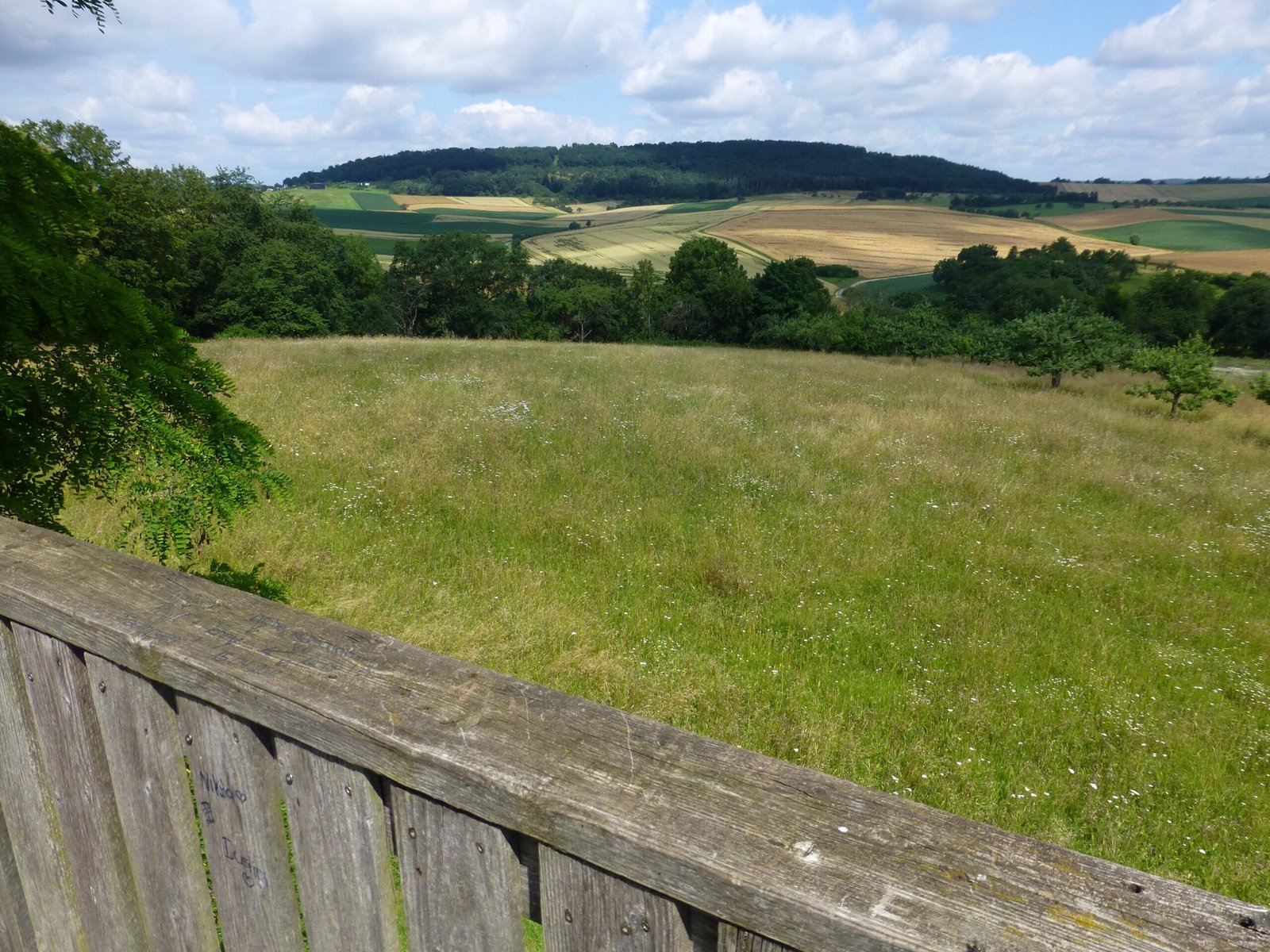
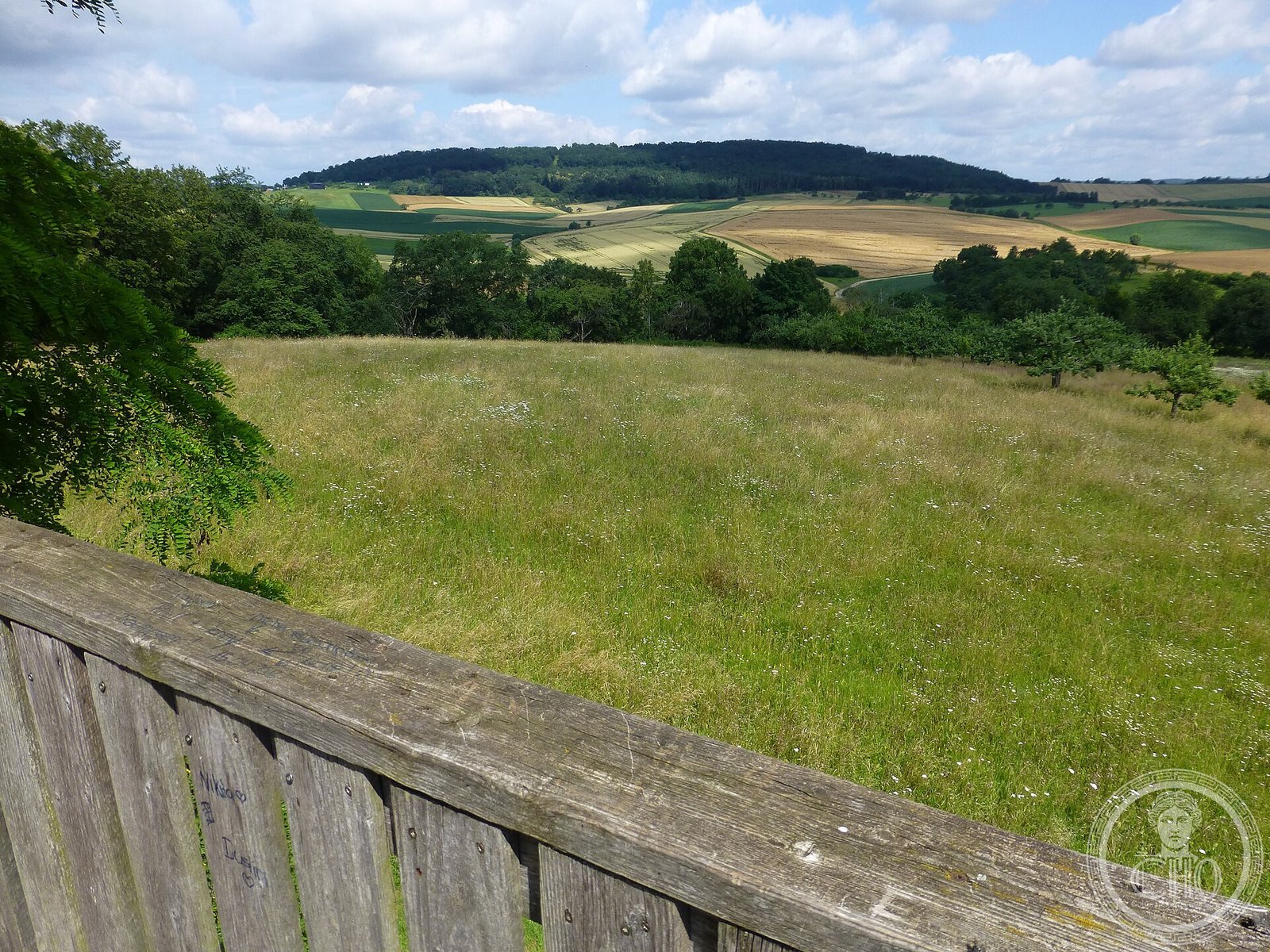
The burial mound itself is visible as a circular earthwork in the field adjacent to the museum; the processional avenue is partially marked. The volcanic cone of the Glauberg rises behind, with the ramparts of the Iron Age settlement faintly visible on its summit. The landscape retains a strong sense of the topographic logic that made this particular volcanic hill the focus of a major Celtic sacred landscape in the 5th century BC.
Practical information
- Address: Am Glauberg 1, 63695 Glauburg, Germany (Keltenwelt am Glauberg museum)
- Opening: Tuesday–Sunday 10:00–17:00; closed Mondays and certain public holidays
- Admission: €7 adult, €3.50 reduced; family ticket available. Under 6 free.
- Museum website: keltenwelt-glauberg.de
- Facilities: Museum shop, café, audio guide (German/English); accessible entrance and displays
Getting there
Glauburg is approximately 45 km northeast of Frankfurt. By car, take the A45 (Sauerlandlinie) north from Frankfurt to the Florstadt exit, then follow signs toward Glauburg/Glauberg — total driving time approximately 45 minutes. By public transport, take an S-Bahn or regional train from Frankfurt to Friedberg (approximately 30 minutes), then a bus toward Glauburg; the journey is manageable but requires checking regional VGO bus schedules in advance. The museum provides detailed directions on its website.
Nearby
- Wetterau Museum Friedberg — 15 km southwest; regional archaeology including Roman and medieval finds from the Wetterau plain
- Saalburg Roman fort — 40 km west in the Taunus hills; the best-reconstructed Roman auxiliary fort on the German limes (UNESCO World Heritage)
- Frankfurt Archäologisches Museum — 45 km south; major pre-Roman, Roman, and medieval collection for the entire Rhine-Main region
- Hallstatt, Austria — 400 km southeast; the type site and eponymous culture of the pre-La Tène Celtic world (UNESCO World Heritage)
Sources
- Felix Müller (ed.), Fürstensitz, Fürstengrab, Fürstenmacht? Der Glauberg in der Keltenzeit (1994–2006): principal excavation reports
- Vera Rupp & Heide Birley (eds.), Weißes Gold: Glauberg — Steinau-Aufenau (2012): Keltenwelt exhibition catalogue with full statue documentation
- Majolie Lenerz-de Wilde, Die Statue vom Glauberg, Germania 79 (2001): first major scholarly analysis of the warrior figure
- Hessisches Landesmuseum Darmstadt: custody documentation for the original Glauberg Warrior statue
- Keltenwelt am Glauberg (keltenwelt-glauberg.de): site documentation and excavation archive
Find it on the map
See this place and what’s around it →📷 Become a Cultural Heritage Online photographer
Share your photos of places: they stay published under your name as the author. The more they're seen, the more you get noticed — and soon a contest will reward the most appreciated photos.
Log in or sign up free to add a photo